Politics & Government
Landmark Meeting Opens Dialogue With Police, Community to Create Bridge, Tackle Drugs, Latino Concerns
Southold Town's anti-bias task force was joined police, elected officials, religious leaders, and educators to break down barriers.


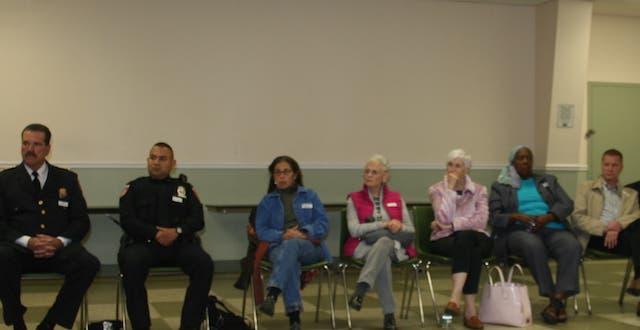
NORTH FORK, NY - In a landmark gathering, Southold Town Police met with a wide range of public officials Thursday night to help shatter communication concerns and open a dialogue with the public with the hope of creating a bridge, especially in the Latino community.
The "Synergy" meeting was convened by Southold Town's anti-bias task force at the Peconic Recreation Center on Peconic Lane, and brought together local law enforcement, Southold Town Supervisor Scott Russell and Councilman Bill Ruland, religious leaders, Southold and Greenport School Superintendent David Gamberg, and anti-bias task force members from RIverhead.
The session began with pizza for all, an ice breaker, and later, the group gathered together for the question and answer session led by Suffolk County Community College's Jim Banks, coordinator of multicultural affairs, and also chair of Southampton's anti-bias task force.
Find out what's happening in North Forkfor free with the latest updates from Patch.
The public brought up issues they found troublesome. Mattituck's Leroy Heyliger, a member of the Southold Town ABTF, said an incident a few weeks ago was heavy on his heart.
"I was with my grandson at the orthodontist's office. My grandson was sitting across from me with ear buds, listening to music, and one officer walked out from an appointment and he was in uniform. He turned around and asked my grandson, 16, 'Do you know anything about the incident at the school?'"
Find out what's happening in North Forkfor free with the latest updates from Patch.
His grandson, Heyliger said, attends Mattituck High School. "My grandson said 'no.'" Later, his grandson told Heyliger that there had been rumors at school about a fight between two black youths. "I said, 'What, you kids all look alike?' It's been eating at me. Is this normal protocol, to question all young black men? Do they all look alike?"
Southold Town Police Chief Martin Flatley, who attended the session with Latino officer Alex Chenche, said it's not protocol to interview a subject in a room filled with people, but he did not have all the information, and did not know if there was a reason the officer wanted to interview Heyliger's grandson. He said he'd look into the incident.
Susan Dingle, an ABTF member, asked Flatley how a person in the community could report such an incident.
"I would hope people would ask questions," Flatley said, adding that there's an open line of communication at the police department. "Misinformation and rumors do no one any good," he said.
A fearful immigrant community
Banks pointed out that members of the immigrant community such as Latinos might be "reluctant" to report an incident due to fears of deportation or retribution.
Flatley suggested a "go-between" such as a church or family member, to work with the police.
The chief recalled Southold's first introduction to gang violence in October, 2014, when a gang-related shooting occurred on South Harbor Road.
"I learned a tremendous amount," he said. "A lot of the members of the community we were dealing with were from El Salvador and told by their families that police departments are corrupt. They don't trust the police."
Flatley said the police need to earn the trust of the Latino community. "I can certainly understand why they don't come to the police if, up to that point in their lives, they've had no trust for police."
Chenche said he's gone to calls where Hispanic couples are "very reluctant to talk" but once he's explained, in their native language, that the job of the police is to protect — and the officers are not there to detain or deport them — the walls begin to break down, and the individuals begin to feel comfortable talking and sharing information.
Sonia Spar of the Southold ABTF said it's important to for the community to know that police are there to help; she suggested religious leaders help to bridge that gap. She said being born in Columbia, she grew up not trusting law enforcement.
Flatley said the "onus" falls on the police department; while new technology exists in police cars, he does not want officers sitting in their vehicles staring at screens, but instead, wants them out creating relationships in the community.
Council for Unity, breaking barriers
Butch Langhorn, assistant to Suffolk County Sheriff Vincent DeMarco, discussed the Council for Unity program in the community and the jail, which is giving gang members an alternative and a new family. Last week, Southold Town Supervisor Scott Russell and Riverhead Town Supervisor Sean Walter attended a Council for Unity meeting at the Suffolk County Correctional Facility.
"When they first told me about it, I laughed. I said there was no way in the world they were going to get these guys kumbaya-ing," he said. There are a number of different gangs in the jail, including Bloods, Crips and MS-13, he said, but Council for Unity had some giving up their colors and finding a new path. "Within six or seven weeks we went from a hellhole — to quietness," he said.
The men were smiling, laughing, and sharing tears, he said.
He mentioned a large graduation party, what some have said was almost a riot, in Riverhead that could have gotten out of hand had it not been for the presence of Council for Unity in the community.
Banks asked what was being done in the correctional facility to address the recidivism rate.
Langhorn said a task force has been created with 45 agencies in Suffolk County and it's led to change. "The Riverhead jail is turning around. I'm proud if it," he said.
Reaching out to law enforcement
Rabbi Gadi Capela of of Congregation Tifereth Israel in Greenport mentioned an incident earlier this year when a menorah was damaged. Although it turned out to be not a hate crime, but the act of kids, it highlighted the need to create a "synergy" between religious leaders and the police department.
Members of the Community Christian Fellowship in Mattituck said they wanted to pray for police officers.
"It is definitely a testament to the community when we are helping each other so we can serve each other as we continue this trek on what we call Planet Earth," Banks said.
All in attendance agreed the meeting was revolutionary and should be the first of many.
Superintendent Gamberg said he likens the comparison to that of a cardiologist who treats someone for heart disease — it's not about taking one pill, it's about a regime, he said, about building rapport and relationships year round, not just at a single meeting.
Gamberg, who taught in a Los Angeles County jail, had Bloods and Crips seething with anger over a drive-by shooting that had left one of the inmate's nephews dead.
Education, he said, begins when children are very young. "It seems to me we have to start early, having kids work and play together. Technology is great, but there is no technological solution. Solutions lie in human engagement."
Deportation fears
Cindy Smith asked about the very real fear many still have after deportations that took place a number of years ago.
Flatley said government has evolved since and said today, the police department does "not go around asking if someone is in the country illegally and putting you in handcuffs. That just doesn't happen."
U.S. Immigration and Customs Enforcement, or ICE, holds are less common today unless someone has committed a serious offense and there is a specific warrant, he said.
Hate crimes
Banks asked about hate crimes in the lesbian, gay, transgender, and bisexual communities. Flatley said there are outside resources in the Suffolk County Police Department to handle hate crimes but thankfully, there have been no record of reports for assault or harassment cases.
Carolyn Peabody of the Southold ABTF said the meeting was critical because while many have good intentions, "It's when people get together and do their share. . .when you stand together to do what's right, good wins out."
Noreen LeCann, vice chair of the Riverhead ABTF, discussed the difficulty in classifying something as a hate crime, such as when Latinos are robbed of their paychecks on Friday nights, when the incidents are called crimes of opportunity.
Flatley said the goal of police is to make crimes fit within the current penal code; LeCann said that leads to frustration when what are clearly targeted crimes against Latinos take place.
Body cams versus dash cams
Flatley addressed the dash cams the SHPD has, explaining how they work, and saying they've been invaluable tools in court. The town's vendor, he said, has suggested waited a bit before considering body cams, he said, until all the issues are resolved. Problems include cameras that would have to be turned off when an officer was at home or eating, etc, and turned on when a crime was unfolding.
"If someone sticks a gun in your face, what are you reaching for first, your gun or the body cam?" Flatley said.
The dash cam, which is now wireless, has caused civilian complaints to drop, he noted.
Drug epidemic
When asked how civilians should report known drug activity, Flatley said drug cases are very difficult to construct.
Heroin, he said, is an epidemic.
"It's everywhere and we are not excluded," he said. "One officer used Narcan five to six times in the last year. Before, you had bags of weed, crack or coke on the street corner, in the back of a car or outside the barn. Now we're getting OD calls from houses that were under the radar — a man, 30, who was able to keep a job during the day and was not a heavy user. All of a sudden, he's overdosed on heroin."
Flately said the community should be patient and keep feeding the police information about drug activity.
Greatest challenges
When asked by Spar what the greatest challenges were, facing the police department, Flatley said drug use is always one of the greatest challenges. Second, he said, is communicating with the Latino community due to a feeling of mistrust.
Russell said a paradox exists, because while police are relied upon for the public health, welfare and safety of the public, at the same time, "they represent a threat to our liberty, rightly or wrongly. It's been that way for hundreds of years."
Dingle said she was "very moved by the event. I've been living here 12 years and this is the first time I've really seen all the constituents of the community together, representing the intentions of a true community. It's a beautiful thing. I really hope we can have this be a beginning, an ongoing thing, and not a once-in-a-lifetime event. This could be the beginning of a community really becoming bias free."
Banks added, 'The word 'universe' means one song. We may be all playing different instruments, but we are all playing the same song. And it should be love."
Of the event, Russell said, "I think it’s a great idea. Any time you can reduce the wall of separation, real or imagined, between the public and law enforcement agencies, it's good for everybody. The law enforcement gets to see the perspective from the public’s point of view and the public gets to understand what law enforcement professionals experience every day."
Get more local news delivered straight to your inbox. Sign up for free Patch newsletters and alerts.