Community Corner
Large Shark Caught Off North Fork Shore In LI Sound
The shark, which he quickly released, was a rare sighting for the longtime fisherman. Video here.


SOUTHOLD, NY — A North Fork fisherman got the shock of his life recently when he reeled in a large shark.
According to John Skinner, the shark was caught near Horton Point in Southold two nights ago.
"I've lived most of my life close to the Sound, but this is the first time I've ever seen a shark there," Skinner said, adding that the shark was caught from the beach.
Find out what's happening in North Forkfor free with the latest updates from Patch.
"It was highly unusual, a sight I never believed I would see on the Long Island Sound," Skinner said, adding that he released the shark immediately and sent it swimming off quickly.
The shark was at least 6' in length but probably not more than 8', and a brown shark. "As a fisherman I was just glad I got it close enough to see it clearly, else I'd go to my grave wondering what exactly I hooked one August night," he said. "I'm especially happy to have the video I recorded. It was slightly unnerving to be wading out in the dark water with it."
Find out what's happening in North Forkfor free with the latest updates from Patch.
Sharks have been making an appearance in East End waters in recent years and as recently as this summer.
Christopher Paparo, manager of Stony Brook Southampton's marine sciences center, said at one time, sharks were very common in area waters. "They have been heavily fished and their numbers have dropped. Due to regulations and better environmental conditions, we have seen some species returning to where they once roamed."
Paparo said a sandbar, or brown, shark was also spotted in shallow waters off the Mattituck coast this summer.
"It should also be pointed out, that these are prohibited species and even targeting them is against the law," he said.
Skinner, Paparo said, was not shark fishing and released the shark quickly.

(John Skinner)
It's not the first time a shark has been spotted in the Long Island Sound this season. A nearly 10-foot, 500-pound great white shark spotted in the Long Island Sound in May then headed to the Hamptons.
According to Chris Fischer, founder of OCEARCH, @GWSharkCabot was then spotted off the coast southwest of Montauk.
The fact that a great white was found in the Long Island Sound for the first time "is a great sign," Fischer said. "It means there's a lot of life, and that the water quality is good."
Sharks, Fischer has long maintained, are "great balance keepers." The fact that they have been proliferating in recent years, with a great white shark nursery found off the coast of Montauk, indicates that water quality is improving.

(Courtesy OCEARCH)
"Sharks don't go where the conditions aren't good," Fischer said. "It's a great sign for the region and it's a valuable tribute to the people who have been working so hard for the last decade to clean up the Long Island Sound."
Fischer, who has spent time in recent years off Montauk, took his team to Nantucket this year in August and in September, will head to Nova Scotia.
With sharks moving from North Carolina and Florida during the next days and weeks, East End residents will be getting "fly bys" as sharks pass through area waters, Fischer said.
Cabot, a Canadian white shark, holds a special place in OCEARCH hearts, Fischer said, as he was one of the first sharks tagged by the organization off of Novia Scotia. Researchers are diligently working to determine if Cabot will head north to Nova Scotia or stop by Massachusetts — the goal is to see if there are two separate populations of sharks or one large one, using both coasts, Fischer said. "We're hoping to gather data and solve the final piece of that puzzle soon," he said.
The shark was named after the explorer John Cabot, OCEARCH said.
Tracking is done through GPS "ping" signals and was located near Greenwich, Connecticut, before heading to the South Fork, Fischer said.
Also this summer, a shark was sighted in a Hamptons creek in July, officials said.
Quogue Village Police said the 10 to 12-foot shark was spotted in Penniman Creek in Quogue.
Southampton Town bay constables told Patch that an advisory was issued to residents after the shark was seen in Shinnecock Bay west of Penniman creek. "It's a natural environment. Fish do swim in the bay," they said.
Officials could not immediately what type of shark was seen.
And it's not the first time shark sightings have sparked a stir on the South Fork.
Last August, a shark spotted in the Shinnecock Bay near the commercial fishing dock at Shinnecock Inlet in Hampton Bays caused a sensation on social media. The shark, which many say was either a blue shark or a mako shark, was seen near the commercial fishing pier, setting off a sea of comments about the unexpected occurrence.
According Fischer, founder of Ocearch, which has led expeditions off Montauk to tag sharks found in a nursery in the Atlantic Ocean in recent years, it's "unusual for a blue shark to be inshore like that." The sharks, he said, are typically found offshore, as they are pelagic fish.
If the shark was "tight to the beach" or to a dock, "there was likely something wrong with it," Fischer said, adding that there was no cause for concern. "They are harmless small fish eaters."
Many commented on social media that the shark likely traveled from the ocean to the bay through the Shinnecock Inlet, following food.
Author and charter boat Capt. Tom Mikoleski of Grand Slam Charters in Montauk said shark sightings are not at all out of the norm on the East End. "We're seeing a lot of sharks here right now," he said. Mikoleski said he recently saw a thresher shark in Montauk right off the Lighthouse. The blue shark in Hampton Bays, some say, might have followed a fisherman cleaning his catch into the inlet.
"There's just a lot of bait in the water — and sharks like to eat," Mikoleski said.
(Atlantic White Shark Conservancy)
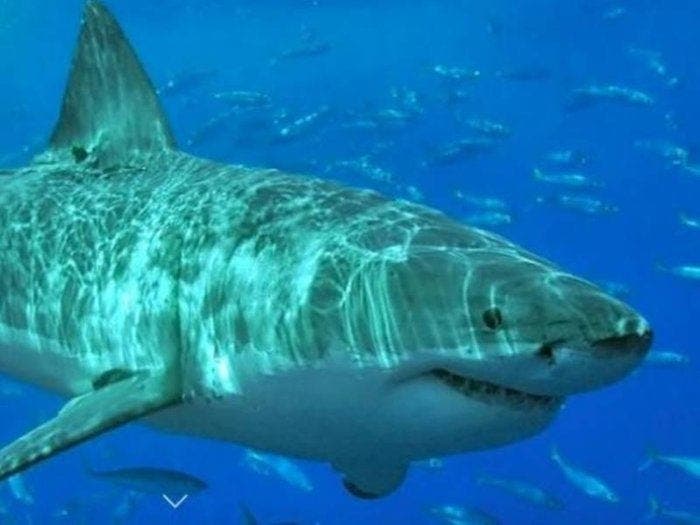
In 2016, great white shark researchers discovered the first North Atlantic nursery for the fearsome predator in the waters off Montauk — explaining the recent surge in great white sharks around nearby Cape Cod.
The Ocearch team said it tracked nine infant great whites to the nursery, located a few miles off Montauk.
There has been a surge of great white sightings off Cape Cod in recent years — researchers say adults feed on seals around the Cape and return to Montauk, where adolescents stay until they reach adulthood at the age of 20. Great whites can live up to 70; they can grow up to 25 feet long and weigh 5,000 pounds.
"This is a historical moment and the first step in revealing the great white shark pupping ground," Fischer said in a statement at the time. "It's this kind of scientific data that will help us collectively make more informed decisions about how to protect this incredible species."
Fischer said the discovery could lead to restrictions on human activity around the nursery in an effort to protect the sharks.
In 2016, the leading shark research team said it suspected Long Island might be a breeding ground for great whites and launched a tagging expedition to be able to determine potential birthing sites.
But the news isn't reason to panic: Experts agree that swimmers have a greater danger of being killed by a faulty toaster oven — or driving on the Long Island Expressway, for that matter — than being devoured by a shark.
Shark attacks on humans are extremely rare — the odds are about one in 12 million. Most shark attack victims survive; bites on humans by sharks are normally exploratory. Worldwide, 200,000 sharks are killed per day; in contrast, about 10 to 12 human lives are lost yearly as a result of shark attacks, researchers told Patch.
Sharks, experts agree, are far less of a danger to people than mankind is to sharks.
"You have more risk of dying by a defective toaster or driving a car than a shark attack, but it's perception," OCEARCH Chief Operating Officer Fernanda Ubatuba said.
Instead, sharks are victims: Sharks are at great risk worldwide due to an industry in Asia and other areas that rely heavily on shark skinning. "It's wiping out our oceans completely," she said.
As apex predators of the ocean, sharks are critical to maintaining healthy ocean systems.
"The current problem we face in shark conservation is that we do not have the necessary data to understand the migratory patterns of our ocean's apex predators, mating and birth sites — the locations we need to protect," a Kickstarter site for Ocearch said.
The breeding sites "are being discovered for the first time," Ubatuba said. "It's necessary to judge at least two breeding sites to determine what they have in common and what draws the sharks there," she added.
Ubatuba said the goal is to connect people from New York to the ocean, to make them aware of what's going on in Montauk, Southampton and across Long Island, "to bring more data so we can really understand what is going on in the waters of New York."
It's important to replace "fear with facts," Ubatuba said. By using the organization's shark tracker, beach-goers can use that information to "make the best judgment when to go to beach and when to avoid it."
Why Long Island is fertile ground for sharks
Long Island is a good place for breeding because, as in other areas of the world where great white sharks breed, the topography includes protected areas, with its shape including bays, said Ubatuba. In addition, food resources and fish bring the sharks "to a safe region to drop their pups," she added.
It's important to determine birthing sites to keep them safe; sharks do not become sexually mature until they are 20 years old. "It takes a long time," she said.
"We're not on the menu"
Joe Yaiullo, curator and co-founder of the Long Island Aquarium and Exhibition Center, said there are precautions swimmers can take, such as not going into the water at dawn or dusk when bait fish, such as bunker, are being fed upon. "Avoiding that situation is always wise," he said.
But, for the most part, humans aren't the first choice for shark fare, he said. "We're not on the menu. If we were, sharks would just be lining up off of Jones Beach, Robert Moses and the Hamptons, just waiting for us to go in. But they're not," Yaiuloo said. "We're large, obnoxious, bony creatures in the water."
Sharks, Yaiullo said, don't have fingers to feel; instead, they "mouth" things, and many times, a shark attack is "just them being inquisitive, asking, 'Is this something I want to eat?' Most shark attacks are not a person getting eaten, it's usually a bite, and the shark swims off, leaving the person intact for the most part."
Deaths from shark attacks are not caused by people being consumed by sharks, he said; instead, victims often bleed out. "If it's a big shark, you might lose a limb but again, sharks eat fish, and seals, that don't have big bones," he said.
Caution is key, Yaiullo said. "It's something to be aware of. Just as if you were going to walk into the plains of Africa, you'd be wary of a lion," he said.
Shark sightings are actually a good thing, he said. "With them being the apex of the food chain, if they're here, it's a good thing for humans," Yaiullo explained. "People shouldn't think that more sharks in the water mean they're going to be attacked. That's not the case at all."
Sharks are a sign of a healthy ecosystem with plentiful fish, clean water and less pollution, an indicator that the United States is doing a good job of managing its fisheries, he said.
Gone are the days of old Montauk tournaments, when sharks were caught, hung from the dock and weighed, then thrown into dumpsters, said Yaiullo. Today's tournaments are tag-and-release events, he said.
He agreed sharks are at risk worldwide. "It's important to spread a conservation message," Yaiullo said. "Not eating shark fin soup, or engaging in all these bad practices. We humans kill a hundred million sharks every year, for shark teeth and jaws. We're doing much more damage to them than they are to us. And if they are doing well, we are doing well."
Ocearch research, Yaiullo said, also includes sand tiger sharks in the Great South Bay. Ocearch buoys are set up, with permanent stations reading the signals of tagged sharks as they pass by.
Long Island is a good area for shark breeding because geographically it extends out into the Atlantic and the Gulf Stream from the South and leads to a very fertile area, rich with nutrients, Yaiullo said. Runoff is a fertilizer, promoting growth of algae, which small shrimp eat, and so on, up the food chain. "It's rich water that supports the whole diversity of life," he said.
On the East End, Mike Bottini, former chair of the Surfrider Foundation of Eastern Long Island, who still sits on the advisory committee, said locally, Greg Metzger, renowned shark expert, as well as Merry Camhi, director of WCS's New York Seascape, a joint program of the New York Aquarium and the Global Marine Program, have done cutting-edge research and spoken at the Long Island Natural History Conference.
One reason for the increase in sharks could be the explosion of the gray seal population after the passage of the Marine Mammal Protection Act and removal of bounty on seals in the 1970s, he said. The gray seals are a major source of food for great white sharks, he said.
Bottini, a naturalist, is also the head lifeguard at East Hampton's Main Beach; he started lifeguarding in the 1970s at Jones Beach and said shark sightings were relatively non-existent. "We rarely, I mean never, saw a shark," he said.
But despite the reality that the chance of a shark attack is relatively nil, Bottini said when he was working at Jones Beach and "Jaws" had just come out, "Every other person sitting on the beach that summer had that book. It spooked a lot of people, including veteran lifeguards. They're out of sight, so you think, 'Maybe they're in there. How do I know?' It's a little spooky."
And that's exactly why shark trackers have taken some of the fear out of the shark experience.
In fact, some sharks have become veritable celebrities.
Mary Lee, the famous 16-foot, 3,400-pound great white shark, made headlines when she was found to be lurking off the Long Island coast, headed toward Fire Island, and then East Hampton.
Sadly, Mary Lou has not been seen since 2017, when she last pinged off the Jersey Shore coast.
Get more local news delivered straight to your inbox. Sign up for free Patch newsletters and alerts.