Politics & Government
North Fork Has Highest Levels of Nitrogen in Wastewater, Officials Say
The town board discussed wastewater improvements on Tuesday.


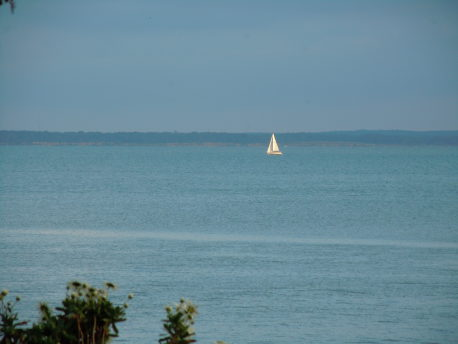
The North Fork's waters are heavily loaded with nitrogen -- with levels in the area's ground and surface waters higher than elsewhere in Suffolk County.
So said Glynnis Berry of Peconic Green Growth and Dave Smith of Natural Systems who came before the Southold town board at Tuesday's work session to explore the idea of decentralized wastewater treatment for the Long Island Sound and the Peconic Bay.
Town Engineer Michael Collins also discussed the idea with the board in February.
Berry said her aim was to discuss wastewater improvements in Southold. The North Fork, she said, has been indicated by Suffolk County as having the highest levels of nitrogen in its groundwater, due mainly to density and agriculture in the area.
Find out what's happening in North Forkfor free with the latest updates from Patch.
Generally, she said, in much of the area, it takes zero two two years for groundwater to reach the surface. "If you do anything for wastewater, you're going to see results very quickly," she said.
Berry called for a phase out of cell pools and said the nitrogen issue must be addressed simultaneously.Other towns, including East Hampton and Southampton, she said, have stricter guidelines regarding wastewater. "This town could be more proactive," she said.
Berry said she began by looking at Orient, where she put out a "small request for proposals," in seven districts where the lots are more dense.
.
Currently, her study of decentralized wastewater treatment is in the design stage, which would cost approximately $1 million, she said.
Berry asked for the board's okay to pursue grant funding for the systems.
Although, based on a survey she took, some residents were receptive to exploring the new wastewater treatment options, some might not be, based mainly on the cost, she said. An engineering report is necessary, Berry said, to facilitate public buy-in.
The goal, Berry said, is to seek voluntary buy-in first for the decentralized systems.
Find out what's happening in North Forkfor free with the latest updates from Patch.
Berry said she was impressed that Southold had a wastewater district and said if everyone was charged $100 per year, $1.5 million per year could be raised.
Maps, she said, help residents realize the urgency to take action. "Maps help them understand what the threat is," she said. "When people start understanding the issues in their neighborhoods, they realize maybe they have to do something about it."Councilman Chris Talbot said in Southampton, recently, $50,000 was earmarked for a groundwater protection plan but the funds were snapped up quickly by only 16 system upgrades.
"People jumped on it," he said.
Berry asked if, down the line, the town wanted to take over the project.
Other areas under consideration for upgrades are Fishers Island and Mattituck, Berry said.
In February, Collins discussed the decentralized wastewater treatment project, which would be the first to be constructed in Suffolk County and has been embraced by the Suffolk County Health Department; the SCHD has agreed to provide funding, he said.
The initial concept design will be covered by a grant, Collins said; the possiblity of applying to Suffolk County for a grant for the next phase exists.
Berry said at the time received a grant for a survey, planning study and mapping conditions; wastewater and groundwater have been identified as an issue.
Berry she is aiming to find three sites on the Long Island Sound watershed and three in the Peconic Bay Estuary. Once located, Berry said her goals is to help the community with the next step of garnering approvals.
Decentralized wastewater treatment has benefits, Berry said. "One big issue is excess nutrient loading." The new system, she said, would be required to have nitrogen levels of 10 milligrams per liter, compared to the current onsite system that has nitrogen levels of 40 to 60 milligrams per liter exiting the system.
"We could see a 75 to 90 percent improvement," Berry said. "That's a huge improvement."
In addition, she said, the water quality is clearer and better processed.
And, Berry added, decentralized wastewater treatment is not as intrusive. "A new sewer system is expensive and invasive," she said.
Whatever is installed, Berry said, can be easily expanded.
Treatment locations can even include sites such as greenhouses, she said. "The systems are not as incompatible with existing land use."
Get more local news delivered straight to your inbox. Sign up for free Patch newsletters and alerts.