Community Corner
Peconic Bay Scallop Season Off To Slow Start — But Some Are Available
After years of dismal Peconic Bay scallop seasons, the morsels of deliciousness are available, just not in large quantities.


NORTH FORK, NY — For five years, what has long been a beloved tradition on the North Fork — the first day of Peconic Bay scallop season — has been fraught with anxiety and disappointment, with just too few mouthwatering morsels of deliciousness to be had.
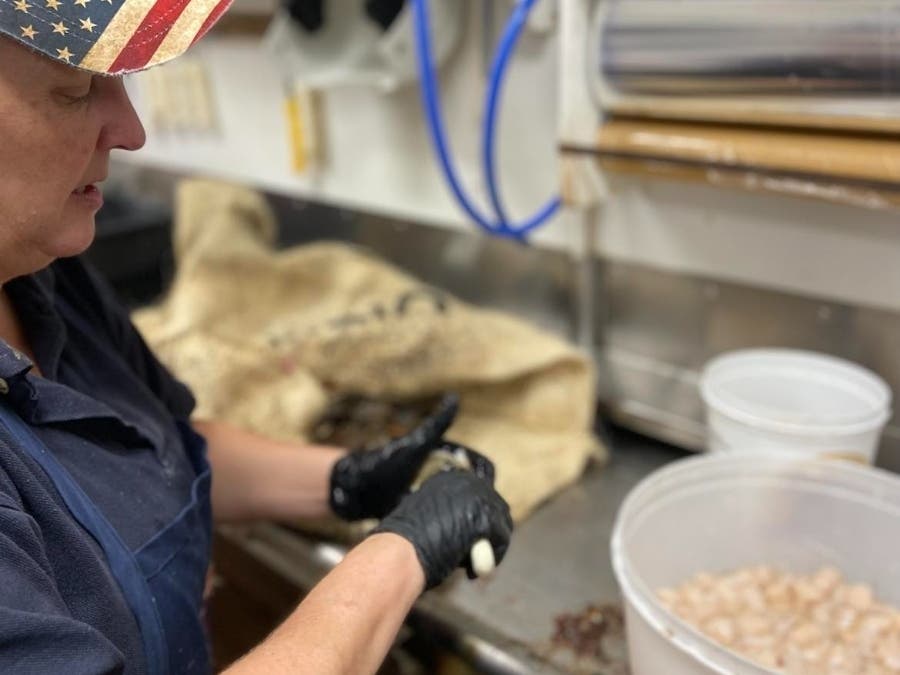
The season, which always kicks off on the first Monday in November, was off to a less than stellar start this year. But, unlike in the most recent past years, there was reason for hope: At Braun Seafood Market Co. in Cutchogue, there were Peconic Bay scallops to be had, as of Monday evening.
"We're opening them," staffers said. As of Monday, the scallops were priced at $25 per lb.
Find out what's happening in North Forkfor free with the latest updates from Patch.
Meanwhile, Charlie Manwaring, owner of Southold Fish Market, told Patch that while there were scallops, the first day overall was "not that good."
He added: "We have some, and we're going to have a few scallops, there's no question about that. But it's not a banner year."
Find out what's happening in North Forkfor free with the latest updates from Patch.
Manwaring said he believes quantity will pick up in a few weeks when all the baymen are done "conching and fishing."
On Monday, Manwaring said, about two to three bushels came in. "That's a good thing," he said.
Reflecting on the dearth of Peconic Bay scallops over the past years, Manwaring said he personally believes the scallops were spawning a feew months earlier than usual.
However, he remained hopeful for better days to come.
"The scallops are actually doing their thing," he said. "Mother Nature wants them back, and she'll give them to us. Every year, it's been a little better."
Speaking with Patch last year on opening day of the season, Keith Reda, general manager at Braun Seafood Market Co. in Cutchogue, said that the picking were "slim.
When asked why the scallops have been so elusive last year, Reda said: "I don't think they have it figured out yet. Sometimes, you have to just let Mother Nature do her thing and stop messing with it."
There was another die off of the scallops in August and September last year, he added. "They have a short life cycle, 18 to 24 months. If scallops are born too early, they just don't make it back to the following season."
Reda agreed, too, with Manwaring, who said that in early November, the baymen are still out fishing sea bass, conching, and clamming, so they don't have as many fishermen out scalloping as they potentially could during the winter months.
Meanwhile, in January, a new study indicated what many had long feared: The die-off of the beloved Peconic Bay scallops in local waters was likely caused by warming waters and heat waves.
The study, commenced by Stony Brook University researchers and published in Global Change Biology, indicated that global warming has contributed to the loss of bay scallops.
As climate change intensifies, heat waves are becoming more and more common across the globe. In the face of such repeated events, animals will acclimate, migrate, or perish, experts said.
Since 2019, consecutive summer mass die-offs of bay scallops in the Peconic Estuary on Long Island have led to the collapse of the bay scallop fishery in New York and the declaration of a federal fishery disaster, with landings down more than 99 percent, Stony Brook University researchers said.
This study, led by Stony Brook School of Marine and Atmospheric Sciences graduate Stephen Tomasetti, PhD, and Stony Brook University Endowed Chair of Coastal Ecology and Conservation, Christopher Gobler, PhD, as well as a collaborative team of researchers, revealed that extreme summer temperatures, becoming more frequent under climate change, had exacerbated the vulnerability of bay scallops to environmental stress and has played a role in the recurrent population crashes, researchers said.
The study even reported the mass die-off of all scallops at a New York site in 2020, when an eight day summer heatwave event coincided with repeated episodes of low oxygen.
Scallops at locations with higher oxygen or lower temperatures survived, however, researchers noted.
Additional research that year confirmed that the combination of high temperatures and low oxygen reduced feeding and energy reserves, causing mortality in ecosystem and laboratory scenarios, experts said.
"Global warming is happening at an uneven pace in space and time. It just so happens that summer water temperatures in the Northeast are increasing at a rate more than 3X the global average, leaving organisms adapted to cooler temperatures endangered," Gobler, the senior author on the paper, said.
By using a combination of satellite temperature and long-term environmental records, field and laboratory experiments, and measurements of scallop heartbeat rates in an ecosystem setting because scallops heartbeat rates vary with water temperatures, researchers demonstrated that coastal waters from New York to Massachusetts — home to the nation’s northern bay scallop fisheries — were rapidly warming. Bay scallops had become increasingly susceptible to the combination of high temperatures and impaired water quality, they said.
Warmer waters physically hold less oxygen, so increasing the baseline oxygen levels in the estuary by improving water quality will help offset future oxygen loss from increased temperature, researchers added.
For years, local officials also reflected on the disastrous impact of the die-off on the local economy and on livelihoods.
"On eastern Long Island, our environment is our economy. The scallop crop industry can only thrive with resources like clean water and efforts to combat climate change," New York State Assemblyman Fred Thiele said in 2022. "With the climate crisis already at our doorstep, we have seen the devastating impact climate change has on our fishing industry. The repeated threat of scallop die-off in recent years due to rising temperatures in our Northeast waters has become crippling to the commercial fishing community and all related East End industries and businesses; this is yet another example of climate change's extreme and adverse impacts across our region."
"We have been watching with dismay the collapse of our unique Peconic Bay scallop population. This research is crucial to not only helping our community restore a vital part of our economy for local baymen and consumers, but will help develop a critically important understanding of how we can address climate change impacts to our environment and marine life," Suffolk County Legislator Bridget Fleming said last year.
And, added Suffolk County Legislator Al Krupski in 2022: "Although the decline in scallop populations is dramatic, I am gratified that the marine science community, which includes so many dedicated individuals and instituions, has pulled together to try to reestablish a sustainable scallop population."
But efforts have been ongoing to save the Peconic Bay scallops, which mean so much to the economy on the North Fork, where rich memories of the season run deep.
n February, news broke about a new program in place to help ensure the long-term survival of the East End's beloved Peconic Bay scallops.
The Robins Island Foundation is supporting Cornell Cooperative Extension of Suffolk’s marine program work to boost the survivial rate of Peconic Bay scallops by experimenting with a shift in its hatchery spawning from summer to fall, a release said.
The plan comes after four years in a row of mass die-offs, CCE said.
CCE’s bay scallop restoration program has also received ongoing support from Suffolk County through the county’s water quality protection and restoration program since 2005, CCE said.
“The CCE marine program is committed to the success of commercial fishing here on Long Island, and a large part of our work focuses on the Peconic Bay scallop,” said Chris Pickerell, director of the CCE marine program. “Recent die-offs have made our job more difficult. This new initiative is aimed at ensuring that we can continue to support the fishery and the local economy.”
CCE researchers said there are two factors contributing to large-scale die-offs. The first is a rise of water temperatures, universally agreed to be an effect of climate change.
Another report recently indicated that the large-scale die off could be attributed to global warming and heat waves.
The other variable is the emergence of a parasite first documented in the Peconic Bay populations in 2019. According to published reports, the regional industry’s annual scallop harvest in 2020 and 2021 was a fraction of that in 2017 and 2018.
The die-off has been devastating to baymen and businesses alike.
“You can’t overstate the economic and cultural and value of the Peconic Bay scallop to life on the East End,” said Krupski.
Bay scallops typically spawn once in the summer during their second year of life. In past years, the CCE team, working in conjunction with Suffolk County, has succeeded in producing large numbers of summer-spawned bay scallops. The current CCE research focuses on the less common uncommon fall spawning.
In October and November of 2022, CCE’s production hatchery in Southold conducted two successful spawns, resulting in about 30,000 young scallops currently in the hatchery. This spring, the restoration team undertook a range of field experiments to evaluate the hardiness of these fall-spawned scallops. The team aimed to investigate survival rates, reproduction, and infection rates of the fall scallops and to compare the results with that of scallops spawned in summer. If fall-spawned bay scallops survive better than those produced in summer, such findings could prove highly useful in future restoration efforts, CCE said.
“We were excited to attempt the first fall spawn of bay scallops here at the hatchery in Southold,” said Josh Perry, CCE’s production hatchery manager. “Spawning and rearing outside the regular season has been both challenging and exciting."
Work still needs to be done, experts agree.
“It’s promising to produce fall-spawned scallops, but now we need to see if these scallops will survive better than those we produced in summer,” said Harrison Tobi, a CCE scallop program specialist, earlier this year. “I look forward to getting in the water and working with my team in the months to come to learn if what we’re trying will significantly improve scallop survival. I’m confident that we’ll soon be better equipped to restore the fishery back to what it was before the recent die-offs.”
Get more local news delivered straight to your inbox. Sign up for free Patch newsletters and alerts.