Politics & Government
Proposition to Extend Community Preservation Tax Passes on East End By Overwhelming Margin
BREAKING: Environmentalists have advocated for the extension and for 20 percent of funds to be used for water preservation on the East End.


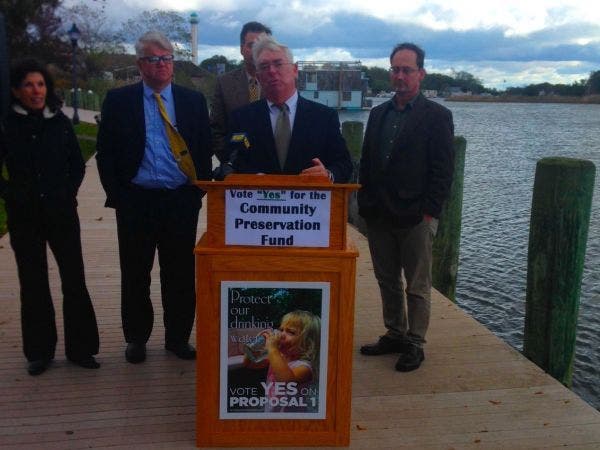
East End voters voted "yes" in a big way to preserving area waterways and open space, voting by a wide margin in favor of a proposition to extend the Community Preservation Fund until 2050 and also, to give towns the ability to utilize 20 percent of those funds for water quality improvements.
Unofficial results Tuesday indicated that in East Hampton, voters supported the proposition 78.19 percent to 21.81 percent. Riverhead residents voted for the proposition 74.72 percent to 25.28 percent, and Shelter Island, 69.50 percent to 30.50 percent. Southampton residents embraced the extension by a wide margin, with 80.15 percent voting "yes" and 19.85 percent, voting "no." And in Southold, the voters gave the extension a green light by a margin of 79.76 percent to 20.24 pervcent.
The news is a victory for environmental advocates: With water quality concerns a key issue on the East End, environmental conservation and advocacy groups, businesses and citizens came together recently to urge residents to just vote "yes" for an extension and expansion of the Community Preservation Fund on Election Day.
Find out what's happening in North Forkfor free with the latest updates from Patch.
Proposal 1 asks voters to extend the CPF program to 2050 and allow for towns to utilize up to 20 percent of the 2 percent real estate transfer tax toward water quality improvements in the five East End towns.
Since it was passed, advocates said at a press conference in Riverhead, the CPF has generated a billion dollars and preserved more than 10,000 acres of open space and farmland on the East End.
Find out what's happening in North Forkfor free with the latest updates from Patch.
Advocates for utilizing the 20 percent toward water quality improvements point to the decline in water quality due to nitrogen loading and other issues on the East End.
“The addition of water quality protection to the CPF comes at a critical time: Scientists have found that nitrogen pollution from sewage is harming our health, our local economy and quality of life,” said Kevin McDonald, conservation finance and policy advisor for The Nature Conservancy on Long Island, at the event.
“The East End’s bays, harbors and lakes are tainted yearly by brown, red and rust tides and blue-green algae blooms from nitrogen pollution."
McDonald pointed to the massive fish die-off in Riverhead in recent years.
Dr. Chris Gobler of Stony Brook University said rust tide blooms are "a new phenomenon to Long Island. They began in 2004 and have occurred every summer since, but at varying intensities. Rust tides are more intense and toxic when provided excess nitrogen. Since the start of this decade when appreciable scallop harvest have returned to the East End, we have observed that during years of more intense rust tides," which included 2012, 2013 and 2016, "harvests have been poor and scallops that were alive prior to the rust tide were dead afterwards."
In contrast, he said, in 2014 and 2015 the blooms were mild and the scallops harvests were good.
"While several other factors also effect rust tides and scallop populations, these trends indicate that controlling nitrogen loading will help ensure scallop harvests are robust in the future," Gobler said.
Scallop season kicked off again on the East End Monday.
Elected officials attended the event to advocate for the CPF extension and expansion.
“Water quality is the key to our quality of life. We swim, fish, and clam in our bays and harbors and the water we drink comes from the ground,” said Larry Cantwell, East Hampton town supervisor.
“It’s critically important that everyone vote 'yes' on Proposition One to protect Long Island’s water for generations," said New York State Senator Ken LaValle. "The CPF has enabled us to preserve important lands, and with the approval of the proposition, we can have the same success protecting our water.”
New York State Assemblyman Fred W. Thiele, Jr. said, “Without a more concerted effort to reduce our nitrogen loadings to our ground and surface waters, the Peconic Bay scallop and our once thriving scallop industry, remains vulnerable.”
Southold Town Supervisor Scott Russell and other Southold town board members have reminded that voting for the proposition does not mean municipalities have to utilize that 20 percent toward water quality issues; some residents have voiced concerns that in Southold Town, unlike other areas on the East End, there is much land still to be preserved and monies need to be utilized for the original intent of the CPF.
Instead, Russell and other town board members said, the vote would mean that a town will have the option, moving forward, to use the funding toward water quality improvement, but would need to vote to do so on a case by case basis.
Patch courtesy photo.
Get more local news delivered straight to your inbox. Sign up for free Patch newsletters and alerts.