Community Corner
Rare Black Swans Set To Head To Forever Sanctuary
The rare black Australian swans rescued by neighbors in Southold will live the rest of their lives peacefully at a North Carolina sanctuary.


SOUTHOLD, NY —Two rare Australian black swans rescued from a Southold creek recently will soon be headed to their forever home.
John Di Leonardo, president of Long Island Orchestrating for Nature, who came to rescue the swans, said the pair will be heading to North Carolina this week.
"We are so grateful that these gentle, inquisitive swans have found their forever home at Skywatch Bird Rescue," Di Leonardo sai. "Wild animals are not pets, but due to being handraised in captivity, continents away from their natural home, these swans cannot be released to the wild."
Find out what's happening in North Forkfor free with the latest updates from Patch.
At Skywatch, he said, "they will live as close to a natural life as they possibly can, with spacious, naturalistic ponds to swim in and other members of their own species to socialize with, in a climate closer to Australia's while still receiving on-site feeding and veterinary care."
LION, Di Leonardo said, is "filled with gratitude for Skywatch giving these magnificent birds sanctuary and for everyone involved in their rescue."
Find out what's happening in North Forkfor free with the latest updates from Patch.
The swans were saved in late July thanks to the efforts of neighbors who joined hands and kayaks and formed a human chain to keep them protected until help arrived.
The swans, because they are domesticated and were likely abandoned by whoever owned them, were unable to defend themselves against wild swans that were attacking them, neighbors said.
After being spotted on Corey Creek, the swans were seen by Andrew Semon and Patricia Conklin in Jockey Creek, Deb Stroup of Peconic said.
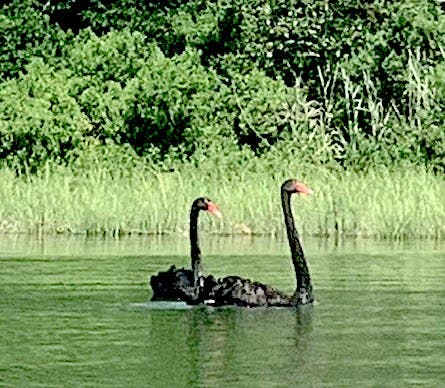
Semon's neighbors tried to protect the black swans from the white swans, who are aggressive, Stroup said. "They jumped on their boards and herded the swans up Jockey Creek, away from the white swans," she said.
"People need to hear that they are in danger," Stroup told Patch at the time. "These poor things are tame and defenseless. They are not suited for the wild."
After a Patch story about the swans, Glenna Ryan was outside her home on Goose Greek and spotted the swans. Her husband, Don, recognized the swans from the Patch article and reached out, as directed by John Di Leonardo, with the swans' new location.
Next, Dana Kuhl and her children Sophia and Nick LaPorta, as well as her parents, William and Rena Kuhl, spotted the swans.
Kuhl and her daughter set out on the water and were later joined by fellow kayakers Kathleen Foley and Cathy Sleckman.
Di Leonardo said he first got a call to help the swans from a representative of the Evelyn Alexander Wildlife Rescue Center in Hampton Bays. Di Leonardo, who has been working hard to try and locate the bull on the loose in Mastic, headed out Southold to rescue the swans, which are known for their distinctive, bright red bills. He was also joined by Karen Testa of the Turtle Rescue of the Hamptons.
After hours on the water, when Di Leonardo arrived, the kayakers formed a human perimeter to corral the swans toward where he was waiting to capture them with a large net.
Leonardo said the swans stayed with him and then at a foster in Huntington but will be heading to their forever home this week.
One of the swans had an infection on its foot; both were very thin and malnourished, he said.
"I'm sure they'll make it — but I'm glad we got them when we did," he said. "I'm sure they were starving."
The black swans, he said, did not know how to forage or defend themselves; they are not indigenous to the area and were likely raised in captivity, Di Leonardo said. Australia also has a very different climate, he said. "Come winter, they'd be dead. But they'd likely have been dead before that. They don't know our natural predators and they don't have a healthy fear of humans, as they should."
The wild swans trying to attack the black swans were just trying to defend their families and shouldn't be blamed, Di Leonardo said.
It's humans who are at fault for abandoning them, he said. "Whoever let them go, left them to a death sentence," he said.
Also, introducing the swans was disruptive to the entire ecosystem; they might have killed a wild swan — or, they might have spread infection, Di Leonardo said. Fowl abandonment has a detrimental effect from health, welfare, and environmental standpoints, he said.
Di Leonardo reminded that it is a crime to abandon a domesticated animal in the wild.
He added that anyone who sees a domesticated swan or other waterfowl should not feed them bread; it can cause serious health problems. Bread is used for bait to help rescue swans but should not be used for feeding.
Wild waterfowl should be left to forage for food on their own, Di Leonardo said. But, during the winter months if wild swans or other waterfowl are hungry and people want to feed them, the best choice is Missouri Waterfowl Feed, he said.
Reflecting on the rescue, Dana Kuhl said: "I feel so grateful to have been part of the 'Great Goose Creek Black Swan Rescue Crew'. It was a privilege and honor to be able to watch the swans and help secure their safety for a healthy life. When we all come together to help anything is possible."
Get more local news delivered straight to your inbox. Sign up for free Patch newsletters and alerts.