Politics & Government
Southold Candidates Face Off On The Issues
Election Day is Nov. 5. See what your candidates had to say on the issues that affect all residents.


ORIENT, NY — Election season was in full swing earlier this month at a Southold Town Candidates Forum, sponsored by the Orient Association and East Marion Community Association, and held at Poquatuck Hall in Orient.
Candidates running for town board and supervisor kicked off the event by sharing details of their bios.
Incumbent Town Councilman and Mattituck farmer Bill Ruland began by discussing his years of service on the Mattituck-Cutchogue school board, where he served as president, and on the town board, where he is also Deputy Supervisor. "Some people do not understand the passion I have to keep Southold, Southold," he said. "The winds of change are everywhere . . .I always want to do what is right for everyone."
Find out what's happening in North Forkfor free with the latest updates from Patch.
Sarah Nappa, running for a seat on the town board, said she understands, as a small business owner, what the next generation of farmers needs to remain viable. She added that fresh perspectives are needed in town government. "Our government needs to be working for for the people and places in our community. The current climate is not working. There is a culture of divisiveness."
Incumbent Southold Town Supervisor Scott Russell said he has served for 14 years; the two most important issues facing the town are quality of life and community character. The bailiwick of the issues, he said, are balancing fiscal management while preserving the quality of the environment.
Find out what's happening in North Forkfor free with the latest updates from Patch.
The goal, he said, is keeping young people in town and making sure to provide a place where older people can afford to live, while still focusing on code enforcement and issues including airbnb-type rentals.
Greg Doroski, who is challenging Russell for the supervisor's seat, said he is running for the position because he believes "we can do better. I think the current administration is not doing enough." He said he and his wife want to give their children the same opportunities they had. Issues such as the comprehensive plan, which had an "unacceptable timeline of 18 months that ballooned to 10 years," need to be addressed. While he said it is great that oyster farmers can now sell at roadside stands "it is is unacceptable that it took six years."
Priorities include the environment and intelligent economic growth, he said.
Incumbent Town Councilwoman Jill Doherty, who also previously served on the board of trustees, is seeking election to her third four-year term. The town board, she said, takes input from all constituents before deciding what needs to be done.
"The most important thing is keeping Southold, Southold," she said. "I'm proudest that we are not Riverhead, we are not up-island — and I want to continue to keep it that way."
Robert Hanlon, running for a town board seat, is a retired attorney who has served with the Orient Association, for four years as president. Critical issues in town include the need for affordable, middle class housing and water quality; the scale and size of housing is also a concern, he said.
On promoting small business
When asked how they would support small business going forward and promote the growth of year round jobs for young people, Nappa said, "I think that small business is the lifeblood of this place. It's a great experience when you go into a shop or restaurant and a lot of the time you are talking to the owner. We need to promote small business, streamline the process, keep people here and encourage new businesses to grow."
Small farms are another way to encourage economic growth, she said; processing is a way for agriculture to remain viable. She said a new processing code took seven years to finish and a measure to allow those in the shellfish industry to sell oysters outside their homes, six years. "We need to do better."
Russell said Southold created a pre-submission conference, so someone with a new business idea could come together with representatives of the building department, zoning board, town attorney and the supervisor to get the applicant "where they need to go" in regard to costs and challenges. In addition, he said, an economic development committee was created that has produced "dynamic" seminars on a range of topics including business grants and small business needs.
Local development corporations enable not for profits to access the bond market; development corporations helped, through the ability to secure bonds, to facilitate expansion at Peconic Landing and the Eastern Long Island Hospital merger, he said.
Doroski said small businesses breathe life into the community but under the current administration, there has been a "lack of certainty. "You need certainty to make good, informed business decisions."
He said in 2016, Russell proposed a moratorium to address the problems in the wine industry. "Since then, not a single thing has been done. The wine industry itself has been calling for these updates," he said. Other businesses have been asking to be allowed to sell directly, something that would give them additional percent margin and mean "real impacts," Doroski said.
Doherty said the town has also worked with local Chambers of Commerce on events such as First Fridays, and Shellebration, drawing out locals and giving day trippers a chance "to enjoy what we have here."
The town also works with the community to help see what grants are available, she said. "There's a lot we do, and a lot behind the scenes. Could there be more? Sure. But most of the code was done in the early 80s, and you can't just change code. Definitions are so important. Without the correct definitions, the code doesn't work. It takes time, and we work with committees, and when we are satisfied, we can change the code we know it's going to work."
Hanlon said living in a Cloud economy, there is no reason people can't work from home or from shared spaces, but there has been no outreach to bring new businesses to town. "We need to tell them, 'We have a lovely town and we can help set you up.'"
As for the code, Hanlon said, "It's complicated but it's not that complicated. Stop saying we can't do it because the code doesn't allow it. If that's the case, we have to rethink that. We have businesses that don't follow the code, and some get down, but some don't," he said. "If the code is wrong, let's change the code — and let's enforce it."
Ruland said all business is important in Southold. "The town's role is to serve all the people, all the time, not just single segments." As for zoning, Ruland said when uses are intertwined in residential areas, there is a need to be careful so that residential quality of life is protected; some uses are just not appropriate for residential areas. "Looking forward, yes, we have to look at the code but we have to look at it in its entirety," he said, adding that the comprehensive plan has an analysis of businesses.
Other issues includes rise in sea level and how the candidates would address the issue.
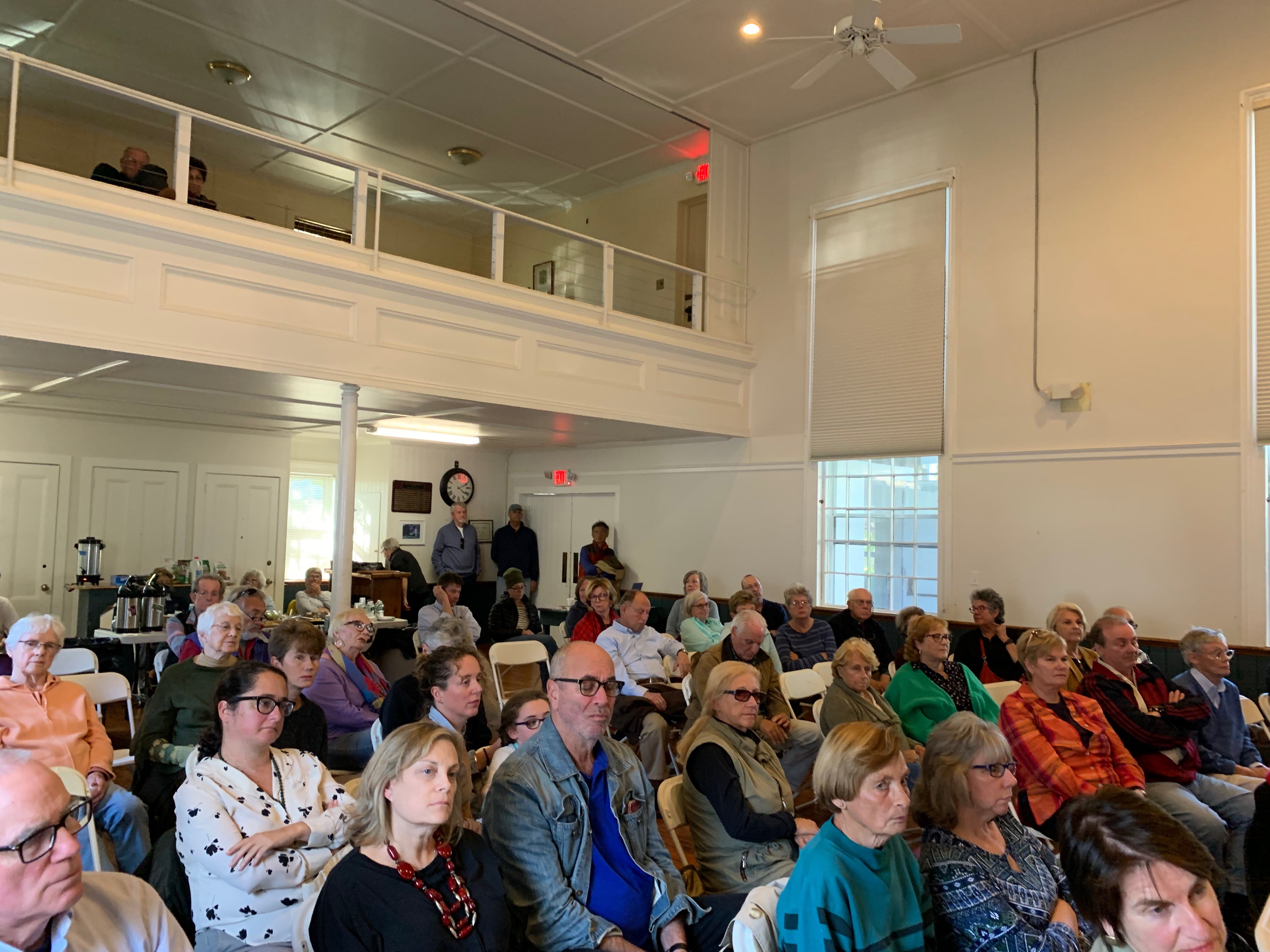
(A crowd turned out for a recent Southold "Meet the Candidates" event in Orient. / Lisa Finn)
The future of farming
Another question centered on farming, whether the town should have a role in getting new farmers up and running and if so, how to accomplish that.
Doroski said agriculture is part of the town's history and natural beauty and part of "what makes us special here. While this administration has done a good job of following the Southold tradition of preserving land, a tradition that goes back to 1983 with the creation of the Community Preservation Fund, we need to do more to make it easier for small farmers to survive."
Nappa, he said, talks about how the town is paving the way for large scale agriculture in town due to the uncertainty small farmers face. "Big ag can afford to litigate their way through. Small farmers can't. It's unacceptable that these things take so long. Farmers, small businesses do not have the luxury the way this government has forced them to," Doroski said. "We need to do more to support small farmers or we will lose who we are as a community."
Doherty said farming has changed over the years and the town has always been cognizant of that and reached out to farmers, changing codes to create overlay zoning so that farmers can house their workers."
The town, she said, has always made farmers, whether greenhouse, potato, wineries, or fisheries, a priority. "Our farms are who we are and each one of us knows that," she said.
Hanlon said he hears a lot of frustration about how the process for farmers takes too long. Vineyards, he said, are farms. "And we have to treat them like farms and not act like they are some strange beast that don’t belong in this town. They bring commerce and opportunity and we have to recognize and cherish that."
Ruland said North Fork farmers live in one of the most expensive places in the nation, where it's extremely hard to get land. The town's development rights preservation program has helped to foster farming, at a much lower price per acre, he said. The town's role should be one of encouragement, he said; balancing codes that might be mended to enhance a person's ability to farm, while remembering that even farms are in neighborhoods and can impact quality of life, with an eye toward mitigating that, he said. "There's no question in my mind that flexibility may be the key. Right now we are in a tough time. It's extremely difficult to borrow money and farming is capital intensive. The town's role should be one of encouragement and serving as a public resource."
Nappa said there is a shift in farming not just in Southold but nationwide, as farmers shift to small, diversified crops and young people look to get back to the land with a focus on ecology, water conservation and food husbandry. Nappa said she will go to the state and county to find funding; the farmstand code needs to be updated, she said.
"Small farms are so important. We need to preserve the farmer with the land," she said. Viable ways to sell products need to be created for farmers. "Once they are gone, they are not coming back," she said.
Russell said he wished to correct Nappa, who said the farmstand code needed to be updated; it was updated. "They wanted licensing, we adopted licensing," he said. As for the six-year claim, Russell said his opponents did not talk about all the work done during that time, including creating definitions, codifying and ag committee, changing easement language so parcels can be subdivided so farms who need smaller acreage can obtain that goal, and an affordable farmland bond adopted to help farmers at risk.
On certain issues, the ag community does come to consensus, but it may not be what the community wants, and the needs of all must be considered. "It's part of a balancing act," Russell said.
Code enforcement concerns
Other issues discussed were code enforcement. Doherty discussed the development of the rental code, and the crackdown on airbnbs that has seen a drop in advertised locations from 300 to about 84. The town is hiring additional staff but has to balance that without raising taxes, she said. The town won two cases in Supreme Court against egregious offenders, she said. "We're getting the job done."
Hanlon said the rental code needs to be more rigorous to include situations not covered, such as single room rentals, subletting and Hamptons style housing. In addition, Hanlon said there is a "sense of unevenness of enforcement across the board."
Ruland said the rental code has helped to uncover many issues that could not be addressed in the past. "People who are renting anything need the expectation that what they are renting is safe," he said.
Due process, he added, can take some time. "When you bring charges against someone you'd better have your ducks in order."
Nappa said she feels the short-term rental code has been "flawed from the beginning" one the town is unable to enforce. "We need to go back to the drawing board and see what the community says and what other communities are doing," she said.
Russell said it was always made clear that the short-term rental legislation was just the first step; the second was the rental code adopted this year. For the most part, Russell said, when the legislation was adopted there was compliance, despite a few "bad actors."
As for his opponents' references to food trucks, Russell said they are not allowed under town code. "Go through the town code and you tell me which parts I should enforce or ignore," Russell said. "You do not draft code by looking the other way. You either accept the code or you don't. I'm not going to cherry pick parts of the code."
Doroski said he has proposed a plan to require all rentals to list a permanent number, one that would used software based technology solutions to scour sites and get information. Hanlon, he said, has proposed bringing in interns to scour through short-term rental listings for information.
The environment and water quality
Hanlon said there's a need to solve the cesspool problem, with everything that's flushed hitting the bays and 30 percent of nitrates in the water coming from septic systems. "The grants are there." While the county has a commitment to a 35-year program, he said, "We can't afford to wait 35 years." He added that the town could mandate upgrades and offer incentives.
Ruland said good, solid scientific observation is needed and there are things that can be done, such as moisture sensors on irrigations systems so they don't come on after two inches of rain. "Making water potable is one of our major priorities, especially stormwater runoff," he said.
Nappa said there's a need to monitor usage and gather data with an eye toward developing a plan and deciding if the town needs a policy on irrigation limits and other issues. Suffolk County, she said, has a plan for all residents to have an alternative wastewater system installed by 2050. "We need to be the leaders here. I don't want to be the second-to-last town in Suffolk County. We need a timeline, a plan, so it's not 2049 and we are in a crisis."
Russell said the town has a water conservation committee but the board decided the message needed to be taken "broader and wider," including groups like Peconic Green Growth and partnering with Suffolk County to collaborate with such groups. While the supervisor said innovative and alternative systems are a great idea, he would not use CPF money for systems when there are 380,000 systems that need an upgrade countywide. Instead, he said there's a need to look at water tax grants and find other ways to fund the program. "I'm not going to mandate this," Russell said. With an IA system costing about $20,000, residents, he said, will need financial assistance..
Doroski said he has a proposal, one he said Russell has called a "pet project," that involves the state and county, which are offering grants to promote installation of nitrogen-reducing septic systems — but there are gaps in support. Next year, Suffolk County is planning to support the installation of 1,200 systems with $10-million in new state funding; in the longer term there is also a proposed $4-billion plan, which would support new septic system installations over the next 50 years, he said. His pilot program would take 2%, or $140,000 from the Community Preservation Fund for one year to provide $2,000 grants to promote homeowner installation of 70 nitrogen-reducing septic systems.
Doherty said the town secured rain gages and clocks, given out for free to residents to encourage odd/even day local irrigation. Doherty, who works for a landscape company, said they educate their customers on alternatives. She compared the IA systems to electric cars, which in time have come down in price and become more efficient. "We need to give it time and see how it works," she said.
Affordable housing
When asked how to grapple with the dearth of affordable housing on the East End Ruland said the public private partnership needs to be expanded; spreading out the opportunities in different areas so no one school district feels the impact. Septic is critical, he added, and one reason why the new Vineyard View density can be achieved, because it taps into Greenport's system.
Nappa said families are leaving town because they can't afford to live in Southold, while Russell, she alleged, "jokes that young people are Southold's greatest export. We need to do more." Rentals, she said, keep poor people poor; there are nationwide programs where people buy homes, build equity, sell and move up the ladder.
Russell fired back, of Nappa's remarks about his words on young people being the town's greatest export: "That was not a joke." However, he said, the likelihood of home ownership right now is not realistic because the grants are not there. The board, he said, has loosened up the accessory apartment code, creating an expanded code that allows up to six apartments as a principal use in the business district; the stumbling block is the Suffolk County Department of Health's septic code. Keeping affordable homes affordable in perpetuity is already in the code, he said.
Doroski, he said, pitched the idea to use affordable housing funds for home improvements. "We are not funding home improvement plans," he said.
Doroski countered that his pilot program would use a portion of the inclusionary zoning buyout money from developers to provide grants to incentivize homeowners to build affordable accessory apartments.
He also said Russell hadn't explored another project like the Cottages at Mattituck, which was launched before he was elected, during his tenure.
Doherty agreed there is a need to partner with private industry; affordable housing regulations are state-mandated, she reminded. There is a need, she said, to investigate federal grants and loans. "We can't raise taxes for everyone for affordable housing," she said, adding that homeowners can build accessory apartments.
Hanlon said apartments in halo centers need to be created; building apartments near creeks and bays will result in seasonal rentals and "not a single apartment will be available for someone who works in Peconic Landing or a restaurant," he said.
The audience then asked questions regarding housing size and scale and the need for a community pool.
Russell said the town purchased a 10-acre parcel near the tennis courts and fields; Paul Pawlowski and his partners submitted a bid and the Sports East vision could soon become a reality, he said.
Nappa questioned why only one person submitted an RFP and why it was being built on town-owned land. Russell said the proposal includes purchasing the parcel from the town and the plans would proceed with the developer's funding.
The candidates also discussed term limits.
Election Day is Tuesday, Nov. 5.
Get more local news delivered straight to your inbox. Sign up for free Patch newsletters and alerts.