Politics & Government
Southold Town Board Votes Unanimously To Adopt New Agricultural Definitions
Despite a heated discussion two weeks prior, the public was largely absent from the meeting where the vote took place.


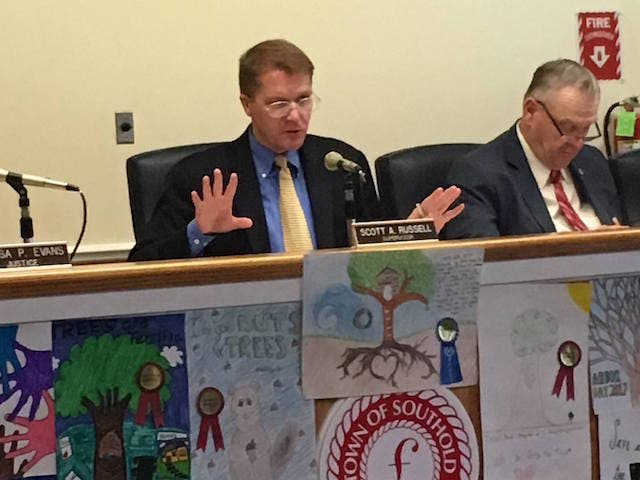
SOUTHOLD, NY — After a heated discussion two weeks earlier, the Southold town board voted unanimously to adopt a set of agricultural definitions recently, with virtually no members of the public present at the meeting.
Earlier in the day at the Southold town board work session, Southold Town Supervisor Scott Russell said it was difficult for the board to "coalesce around a set of definitions when I don't see agreement from the ag advisory committee."
Russell was referring to a public hearing held two weeks earlier during which members of the public stood up to address their concerns.
Find out what's happening in North Forkfor free with the latest updates from Patch.
At that meeting, Russell said the current code had no definitions; the definitions were being added, he said, with the intent of adding uses allowable to farmers. "I don't know how that becomes overly restrictive," he said. "It's being more permissive."
At the hearing Jessica Anson, public policy director for the Long Island Farm Bureau — who did not attend the town board meeting for the actual vote —said she believed the definitions "directly contradict the 60/40 rule."
Find out what's happening in North Forkfor free with the latest updates from Patch.
Russell explained that the town's code allows for a farmstand up to 3,000 square feet. At least 60 percent of the sales must be from agricultural products grown on site and in its harvested state, meaning not processed into something else. However, 40 percent of the sales can be from crops that have been processed. In addition, the 40 percent also allows for other accessory products as well, he said.
Before the vote, he said the 60/40 rule, if applied, "would put wineries out of business."
He asked the board if they were ready to adopt the definitions.
At the work session, Councilwoman Jill Doherty said the vote was just for definitions. "We have to take the next step," she said.
Councilman Jim Dinizio agreed and said the definitions needed to be adopted, with an eye toward developing uses; Councilman Bob Ghosio agreed.
"You have to start with something," Doherty said.
Dinizio added that he was concerned with zoning, and said individuals who lived in an area where farming was allowed couldn't just come in and have "all the rights and privileges the definitions here will convey."
Chris Baiz, chairman of Southold Town's agricultural advisory committee, said that's why the definition for bonafide farm operation was included.
Farmer Doug Cooper said while there are things in the new definitions some are "not real happy about," he felt it was imperative to move forward. "Once it's on the books, if problems come up, they can be addressed, hopefully, in the future."
Of the definitions, Baiz said, "We are trying to get it right. We're 98 percent of the way there, let's get it on the books."
Russell commended Baiz's tremendous efforts in crafting the definitions. "He shepherded this thing through. We owe him our thanks and gratitude," he said.
At the meeting, Baiz said he supported the adoption of the definitions. "This has been a very long, collaborative process to better identify what is agriculture in the Town of Southold. Not to create new agriculture, but to identify what is there today," he said.
Permitted use regulations are yet to come under the guidance of Russell and the town board, Baiz said.
Surveying the near empty Town Hall boardroom, Russell said, "I’m surprised isn’t a larger contingency here tonight. I thought there would be a lot of unresolved issues."
Baize said it would still be a collaborative effort going forward. It's imperative that the "gene pool for the future" be able to keep agriculture flourishing, he said. "Unless the town doesn't want agriculture as a major use — but we feel that we do, and we feel the town does, as well. This helps us better identify what we can do in the future."
Dinizio said he wished the "one sentence definition" that had been in the code, relating to agricultural use, farm buildings and farmstands, could remain. "We've lived this long with those three definitions. My personal views are, the more words we have, the more words there are that could be misunderstood by people," he said. But, he added, he would defer to the farmers' expertise.
The board voted unanimously to adopt the new definitions.
"I'm disappointed many people here two weeks ago aren't here tonight," Russell said, adding that there hadn't seemed to be clear consensus from the ag community.
Of the debate over the word "primarily" that some had said needed to be added, Russell said the word was "ambiguous" and could lead to problems. "You can't bring someone to court because they violated an adverb," he said. "You need to have something that's enforceable."
Of the word "primarily," he said, "The word was discarded — and rightfully so."
He added that the agricultural community should not say something is overly restrictive when it's what they asked for.
After the meeting, Russell elaborated: "The problem with the definitions is that they are trying to include all of agriculture under so few definitions. The industry is very diverse. For example, what may make a good farmstand definition doesn't work for a winery. Putting all of the retail components for so many different businesses and calling it 'on farm direct marketing' won't work. I appreciate all of the hard work some ag advisory members put in but I think we will invariably need to make substantial modifications and additions as we move forward."
And, he said, "it was disappointing to see virtually no one there that was there two weeks ago," adding that, in his opinion, Anson, from the Long Island Fam Bureau, had "made some substantial misstatements of fact, and it would have been mutually beneficial to discuss them."
Heated public debate
Two weeks earlier, Southold Town Hall was packed with a crowd of farmers who turned out in force to discuss proposed changes, regarding definitions, to the town code's chapter on agriculture.
Baiz began by explaining that work on the code had been ongoing for several years, during which members had met with members of the town board at work sessions and code committee meetings to "come up a viable list of meaningful definitions for agriculture", including definitions for day to day practices, he said.
Farmers on the North Fork face unique challenges, Baiz said, struggling to survive in an area where farmland is among the most expensive in the nation; farmers have to face not only operational costs but also mortgage and tax expenses. Basic crops such as potatoes simply don't yield a profit anymore, he said, with value added products critical.
"The paradigm has shifted," Baiz said. To that end, he said the goal is to cultivate cops that allow for a better cash flow and economic viability for farmers. "I want my granddaughters to be able to do anything they want so long as they come back here by the age of 23 and start running the farm for me," he said.
Baiz took responsibility for forgetting the word "primarily" in three definitions, as it pertained to agricultural processing, agricultural processing building and on farm direct marketing building.
The definitions proposed read as follows:
Agricultural processing: The on farm processing of agricultural products at and from a single farm operation located within the Town of Southold, which has been converted from its original (raw) state into a processed or prepared product through applications of cooking, distilling, fermenting, crushing or straining, etc. Such processed agriculture products include, but are not limited to, jams, jellies, cheeses, potato chips, jerkies, meats, fowl, fish, breads and baked goods, beer, wine and distilled alcoholic and non-alcoholic beverages.
Agricultural processing building: An on farm operation building, or part of a building, used for processing and storage of agricultural products of a single farm operation into processed agricultural products as defined herein.
On farm direct marketing building: An on farm building, or part of a building, used for the direct farm marketing of agricultural products and agricultural processed products from a single farm operation.
He said the word "primarily" should be added before "single farm operation", and urged the board to pass the legislation as soon as possible.
That word is necessary, many said they believed, because without it, selling products from other farms might no longer be a possibility.
The word was omitted from the final adopted code.
Farmer Sam Mccullough of Cutchogue said he has lived on the North Fork since the 1970s and got his first job on a farm; now he grows grapes for a winery. He said he fully supports modernization of the definitions and code.
"Agriculture in our neighborhood has evolved in a way I think no one could have imagined. Some changes are positive, some are not," he said.
He agreed the word "primarily" needed to be added.
As did Anson, who said while changes and updates to the code are necessary for clarifications, she was, too, concerned about the definitions of agricultural processing, agricultural processing building and on farm direct marketing building.
Russell added that processing was not allowed at all right, at the time of the hearing. "We're saying it's going to be allowed," he said.
Anson agreed with the other speakers that the word "primarily" needs to be added, because otherwise, "it's too easy to interpret this differently."
"I submit the opposite," Russell said.
After the meeting, he said, "I can understand why some want to expand the definition of processing to allow supplementing the operator's crops with that from others. However, suggesting use of the word 'primarily' is disingenuous. Primarily it is a term of art, subjective and nebulous. Without a clear definition, using such an ambiguous term creates a loophole that you can drive a truck through. Of course, they'll assure us that the truck will be loaded with only local crops. How stupid do they think the town board is?"
He added, "The board is trying to permit processing but as a means of a farmer expanding his opportunities on his own farm. It's astonishing that the representative of the Long Island Farm Bureau would call the new code 'overly restrictive'. We are actually adding allowed uses on farms which currently aren't permitted. How is that 'overly restrictive'? If she thinks the code could be better and wants to makes specific suggestions for changes, that's reasonable. But, use of the words 'overly restrictive' is intellectually lazy."
Suffolk County Legislator Al Krupski thanked the town board and the ag advisory committee for taking on the task and asked if it might be a good idea to add greenhouses to the section on agricultural production buildings; he also asked if it might be prudent to add some verbiage stating that farmstands can't open until "products are actually being harvested and grown on site, to be sold to the general public, to add some clarity."
Beekeeper Laura Klahre of Blossom Meadow Farm questioned the definition of bonafide farm operation, which states that a farm that is located on land with not less than seven acres of land used as a farm operation in the preceding two years for the production or sale of crops, livestock or livestock products, of an average gross sales of $10,000 or more, or is located on land of seven acres or less with an average gross sales of $50,000 or more, or has been issued a farmstand permit. She said the definition seemed "off" and since land was so expensive, no matter what size the parcel, all farmers should be embraced.
Russell said the definition comes directly from New York State.
"That doesn't matter to me," Klahre said.
Baiz added, "New York State Ag and Markets doesn't understand how we operate down here."
He said the town does allow for startup ag operations to come to the ag advisory committee. "Bring us your business plan, show us your land holdings and what you are planning to do, and your checking account, to show that you can do it, and we will grant you a farmstand operator's permit so you can sell" even if the two year requirement hasn't been met.
Karen Rivara, a shellfish farmer in Greenport who sits on the ag advisory committee, said those three definitions in question sparked some concerns because, as an aquaculture operation, "We can't set up a farmstand without people drowning, getting to it." Her products can be sold on other farmstands, she said. To leave the definition as is, without the word "primarily" would "eliminate" the opportunity to sell the products at other farmstands, she said.
"We don't want to see someone bringing products from outside town, saying it's local. . . but we want to maintain the ability to have some flexibility and sell other people’s products," she said, adding that the issue needed to be worked on, for clarity. "We want to keep aquaculture and agriculture thriving in the Town of Southold," she said.
Russell said, under current code, selling oysters to a farmstand is permitted and the definitions "wouldn't change that."
Adam Suprenant of Coffee Pot Cellars brought up the Farmers' Bill of Rights. "We have the right, and I feel very strongly about this, to build farm buildings, spray to protect our crops and protect our crops with deer fencing," he said. He said, according to the Farmers' Bill of Rights, "There has been language in the town code for over 20 year that gives us the right to process and market on our land," he said.
Russell said the aim of the definitions was to afford farmers' the ability to process. "Under current code you don't, but we agree that you should and we're adding it as a use," he said. "I'm getting confused. We're saying, 'Let's develop code and allow it,' but you're saying it's restrictive, when we're developing code that makes it permissible."
After the meeting, Russell said, "The speaker completely misunderstand the Farmers' Bill of Rights if he thinks the proposed code changes runs counter to it. He said that they have fundamental right to 'process', which is exactly what the amendment allows. Where he misses the mark is that the discussion wasn't about the right to process, but how much a farmer should be allowed to process from other people's" products, he said.
Russell said the aim is to allow farmers to allow onsite processing, but also, critically important, to make a commitment to grow the crops or grapes, in the case of wineries.
Ira Haspel of Southold said he'd like more clarification on the "bonafide farm operation" definition and said it might be difficult for new farmers to get started.
Mccullough said the threshold to get into processing should be, perhaps, 75 percent of crops produced onsite and definitely more than half.
"We need to define 'threshold,' to go into processing," Russell said. "You can't go into selling if all your stuff is coming from other farms."
Get more local news delivered straight to your inbox. Sign up for free Patch newsletters and alerts.