Politics & Government
Southold Town Officials To Meet With Assemblyman, Discuss Concerns Over Proposed Peconic Bay Regional Transportation Council
BREAKING: Although the idea didn't receive wide support two weeks ago, Scott Russell said a meeting is planned to discuss concerns.


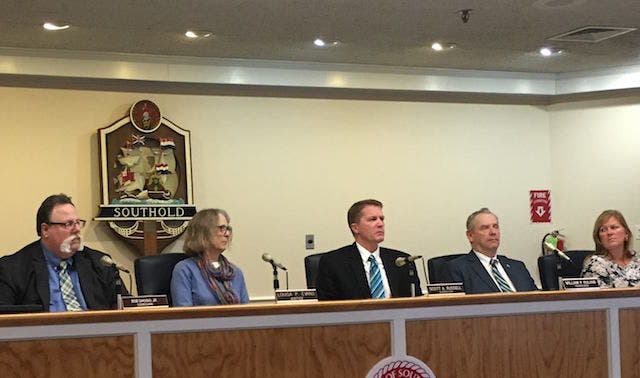
SOUTHOLD, NY — Southold Town board members who initially expressed reservations about a proposed Peconic Bay Regional Transportation Council will meet with New York State Assemblyman Anthony Palumbo to discuss concerns.
The town board discussed a home rule request at a work session two weeks ago; the concept initially garnered little support from the Southold Town board.
The proposal has been pitched by New York State Senator Ken LaValle, Palumbo, and New York State Assemblyman Fred Thiele.
Find out what's happening in North Forkfor free with the latest updates from Patch.
The goal, according to the proposed legislation, is to address public transportation issues on the East End: "The legislature hereby finds that over the past 30 years, rapid growth and development in the Peconic Bay region of Long Island, while providing for a successful economy, has also resulted in some unavoidable, adverse impacts that threaten the region's future quality of life and future economic prosperity. Traffic congestion has been one of the primary adverse impacts from such rapid development.
"Expanding traffic congestion has resulted in deteriorating traffic safety with increased traffic accidents and fatalities. In addition, traffic congestion has resulted in increased trip delays, declining air quality, adverse impacts to historic and rural resources in the region's villages and hamlets, parking problems, adverse impacts to residential communities and neighborhoods resulting from the diversion of traffic from major highways and arteries to rural residential streets and roads," the legislation says.
Find out what's happening in North Forkfor free with the latest updates from Patch.
In addition, the proposed legislation states, the area's tourist and second home industries, deemed "the cornerstone of its prosperity, are threatened by the adverse consequences of traffic congestion."
Plans could include exploration of shuttle trains combined with bus service and light rail service on the East End, proponents say.
Southold town board's initial reservations
Southold Town Supervisor Scott Russell said at a prior work session two weeks ago that the home rule request to support the Peconic Bay Regional Transportation Council did not receive widespread support; the belief was that the new legislation would strengthen the role of the council.
"We are all uncertain of the type and the extent of the future authority," Russell said in an email at the time. "We also raised historic objections because the issue of ferry service should be part of any discussion that tries to improve East End transportation. The omission was an effort to placate East Hampton and we object, since Southold doesn't receive any custom-tailored exceptions."
Back in 2004, Southold, Shelter Island and the Cross Sound Ferry filed suit against East Hampton in regard to zoning laws that ban ferries in East Hampton, something they deemed "unconstitutional." Southold officials maintained at the time that East Hampton's decision to ban ferries placed an unfair burden on the North Fork.
"The home rule request was taking the role of the council up a notch," Russell added two weeks ago. "The new powers that the council would be given are moving it closer to an actual authority, including the right to expend funds and accept property. There’s a heck a lot of homework that needs to be done before we take the council that far."
In addition, Russell said, the basis for most of the work so far has been the Volpe study.
Back in 1996, the East End Supervisors and Mayors Association, with an eye toward addressing growing transportation concerns, created the East End Transportation Council to work with the New York Metropolitan Transportation Council.
Next, the federally funded Sustainable East End Development Strategies pilot was born.
Finally, a new study by Volpe National Transportation Systems aimed to spotlight public transportation options on the East End. The study concluded that a coordinate rail-bus network would be a viable option on the East End.
The Volpe study, Russell said, "was an interesting read, but hardly something we can organize a regional authority around. Plus, from early on, East Hampton would not participate if ferries were part of the study. One of the first goals of this, or any transportation initiative, should be an equitable distribution of all traffic. Southold has continually seen more than its share. This is due in no small part to the presence of a ferry in Orient that serves the entire region. Let’s re-examine roles and responsibilities here before we go this far with a new authority."
Urging the board to support the proposal
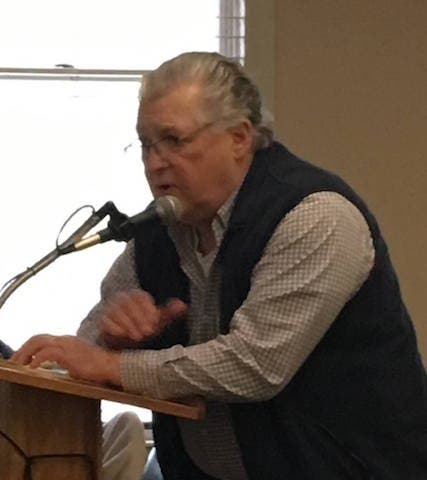
At Tuesday's town board meeting, Art Tillman, chair of the Southold Democratic Committee, urged the board to consider passing a resolution in support of the proposed council.
The council, he said, would represent the five East End towns, serve as an advisory agency and make recommendations to the MTA and Long Island Rail Road, as to what can be done to relieve traffic congestion.
As for concerns that too much weight would be given to the South Fork, with not enough attention to the North Fork, Tillman said, "I don't see it that way." Instead, he countered, the council would serve as a way for Southold's needs to be funneled through a larger organization so the town and East End as a whole have a greater opportunity "to make changes for the better."
He also referred to the Volpe study, which talked about a Peconic Bay Transportation Authority that would break from the MTA, much as the Cape Cod Transportation Authority broke from Greater Boston's public transportation system.
"They did a financial analysis and said it was feasibly economically and that's a key question here," Tillman said.
Tillman said at the time it was determined that approximately $62 million in MTA tax was collected from the five East End towns. Today, he said his "guess" is that number is around $75 million, and "that could be funneled to make the changes necessary."
What's currently called for is a study, Tillman said, and that would "put pressure on the MTA and LIRR to give us the best service, and for Suffolk County to allocate for more buses. I'm urging the board to be supportive, by resolution."
He added that the current LIRR administration is "currently very favorable to listening to, and implementing, our needs, but they want us to tell them what we want."
A new plan for expanded LIRR service unveiled recently by Thiele for the East End would mean an extra train from Greenport, Tillman said, "but that's no big deal." The Volpe study, Tillman said, said 10 additional trains in and out daily could be accommodated, not all the way to the city, but to Ronkonkoma.
"All over the country, light rail trains and conventional trains extend out from inner cities to the airport. They have to purchase land, lay tracks. In our situation, we have tracks already going to Ronkonkoma that are well maintained. The problem is they have not given us the trains," Tillman said.
Trains, he added, do not pay for themselves. "Profit is not the motive here," Tillman said. "It's public service, to get the traffic off the roads."
Tillman said if there was a train to Greenport he was sure the Connecticut-based casinos would provide buses for passengers to the ferry.
"Our people need access college, sports, jobs, entertainment up the island — and they need access to the airports," Tillman said. "I’m personally a little tired of picking up and dropping off people a the airports when the train goes right there."
Chris North, a Suffolk County Community College student, also asked the board to consider supporting the measure; he said he relies on public transportation and often waits for lengthy periods of time for the bus.
Southold Town to meet with Palumbo, discuss concerns
Russell said the goal moving forward is to meet with Palumbo to vet the Southold town board's reservations.
"I have been talking to Assemblyman Palumbo to set up a meeting within the next few weeks. I think we need to get a clear understanding of what authority the council will have and what the structure will be for decision-making," he told Patch in an email after the meeting. "Would it be the supervisors/ mayors? Members appointed by each municipality? Would the votes be weighted? The legislation actually grants more power to the council than it had historically. We just want to make sure that we are are all clear of the role and authority of each town moving forward."
At the meeting, Russell told Tillman that the board had received the resolution a bit late but had issues that needed clarification. The meeting with Palumbo would help to define goals and have concerns allayed, he said.
Russell said he's well aware of the voluminous Volpe study and has read the entire document.
"It didn't say it's 'feasible,' it says it's 'feasible if this happens, and that happens.' Those are big ifs. But getting back to the core issues of the council — the board didn't dismiss it out of hand. We had concerns, such as 'one man, one vote'" per town. "That hasn't worked well for Southold in the past," Russell said.
He also asked why East Hampton officials were able to simply decide they wanted no ferries.
And, Russell added, a bus to the ferry from the Greenport LIRR station "does nothing for the people of Southold Town. It feeds the casinos. Their financial future isn't of concern to me." His singular concern is the residents of Southold Town, Russell said.
However, the supervisor said, "We'll go over the concerns and I'm sure we'll be able to resolve everything."
Get more local news delivered straight to your inbox. Sign up for free Patch newsletters and alerts.