Community Corner
Superintendent Honored For Work Keeping Diversity, Unity Alive
Tears and love filled the Cutchogue East Elementary School library Thursday night as Dr. Anne Smith was honored for keeping unity alive.


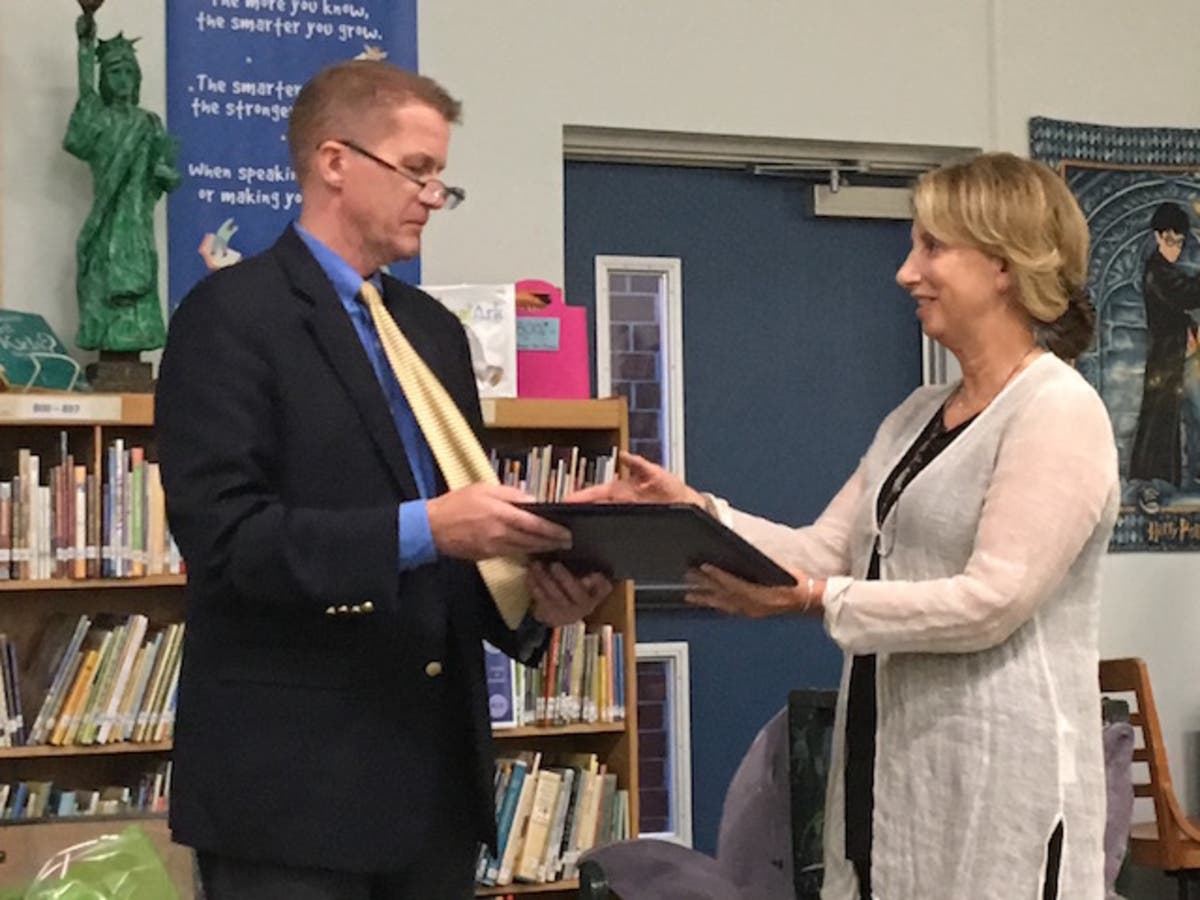


CUTCHOGUE, NY — Tears of gratitude and love overflowed in the Cutchogue East Elementary School library Thursday night as the Southold Anti-Bias Task Force awarded Mattituck-Cutchogue School Superintendent Dr. Anne W. Smith with the 2017 Helen W. Prince award, for her work in keeping diversity and unity alive.
Smith is a fierce supporter of civi and human rights and imbues her life's work with tenets of her ongoing mission, those present said.
Southold ABTF member Leroy Heyliger, speaking before a packed audience, began the event by explaining that the Helen Wright Prince Award, created in memory of a woman who created the migrant labor camp school in Cutchogue, is meant to honor those who dedicate lives to promoting diversity, unity, and fairness.
Find out what's happening in North Forkfor free with the latest updates from Patch.
Heyliger said Prince worked for 10 years at the migrant labor camp school, teaching children and changing young lives.
He said it was particularly appropriate that the event honoring Prince and Smith be held on Oct. 5, United Nations World Teachers' Day, which commemorates teachers and their gifts to society.
Find out what's happening in North Forkfor free with the latest updates from Patch.
"Empowering teachers means empowerment of students," he said.
Next, Steve Wick, keynote speaker and executive editor of the Suffolk Times, spoke about his own moving experience with some members of a North Fork migrant labor camp.
Wick, who lives in Cutchogue, said at one time, there were many migrant labor camps at railroad crossings; he spoke of his experience getting to know some individuals who lived in the last existing farm labor camp on the North Fork.
His journey of discovery began one day when he followed a "frail man on a bicycle that looked like it had fallen off the back of someone's truck, trying to pedal his way up Depot Lane."
Wick followed the man to a low cinderblock building, all that remained after the camp's barn burned down earlier.
He met the man, whose name was Robert, and learned that he had come from the rural South but had lost connection to his family, and had no idea where they were or if they were alive. He'd been involved in the farm labor movement for years, picking oranges in Florida and potatoes on Long Island, Wick said.
"He had lost his life," Wick said.
The plight of farm laborers far from home was featured in a 1950s documentary by Edward R. Murrow, "Harvest of Shame," he said.
"In the 1960s men in rural Arkansas were told they could come to Long Island, put potatoes in bags, and then be taken home. But of course not of that ever happened," he said.
Speaking of the camp he'd explored, Wick remembered Jimmy Wilson, manager of the camp, who had a farmstand, as well as a man named Frank Singleton.
Wick was to learn later that Singleton was not his real name; his true name was Frank Snyder. The man, he said, didn't know what state he was from, how old he was, or his parents' names.
"He didn't have a wallet. He had absolutely nothing," Wick said.
Another man, Oliver, was given away as a baby to a cousin.
When the camp came to an end, Wick wanted to know what he could do to help those who had nowhere to go find their beginnings.
He started with Frank Singleton, asking him to dig deep; Singleton remembered a Lincoln High, somewhere nearby, in one of the Carolinas.
On a quest, Wick began making phone calls and calling Singletons in the town where he'd found a high school by the same name. On one call, he connected with an older man who eventually joined the search, knocking on doors and finally, telling him he'd found a Snyder.
"I think I've found Frank's family," Wick was told.
Despite believing he was looking for a Singleton, still, he made that phone call, and, when the woman on the line asked about Frank's limp and other identifying details, he knew he'd struck proverbial gold.
Frank, Wick said, had no ID and couldn't board a plane, so he drove him to South Carolina, "where he found his mother, waiting for him," he said. "It was an astonishing night."
In another act of kindness and heart, Wick did the same for the man named Oliver, and found the mother that had given her baby to a cousin years before, hoping to provide a better life.
Wick drove Oliver all the way to Georgia and when they drove up in front of an impossibly tiny house, his mother was standing there, waiting, after a lifetime, to hold her son. "It was pretty incredible," he said.
Jimmy, Wick said, was in his mid-80s and had no desire to go back to his childhood home, but asked Wick to find his mother's grave and place flowers there. Despite Wick's best attempts, Jimmy wouldn't budge and refused to go, so Wick headed to Georgia, found a little Baptist church where Ada Wilson, Jimmy's mom, was buried, with no marker.
When he returned home, Jimmy had died.
"He was one of the remarkable people you get lucky enough to meet," Wick said. "Even if they are farm workers, putting potatoes in a bag, they all have stories to tell . . . all have lives worth living. When you reach out and try to do something for one person, in doing it, you can literally change the world," Wick said.
Changing the world, one student at a time
Southold Town Supervisor Scott Russell spoke next, and said the Southold ABTF is one of the nicest and hardest-working groups he's ever had the pleasure to work with.
He added that partnerships are critical and said Smith has been a great partner in spreading a message of tolerance.
"Children aren't born intolerant," Russell said. Surrounding children with a message of tolerance, as Smith does, "will have a profound effect on the community" now and in the years to come, he added.
Russell then presented Smith with a proclamation from the entire Southold town board.
Smith, overwhelmed with emotion, thanked her family and school colleagues, including Cutchogue East Principal Kathleen Devine, as well as parents and students.
Smith spoke of gratitude and said she is grateful to live and work in Southold Town, where so many take a stand for "equanimity, inclusion and unity."
She added, "I think of my work as being a gardener. My wish is to meet the needs of the moments that root us deeply. Words and images have meaning and we must pay attention and use them for good," she said.
She added that she and others in the district stand on the shoulders of those who came before in community "steeped in respect and civility."
Most of all, she said, "Our children need to know, above all, that they are loved . . .loved by their families, the school, town and community. We need to embrace and engage to work toward being a bias free community."
Devine spoke of the writing, artwork and music the children had done to celebrate civil and human rights, with children performing at the event.
Kids created kindness rocks for guests to enjoy.
Southold Town Councilman Bill Ruland, who served on the BOE for many years, also spoke of when Smith was hired.
"You've made a profound impact on the district and the children," he said.
Others from the audience also spoke, including Robert Prince, Helen's son, who came to thank the town for keeping his mother's story alive.
Photos, video by Lisa Finn.
Get more local news delivered straight to your inbox. Sign up for free Patch newsletters and alerts.