Politics & Government
Tempers Explode at Greenport Short Term Rental Discussion
Residents got heated at a Greenport village board meeting over the controversial issue of short term rentals Thursday night.


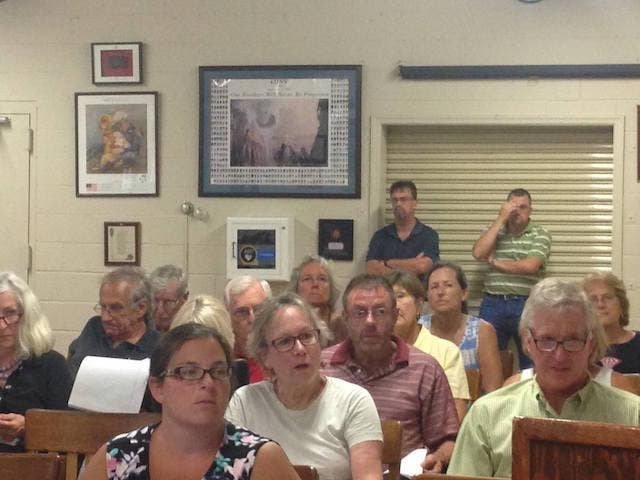
GREENPORT, NY — Temperatures weren't the only thing steaming in a standing-room-only crowd at the Greenport Village board of trustees work session Thursday night, where a heated crowd stood to take a fierce stand on both sides of the divisive short term rental issue.
The Greenport Village board currently has no legislation in place to address short term rentals, although the issue has been spotlighted for more than a year, with discussions at both the village board and code committee levels.
Greenport Village Mayor George Hubbard said the aim of Thursday night's gathering was not to hold a formal public hearing, but to hold a public discussion on the draft legislation that's been released, which outlines potentially bringing the issue of short-term rentals into code pertaining to year-round rentals.
Find out what's happening in North Forkfor free with the latest updates from Patch.
When that code was first crafted, short term rentals hadn't yet exploded onto the landscape, he said.
The draft also includes a possible 20 percent cap on short term rentals proposed by Trustee Doug Roberts.
Find out what's happening in North Forkfor free with the latest updates from Patch.
The mayor said the goal was to engage in public discourse before any final draft was released before moving forward toward hopefully having some legislation in place for next season.
Once a final draft is complete, a formal public hearing will be held before the village board votes, Hubbard said.
A divided crowd
Residents turned out on both sides of the divisive issue.
John Kramer, a Sterling Street resident, said the point of the legislation is to control behavior. Including short term rentals in the code give landlords the ability to take away the lease of a bad tenant; it also will allow the village to compile a comprehensive inventory of what rentals exist in Greenport, both long and short-term, he said.
"Time doesn't mean anything, it's the behavior that counts," he said.
Kramer said, though, that in his short term rentals, guests do not cook. Instead, they eat out all the time and pump dollars into the local economy, with many coming to the area for weddings.
"If you shut down short term rentals we'll lose all the wedding business; it's going to have a severe economic impact on shops in the village," he said.
Jane Ratsey Williams, who also has a short-term rental at her office property, added, "I feel the village is cheating itself. Short term rentals bring in nice money for us," she said.
Williams advocated a $500 fee annually for all renting their properties short term; with that fee should come a checklist the village expects, including inspections. "It's important that we keep the quality of our neighborhoods. I think we need strict standards," she said.
Greg Tack asked what exactly the village was trying to solve with the proposed legislation.
Hubbard said the goal is to ensure all rentals in the village are inspected, and that people are living in safe conditions.
Tack said he supported a yearly fees; those monies could potentially be used to create some affordable year-round housing. "We need to strike a balance," he said.
Resident Linda Gordon, meanwhile, said she doesn't think the issue is short or long-term, the problem is landlords cramming five or 10 people in a home and collecting exorbitant monthly rents.
"That's the problem and it's changing the landscape of Greenport," she said. Overcrowding, she said, is preventing year round employees from finding housing and also placing a severe burden on services in the village. With legislation, the village could take away permits from landlords that don't comply with safety standards, she said.
Resident Jeanne Cooper came out swinging, at first outlying why "a majority" of those renting their homes are committing "mortgage fraud." She said anyone who utilizes Fannie Mae or Freddie Mac federally financed programs for their mortgages are not allowed to rent out homes meant as primary or second homes.
Cooper said she has a list of 30 homes locally in the village that are listed for rent online, that shouldn't be; she urged the village to engage a title company to go to the county and get certified copies of mortgages and riders. "We certainly don't want to be complicit with mortgage fraud against a legal agency."
Doug Moore, who also chairs the Greenport zoning board of appeals, said it is "incorrect" to say that there was no consensus when the issue was before the code committee; there was a strong consensus for an owner occupied short term rental, he said.
Moore also said he's not in favor of a cap. "There's always the issue or impression of favoritism," he said. "I feel the cap is not the best solution at this point."
If the board is amenable, Moore said some limitations about the number of short term rentals an owner could have over a specific period might be the answer; other local municipalities have set such specific periods of time, he said.
The village board needs to come to consensus about what it wants to do before code can be written, Moore said; he also advocated for putting all the village's rental code in one chapter, including sections on B and Bs. He said he was in favor of registering all short term rentals and uniform data collection is critical.
Moore also said it would be a good idea to have a professional property manager on premises, if the owner was not, to confirm guest and handle any issues. "The first call should not be to the police," he said.
Resident Bill Swiskey said trying to fit the short term rental under the year-round rental law wouldn't "fit."
He also said a cap would never be a feasible option. "There could be more than 20 percent here right now, we don't know," Swiskey said.
Hubbard said there are currently 189 short term rentals listed online.
Swiskey suggested the village look over East Hampton, Southold, and Riverhead code on short-term rentals and then present a draft to the public.
Joyce deCordova said she welcomed the idea of registering short term rentals to address safety issues and protect residents.
Chatty Allen agreed, saying safety was key. One year-round resident just moved in and fell through unsafe floorboards, she said. Unsafe overcrowding needs to be addressed, she added.
One critical issue, said Liz Smith, is establishing intent; she also agreed all the rental code should be in one chapter. She said definitions in the code needed to be clarified, including the definition of family. "The view of family here is very narrow, with a very one-culture approach," she said; currently, the code defines family as those related by blood, civil union or marriage.
Trustee Mary Bess Phillips said the issue was a "sore point" in code committee and one upon which not everyone agreed; she added that the code committee did look at Riverhead and East Hampton's short-term rental legislation.
Gesturing to the full, packed room, Smith thanked the board for inviting the public to weigh in. "It's obviously hitting a nerve with people in the community," she said.
Chris Balzaretti, meanwhile, said he would not have bought his Wiggins Street investment home last year, pouring money into renovations, if there was a short term rental law. His short term renters, he said, are "great people" infusing the economy with a steady cash flow.
When asked why they use short term rental sites, Balzaretti said his guests point to a dearth of available hotels or B&Bs.
Balzaretti said he has more problems with his year-round renters than short term.
He said if the board set a minimum of two weeks — as Southold did last year — or 30 days, scores of short term rentals would be lost. "Don't kill it off," he urged.
John Saladino questioned how the short term rental issue has potentially become part of the year-round rental law legislation; Trustee Julia Robins reminded that currently, short term rentals are exempt.
Phillips said the aim was to give the village a database and to inspect for safety.
Long history of summer rentals in resort community
Pat Mundus said for years, homeowners have rented out their houses to families who want to bring their kids to the beach. "Why is a two week rental so bad?" Mundus, who has lived in Montauk, Bridgehampton and Amagansett, said everywhere, "it's the same, exact story. For the least 100 years, people have been renting out their houses for two weeks and going to live on their boats, or going away. It not a new phenomenon and it's certainly not bad for the community."
She reminded that the village has long been a resort community and a haven for families who want to bring their children to Greenport; those working families, she said, cannot afford a $450 per night hotel fee with three kids.
Another man said he lives in the village but under the new proposed code, could not rent out his second home because it would not be owner occupied. He also said he was not in favor of a 20 percent cap.
Roberts said the current draft is a "catchall of different ideas" put forth by the board with the purpose of garnering public input.
"My goal is about protecting our year round economy," Roberts said, adding he hopes to ensure housing remains for year-round workers who are employed, for example, at the hospital, Peconic Landing or the shipyard.
"Vigilante-ism" in Greenport
Ellen Schnepel said when she sat in on a code committee meeting last year, not one person in that committee was a short term rental owner. "It seemed pretty obvious to me that forward movement on this issue is being determined by people not closely affect by it, such as people who don't rent."
Phillips said that wasn't true.
Schnepel said the document left many unanswere questions and said details such as renting a house to a fireman or senior were "getting into the nitty gritty, and really hard to control or implement. I think it's a dangerous route you're taking in here, trying to define who gets exemption and who can rent."
After last year's meeting, Schnepel said she wrote a letter to the media, concerned about "vigilante-ism." She pointed to someone saying there were 30 illegal rentals on her street. "How does one find this out?" she asked, adding that the situation was evolving into one where "neighbors turn in neighbors. I was told, 'If you can't afford to own a house, you should leave.' I was mortified."
Cooper stood back at the podium and said she's come to the board with "facts, not vigilante-ism. I didn't want to get emotional."
But then, in a very emotional address, she said. "We're a community. We raise our children here. We take care of our elderly here. We know our neighbor next door; I take care of her dog. I know the little girl around the corner who sometimes loses her way."
Short term rentals, she said, "bring strangers into our neighborhoods" on a revolving basis. She has five grandchildren who she walks to the park with, Cooper said. "There's a constant turnover of strangers. That's a safety issue, a quality of life issue" with strangers and "dogs you don't know. It's not a little thing, to have strangers walking by your house or next door all the time. It's very disconcerting."
The village board, she said, has the power, as a governing board, to make a change. "The strength, the commitment of our legislators to stand up for what's best for our community, that's what we are entrusting you to do for us."
And, she added, "not to be rude," but for those who have purchased homes during the recession with the intent of turning them into B and Bs or two family homes for investment purposes, but who now need to rent the space to pay for it, "If somebody can't afford a second home without renting it out, they shouldn't own a house. They should sell it."
That did not apply to an owner occupied homes, such asn elderly woman renting out a portion of her house, she said.
At that point in the meeting, which reflected a wide range of residents airing their sometimes widely divergent views, tensions escalated.
"They want to use our parks, our roads, our Mitchell Park, which we bled for, and the only way they can do it is by putting strangers in my community," she said. "Don't burden our community with strangers on a regular basis because you want to own something you can't afford."
Mundus, livid, returned to the podium. "Now we might actually be funneling down toward the meat of this whole issue," she said. "This is homophobia. You are afraid of a stranger's dog? This is a resort community, for pete's sake."
The population in a tourist area swells every summer, Mundus, an airbnb host, said.
She explained her situation: As a recent widow, she is working to maintain a four bedroom house on a widow's pension check. "I would like to remain a contributor to this community," Mundus, who sat on the planning board for five years, said.
And, for the one room she rents upstairs, "Every single person who has stayed in my house has been more responsible than my family or my friends. Even if they have strange dogs."
She added, "We are a resort community. There are strangers everywhere, in every neighborhood, in every store. It's nothing to be afraid of."
The board adjourned the hearing and said further discussion would ensue.
"I wanted to hear from everyone here, rather than just six people in the room" at code committee, Hubbard said, thanking the large group for turning out."Now, we're going back to work."
Get more local news delivered straight to your inbox. Sign up for free Patch newsletters and alerts.