Community Corner
A Literary History West of the Hudson
A look at one of Nyack's most literary past-residents


I have to admit it: I’m a Washington Irving devotee.
The author of “Rip Van Winkle” and “The Legend of Sleepy Hollow” is my hero, and I am a Sunnyside/Christ Episcopal Church/Sleepy Hollow Cemetery loyalist.
However, since writing for Nyack-Piermont Patch, I’ve fallen in love with Nyack—and learned that the literary history on this side of the Hudson is equally significant.
Find out what's happening in Nyack-Piermontfor free with the latest updates from Patch.
(For a look at works of fiction set in Nyack, click .)
Recently, after a cheeseburger and fries at , I strolled South Broadway in a tandem effort of leisure and an attempt to introduce myself to local business owners. Eventually, I came upon a Historical Society of Rockland County marker and a grand, older white house adorned with many shutters.
Find out what's happening in Nyack-Piermontfor free with the latest updates from Patch.
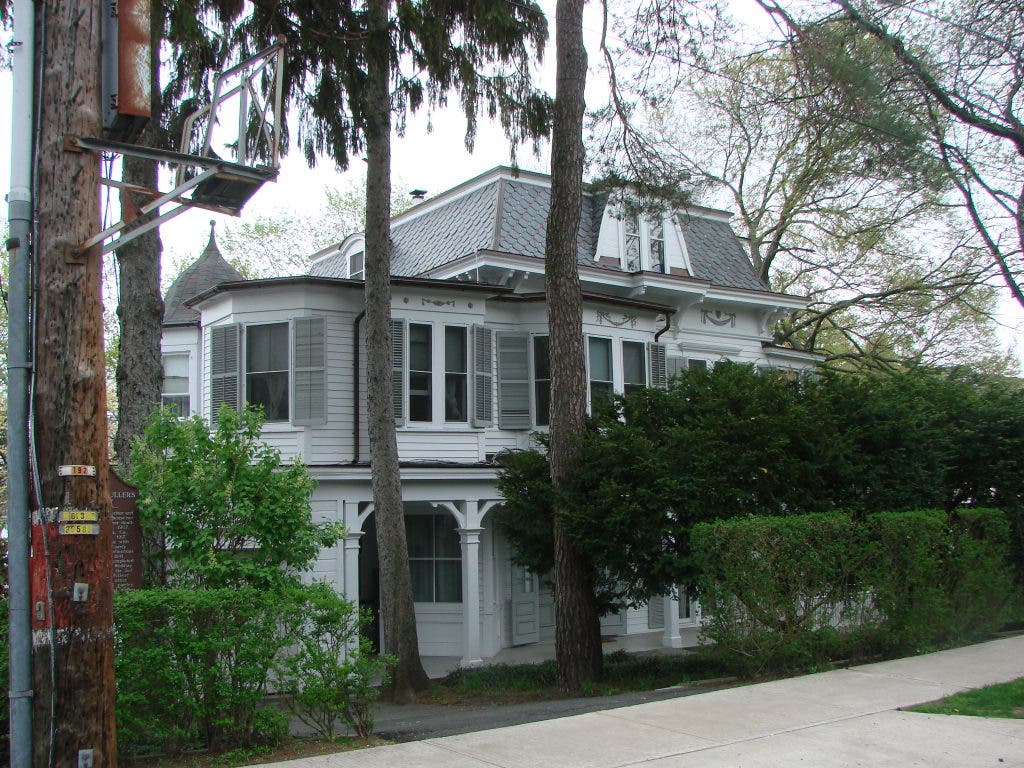
The place, the marker noted, was once the home of famed writer Carson McCullers, who lived there from 1945 until her death in 1967. The marker explains that McCullers completed her most famous work, The Member of the Wedding, while residing here, in addition to writing the Ballad of the Sad Café in 1951, Clock Without Hands in 1961 and several other plays, short stories and poems.
The next thing I did was feed a bit off of my daughter Stefanie’s love for theater, and headed to my local library to read the play-version of Ballad of the Sad Café, which McCullers and famed playwright Edward Albee tweaked for the stage. It was a fascinating read, and also aided my envisioning of McCullers hard at work at 131 South Broadway, perhaps writing the novel in longhand.
My next trip was to the , whose file on McCullers is extensive. I gleaned some basic information: construction on the home began in roughly 1871. Originally planned as a Methodist church, building operations ceased in 1873 due to a depression. The three-story house—which has a single level porch in front but double in back and many clapboards—went through various hands until purchased by Carsen McCullers’s mother in 1945. McCullers, who suffered with depression and illness during her almost-50 years, was helped by playwright Tennessee Williams, who provided funds for her to covert her house into five separate apartments so she could gain rent income. The cherry, dogwood and magnolia trees dotting the landscape were given to McCullers by artist Henry Varnum Poor. Local resident Dr. Mary Mercer, McCuller’s psychiatrist and close confidant, purchased the home in 1968 after McCuller’s death from a brain hemorrhage, and now rents the apartments to artists and writers, keeping a cultural, McCullers-like feel to the home.
I returned during on overcast day to take exterior photos of the house. A woman was exiting as I prepared to shoot a photo. “Excuse me, do you live here?” I asked.
“Oh no,” she responded. “I just work here.” When she asked why I inquired, and I told her my story, she looked noted, “Well, it’s quite a house.”
I turned back to 131 South Broadway, wandered in a neighboring driveway along its southern side, trying to get a good peek into the backyard without trespassing. I then returned to the front of the house, it sitting quietly just a block from the hustle of eateries and retail shops on South Broadway. The trees and bushes in front shielded the home, and I eventually reached the front walkway leading to the front door, and had an urge to go ring the bell or knock.
Something—maybe the thought of interrupting literary endeavors—just didn’t seem right. I instead took my final shots with my camera and returned to my car.