Community Corner
New Documentary Captures Human Impact Of Nyack's Urban Renewal Program
"What Happened to Jackson Avenue" offers accounts of the 124 families, mostly Black, who lost homes, businesses and accumulated wealth.


NYACK, NY — A new documentary, "What Happened to Jackson Avenue," offers real-life accounts of the human impact deeply felt by the 124 Nyack families, nearly 80 percent Black, who lost their homes, businesses and generations of accumulated wealth to eminent domain under Nyack's Urban Renewal Program in the 1960s.
"My father called it urban removal, which it really was," former Nyack resident Faith Blount says in the film.
Urban renewal projects irrevocably changed the landscape of American cities and villages in the 1950s and 1960s. Ostensibly to stimulate economic and social ‘revitalization,’ many of them resulted in the destruction of entire communities.
Find out what's happening in Nyack-Piermontfor free with the latest updates from Patch.
Blount grew up in the midst of Nyack's Urban Renewal Program, which as the documentary shows was highly touted by the village's White leaders.
Her family lived with her grandparents, who owned a house on Liberty Street that had their business attached. During urban renewal, they were given some compensation for the residence, but not for the business, which was their livelihood. Like many, they moved away.
Find out what's happening in Nyack-Piermontfor free with the latest updates from Patch.
.jpg)
The documentary was produced by the Phoenix Theatre Ensemble, a New York City-grown theater company now with a home and annual live arts Festival in Nyack.
The public screenings in Nyack are presented in collaboration with the Rivertown Film Society. The first screenings will be held at The Nyack Center, South Broadway and Depew Avenue, at 8 p.m. June 24 and July 7. Watch the trailer. Tickets are on sale now for $25 in advance and $35 at the door.
Panel discussions following the 60-minute screenings will give audiences opportunities to hear live from storytellers interviewed in the film, as well as the documentary creators. Nyack activist, artist and historian Bill Batson (also in the film) will moderate.
Batson's grandmother’s family, the Averys, moved to Nyack in the late 1800s. They lived through, and spoke out against, urban renewal. His family home on Jackson Avenue was a casualty.
In fact, inspiration for the new documentary sprang from a comment made by Batson in the summer of 2019 as he stood in the main parking lot at the center of the village (once Jackson Avenue).
.jpg)
That sparked two years of research, interviews, photography and editing by young filmmakers Hakima Alem and Rudi Gohl.
Batson told Patch he wanted to be a part of the documentary because he was impressed that the folks at Phoenix Theatre Ensemble were interested in exploring an accurate history of Nyack that didn't overlook marginalized people or the historic events that affected them.
"Not only did they explore that history, but they honored the testimonials that they recorded by creating a world-class documentary," he said. "My cousin who grew up on Jackson Avenue just saw the film and was moved to tears by it."
Nyack was not alone in the Hudson Valley. The University of Richmond's digital project, "Renewing Inequality: Family Displacements through Urban Renewal, 1950-1966" takes a deep look at the local impacts of the federal policy that reshaped more than six hundred cities and towns well into the 1970s.
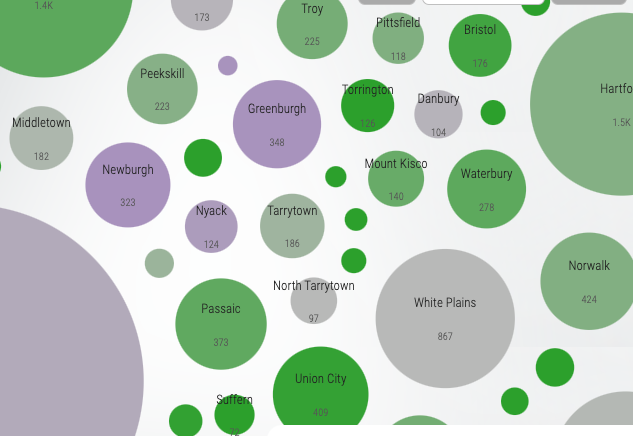
Batson said the urban renewal program was a model for atrocities elsewhere.
"While doing research in the archives in Cape Town, South Africa, I learned that the architects of Apartheid studied urban renewal as a template for their racial forced removal program," Batson told Patch. "They also studied our reservation system, used to steal land from Native Americans and isolate their communities, for their homeland program where native Africans were internally banished from 1948 until Mandela's election in 1994."
Get more local news delivered straight to your inbox. Sign up for free Patch newsletters and alerts.