Crime & Safety
NY Officials Issue COVID-19 Vaccination Scam Warning
If you get a text message about confirming your vaccine status that seems to be from the state: Delete it right away.


NEW YORK, NY — A new scam has begun making the rounds since governments and businesses in New York began mandating their employees be vaccinated against COVID-19, state officials warned Tuesday.
The New York State Division of Consumer Protection and the New York State Department of Health said a text message phishing scheme to try to steal personal information is targeting people who are attempting to validate their vaccine status.
Phishing texts are fraudulent messages to trick you into installing malicious software onto a computer or mobile device or to obtain your sensitive personal information to commit identity theft.
Find out what's happening in Nyack-Piermontfor free with the latest updates from Patch.
The state and many private companies, particularly in the health care sector, recently required certain employees to be fully vaccinated — and scammers are exploiting those policies.
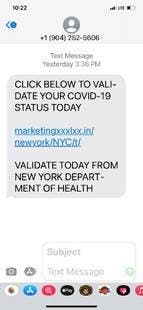
The illegitimate text message shown below attempts to impersonate the NYS Department of Health and tells the recipient they are required to enter their information to validate their vaccination status.
Find out what's happening in Nyack-Piermontfor free with the latest updates from Patch.
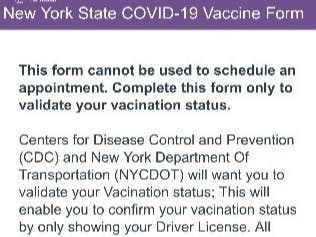
The form the message links to (shown above this article) is also a sophisticated fake.
Anyone who receives such a text message should delete it right away.
Scammers use email or text messages to trick you into giving them your personal information. They may try to steal your passwords, account numbers, or Social Security numbers. If they get that information, they could gain access to your email, bank, or other accounts.
Scammers launch thousands of phishing attacks like these every day. Entering any information could put you at risk of identity theft.
To help protect against phishing or smishing (SMS phishing) scams, the NYS Office of Information Technology Services and the Division of Consumer Protection recommend the following precautions:
- DO exercise caution with all communications you receive, including those that appear to be from a trusted entity. Inspect the sender’s information to confirm the message was generated from a legitimate source.
- DO keep an eye out for telltale signs of phishing - poor spelling or grammar, the use of threats, the URL does not match that of the legitimate site. If the message does not feel right, chances are it is not.
- DON’T click on links embedded in an unsolicited message from an unverified source.
- DON’T send your personal information via text. Legitimate businesses will not ask users to send sensitive personal information through text message.
- DON’T post sensitive information online. The less information you post, the less data you make available to a cybercriminal for use in developing a potential attack or scams.
For more information on phishing scams, as well as steps to mitigate a phishing attempt, visit the NYS Office of Information Technology Services Phishing Awareness resources page or the Division of Consumer Protection Phishing Scam Prevention Tips page.
The New York State Division of Consumer Protection serves to educate, assist and empower the State’s consumers. For more consumer protection information, call the DCP Helpline at 800-697-1220, Monday through Friday, 8:30am-4:30pm or visit the DCP website.
Get more local news delivered straight to your inbox. Sign up for free Patch newsletters and alerts.