Schools
OHS Senior Is Among 40 Finalists in Regeneron Science Competition
Michael Pavelchek advances in the prestigious Regeneron Science Talent Search, the oldest science and math competition in U.S.
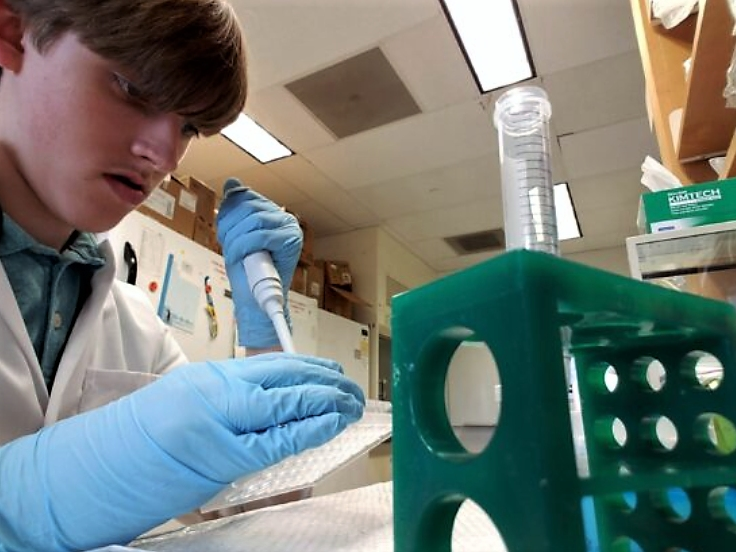
Ossining High School senior Michael Pavelchek is one of 40 finalists in the prestigious Regeneron Science Talent Search for his research on allergic asthma.
Earlier this month, Michael and six other OHS seniors in the Science Research Program were selected as semifinalists for the 80th annual contest. Regeneron and the Society for Science chose 40 students from the top 300 scholars to advance to the finals, which will take place virtually due to the ongoing COVID-19 pandemic, from March 10-17. They will compete for more than $1.8 million in awards; each finalist will receive at least $25,000.
Michael studied immunoglobulin E (IgE) plasma cells, which are the primary cause of inflammation in allergic asthma. They are produced from immunoglobulin G1 (IgG1) memory B cells through a process called sequential switching. After learning of a recent finding that there are two sub-populations of immunoglobulin G1 Memory B cells – one that produces IgE inflammatory cells and one that does not – he researched whether key genes involved in the production of the inflammatory cells were different in the sub-populations. Through research on mice, he found that the genes Swap70 (switch associated protein 70) and the Myc protein-coding gene were key to the production of the inflammatory cells.
Find out what's happening in Ossining-Croton-On-Hudsonfor free with the latest updates from Patch.
“As current long-term treatments for allergic asthma remain limited, drugs that target genes such as Swap70 and Myc could be used as treatments for allergic asthma,” he wrote in his research summary.
The 2021 finalists, including six from New York, were selected from 1,760 students who entered an original research project. They were chosen based on their projects’ originality and scientific rigor; their potential to become world-changing scientists and leaders; and their achievement and leadership inside and outside the classroom.
Find out what's happening in Ossining-Croton-On-Hudsonfor free with the latest updates from Patch.
“This year’s finalists represent many of our nation’s most promising young scientists who, even during a global pandemic, are using their ingenuity, resourcefulness and STEM skills to work toward a better future,” said Dr. George D. Yancopoulos, co-founder, president and chief scientific officer of Regeneron, and a top winner in the 1976 Science Talent Search.
Michael conducted his research in Dr. Maria Curotto de Lafaille’s lab in the Icahn School of Medicine at Mount Sinai Health System in New York City. He contacted Dr. Curotto, an associate professor in pediatrics, allergy and immunology, after reading some of her papers on asthma and immunology. He is particularly interested in these topics because he and his brother both have asthma and multiple allergies, but the severity of their reactions differs greatly. He spent the summer after his sophomore year in the lab, and he completed a computational component of the project last summer.
At OHS, Michael has been a member of the Engineering Club since his freshman year. This year, he is secretary and director of the electrical department. Outside of school, he is a Boy Scout and recently reached the rank of Eagle Scout. His Eagle Scout project entailed removing an old bridge at Teatown that had sunken into the ground, constructing a new bridge that allows for runoff, and removing invasive species.
Michael belongs to the Croton Sailing Club and enjoys visiting national parks. He has been to about 10 so far out of the hundreds of them, including Theodore Roosevelt National Park in North Dakota. “I want to visit all the national parks in my lifetime,” he said. “I really like nature and what you see in national parks is not something you’ll see other places.”
Michael said he is thankful to Science Research Program co-teachers Angelo Piccirillo and Valerie Holmes. They work closely with students and spend time with them on things like perfecting their speaking and presentation skills. “They’re there to help you, and they’re there to guide you,” he said.
Mr. Piccirillo said he and Ms. Holmes are especially grateful to all the scientists who mentor OHS students each year.
The other semifinalists from OHS were Charles Brown, Nicole Camilliere, Victor LaVaglia, Linlee Mangialardi, Leela Roye and Meagan Ryan. Semifinalists each received $2,000 awards for themselves and for OHS.