Schools
Ossining High School Receives National 'Schools of Opportunity' Silver Award
OHS is one of 20 schools in the U.S. and one of four in New York to be recognized for excellence by the National Education Policy Center.
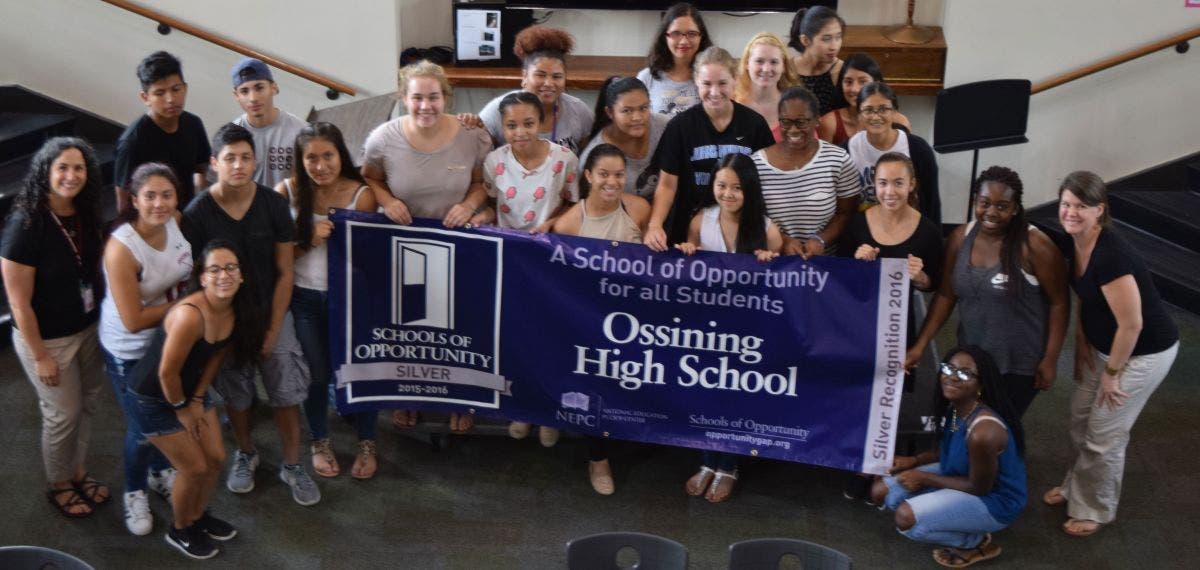
Ossining High School is one of only 20 schools from across the country to receive recognition as a 2016 “School of Opportunity.” The coveted national designation honors excellent public high schools that actively strive to close opportunity gaps and help all students succeed.
Opportunity gaps are the differences in opportunities and resources that drive achievement gaps, according to the National Education Policy Center at the University of Colorado, Boulder. “Schools of opportunity” are helping raise students’ achievement by closing opportunity gaps that are within districts’ control.
“Ossining High School has created a high expectation culture for its diverse student body through an array of innovative programming and comprehensive course offerings, and that stood out to the national team of reviewers,” said Carol Burris, “Schools of Opportunity” initiative co-director.
Find out what's happening in Ossining-Croton-On-Hudsonfor free with the latest updates from Patch.
The National Education Policy Center said two innovative programs in particular exemplify OHS’ commitment to providing opportunities for all students. One serves students with disabilities and the other is for language minority students.
“I am honored that our high school was selected,” Ossining Superintendent Raymond Sanchez said. “This award serves as recognition of our mission in the school district and the hard work and dedication of our high school staff.”
Find out what's happening in Ossining-Croton-On-Hudsonfor free with the latest updates from Patch.
The program for students with disabilities is not only academically challenging but also fosters an atmosphere in which each student, regardless of ability, is encouraged to acquire the skills necessary to become an independent, lifelong learner.
Eighty-three percent of Ossining’s special education students are placed in either mainstream classes with additional support or in “inclusion” classes co-taught by content and special education teachers. All students with disabilities are active participants in elective and extra-curricular programs.
Similarly, Ossining High provides culturally responsive pathways for language minority students. Through the integrated co-teaching model, an English as a New Language teacher and a content area teacher co-plan, co-teach, and co-assess students as they fully participate in classes with native English-speaking peers.
An emergent literacy program provides students with low literacy skills or interrupted formal education with accelerated instruction that integrates literacy and content learning. About a dozen students are in the program, which is in its second year. The school also offers a course for native Spanish-speaking students who are studying for a high school equivalency diploma.
OHS receives a lot of recognition for specific programs, but this award is for the school as a whole, Principal Joshua Mandel said. The school has outstanding staff members who want to innovate and embrace new teaching methods and programs, as well as a supportive community, school board and superintendent, he said.
“The staff never gives up on kids. They’re always willing to try new things and so is the community,” Mr. Mandel said. “The reason I really love this award is I think it’s recognizing a culmination of many people’s efforts to help kids.”
More than 100 high schools from 26 states applied for the designation this year. The National Education Policy Center piloted the program in New York and Colorado in 2015 and has expanded it to recognize schools nationwide that are committed to equity and excellence.
The “Schools of Opportunity” initiative goes beyond test scores to evaluate schools, such as how schools create and maintain healthy environments, broaden and enrich curriculum, and use a variety of assessments to respond to student needs.
“Research suggests that about one-third of variance among students’ test scores can be attributed to schools, with the remainder likely due to poverty-related factors,” said Kevin Welner, director of the National Education Policy Center and “Schools of Opportunity” co-director. “Because schools play this important but not controlling role in measured learning, the ‘Schools of Opportunity’ project rejects the idea that test scores identify the nation’s best schools.”
For more information about the “Schools of Opportunity,” visit www. opportunitygap.org.
(Photo credit: OHS seniors Alejandro Cabrera and William Ludlum.)