Weather
When Will The Smoke Clear From Long Island And The Hudson Valley?
"Tomorrow could possibly be even worse," Interim Health Commissioner James McDonald said in a briefing Wednesday afternoon.


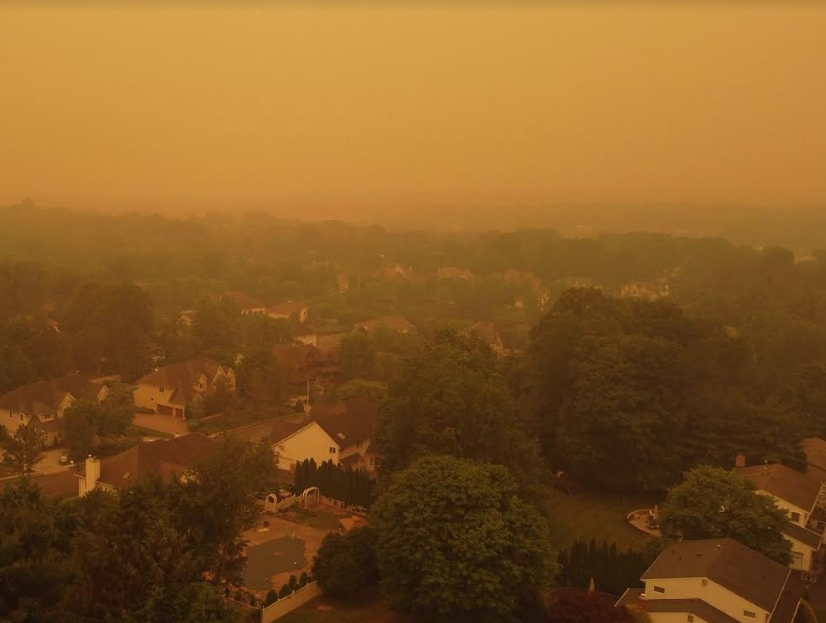
NEW YORK — Smoke blowing south from the wildfires raging in Quebec has brought downstate New York its worst air quality in decades, state officials said in a news briefing Wednesday afternoon.
"Yesterday everyone saw the Dickensian skies. Conditions seem to have worsened today," said Environmental Conservation Commissioner Basil Seggos.
"Tomorrow could possibly be even worse," Interim Health Commissioner James McDonald said.
Find out what's happening in Ossining-Croton-On-Hudsonfor free with the latest updates from Patch.
State officials have already issued an air quality health advisory for Thursday that includes the Hudson Valley, Long Island, New York City, eastern Lake Ontario and central and western New York. It urges people to limit outdoor activities.
"We don’t expect any relief from the fires that are burning across the provinces," Seggos said.
Find out what's happening in Ossining-Croton-On-Hudsonfor free with the latest updates from Patch.
How soon the smoke will dissipate is a top question on their minds. Unfortunately, the forecast does not call for rain in Quebec until possibly next week, they said. "Ultimately this is going to continue … likely through the weekend."
The smoke contains fine particulate matter — tiny solid particles or liquid droplets in the air that are 2.5 microns or less in diameter. PM 2.5 can be made of many different types of particles and often come from processes that involve combustion (e.g. vehicle exhaust, power plants, and fires) and from chemical reactions in the atmosphere.
"There’s a lot of things in the air from a wildfire," McDonald said. "Smaller than 2.5 microns — one of my hairs is probably 50 microns — you can’t see it with your naked eye. When objects are smaller than 2.5 microns they can migrate down into our lower respiratory tract easily."
Exposure can cause health effects such as irritation to the eyes, nose, and throat, coughing, sneezing, runny nose, and shortness of breath. Exposure to elevated levels of fine particulate matter can also worsen medical conditions such as asthma and heart disease. People with heart or breathing problems, and children and the elderly may be particularly sensitive.
Symptoms may not appear right away, McDonald said. You’re inhaling air that’s more polluted. It may take time for it to settle into the lungs and cause an inflammatory reaction. You might wake up tomorrow or Friday with a cough.
Staying indoors may reduce exposure, though if there are significant indoor sources of PM 2.5 (tobacco, candle or incense smoke, or fumes from cooking) levels inside may not be lower than outside.
Some ways to reduce exposure are to minimize outdoor and indoor sources and avoid strenuous activities in areas where fine particle concentrations are high.
McDonald pointed out that the AQI index had been accelerating rapidly. In Syracuse, it was over 300 Wednesday morning. (Air quality alerts are issued when the AQI goes over 1o0.)
As for the Hudson Valley: The AQI near Kingston at 3 p.m. was 224. It was 221 in Pomona and 263 in North Salem.
On Long Island: the AQI was 235 near Glen Cove, 220 near Merrick and 170 near Holtsville.
He recommended people check their local AQI number and recommended AirNow.gov.
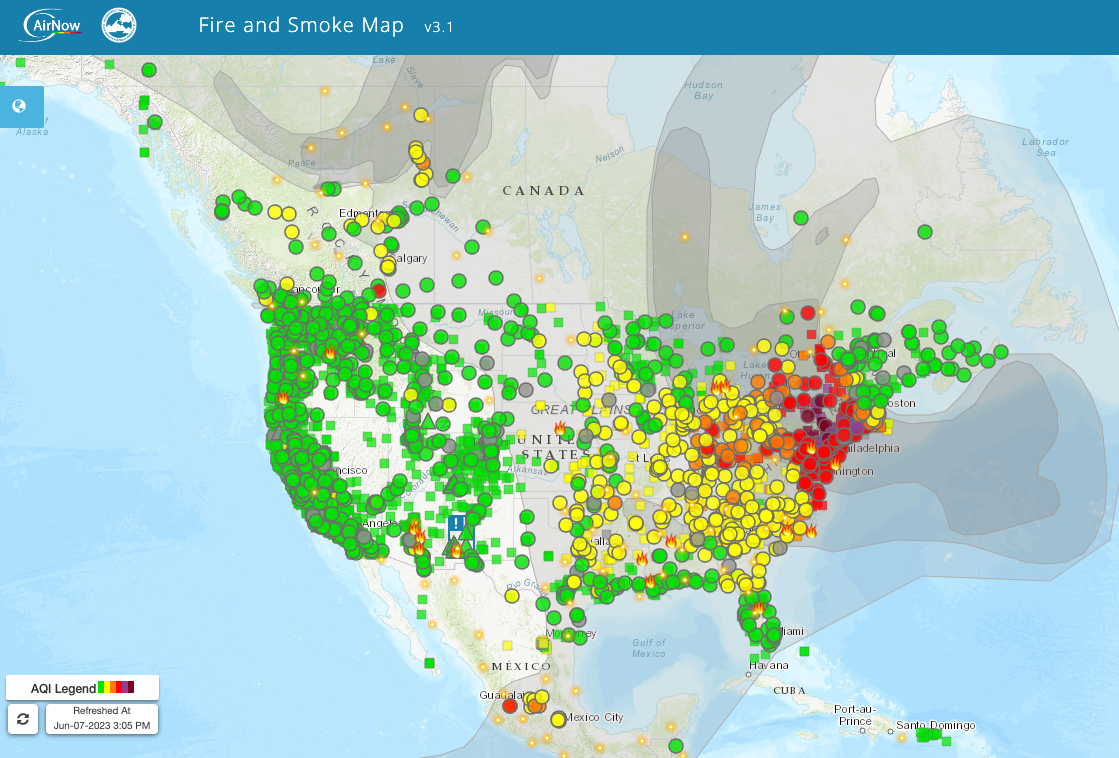
"If it’s over 300 I would wear a mask," McDonald said. "If you have to go outside, a mask is a way to protect yourself. When you filter the air you breathe, the particles aren’t getting into your respiratory system. So you’re not getting clogged up and … put at risk."
Use the best quality mask available to you, he said.
"Conditions will dictate the actions folks need to take," Seggos said.
The New York State Department of Labor’s Division of Worker Protection on Wednesday encouraged employers located in regions with Air Quality Health Advisories in effect to limit outdoor work and activities that require exertion. Industries with workers who may be especially susceptible to the impacts of the Canadian wildfire smoke exposure include farming and agriculture, construction, landscaping, highway maintenance, and other fields that require outdoor heavy-exertion labor.
A slight shift could be coming soon, AccuWeather Director of Forecasting Operation Dan DePodwin said. "On Thursday and Friday, the worst smoke and related air quality is expected to shift west across the Great Lakes and parts of Ohio Valley and interior Northeast including the cities of Buffalo, Pittsburgh, and Detroit."
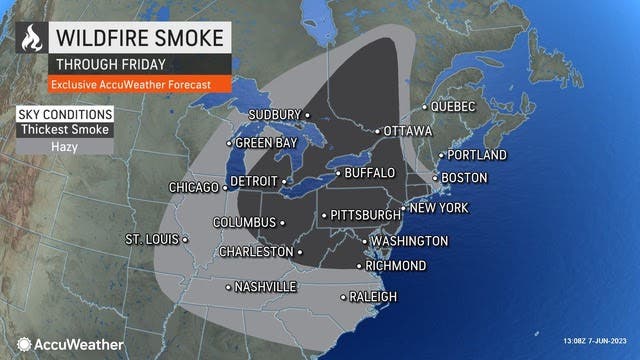
DePodwin added, "Later this weekend into early next week, a storm moving through the Ohio Valley may cause the smoke to wrap westward across the Great Lakes and then southward through the Ohio Valley and into the mid-Atlantic. This behavior - where a storm 'ingests' smoke and transports it far away from the fires - occurred in May with fires in Alberta and can result in a 'smoke storm.'"
In a briefing Wednesday afternoon, New York Gov. Kathy Hochul said, "This is expected to go for the next few days. There was some thought yesterday that this would abate by Friday. I just received an update minutes ago that that is not expected. So people need to prepare for this over the long haul. And again, we can all feel it. It is an effect - one of the collateral damages of climate change. It's an environmental crisis, and I just want to make sure all New Yorkers are aware of this. You may not see it. You may not even feel it. But it is having a negative effect on everyone. So please take precautions throughout our state."
Literary reference: In "Our Mutual Friend,"Charles Dickens wrote, "Inanimate London was a sooty spectre, divided in purpose between being visible and invisible, and so being wholly neither. Animate London, with smarting eyes and irritated lungs, was blinking, wheezing, and choking."
SEE ALSO
- Westchester Implements Safety Measures Due To Canadian Wildfires
- Peekskill Area Schools Alter After-School Activities Wednesday
- Hastings Closes All School Buildings, Facilities At End Of Day
- Smoky Haze Triggers Early Dismissals At Chappaqua Schools
- Ossining Cancels After-School, Evening Activities
- Quebec Wildfires Cause 2nd Day Air Quality Alerts In The Hudson Valley
Get more local news delivered straight to your inbox. Sign up for free Patch newsletters and alerts.