Community Corner
There’s No Excuse, Reduce Your Use!
Long Island Water Conference Partners with DEC, AWWA and IANY for Water Conservation Announcement as High-Demand Irrigation Season Begins
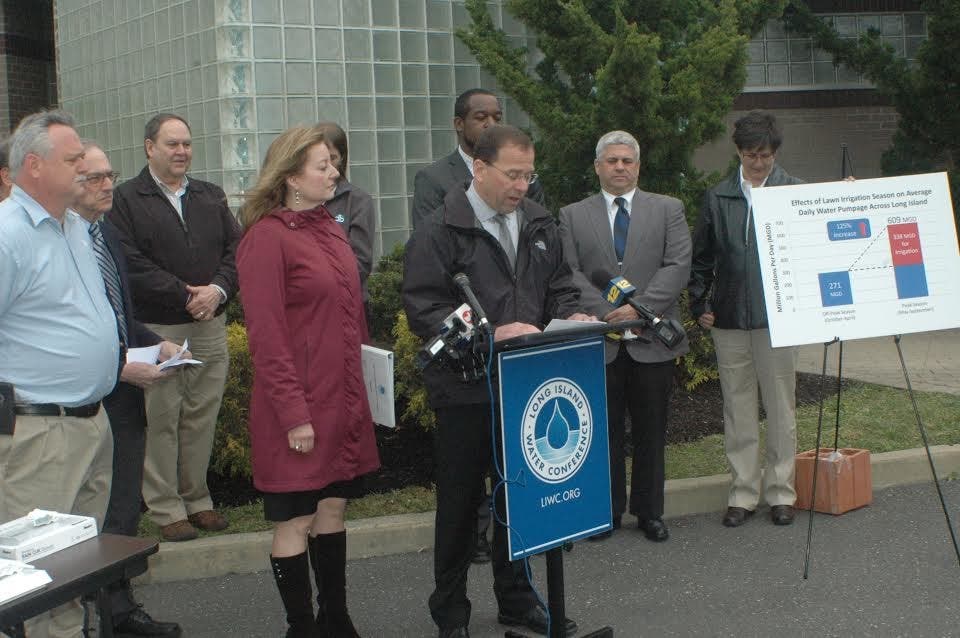

Massapequa, New York (April 19, 2017) – The Long Island Water Conference, in partnership with the New York State Department of Environmental Conservation (DEC), the American Water Works Association (AWWA) and the Irrigation Association of New York (IANY), today held a press conference to discuss the massive spike in water usage caused by irrigation systems. Across Long Island, water providers pump approximately 125 percent more water each day between May and September, and this increase is an exclusive result of irrigation system consumption.
“During the irrigation season, Long Island water providers collectively pump an average of 338 million more gallons of water each day,” said Long Island Water Conference Chairman Stan Carey. “This increase is directly associated with the volume of water needed to supply our irrigation systems. Unfortunately, what most don’t realize is a significant portion of this water is wasted by inefficient and mismanaged irrigation systems. Today’s announcement serves to raise awareness for the simple ways homeowners can become part of our island-wide conservation effort to protect our most precious natural resource.”
As part of its daily mission, the DEC works hard to ensure Long Island’s sole-source aquifer is not only properly protected, but remains sustainable for the indefinite future. During today’s announcement, the DEC outlined its program requiring all water providers submit plans to reduce system-wide water usage by 15 percent.
Find out what's happening in Oyster Bayfor free with the latest updates from Patch.
“DEC is proud to be working with the Long Island Water Conference, American Water Works Association (AWWA) and Irrigation Association of New York (IANY) to educate the public on best irrigation practices,” Region One DEC Regional Director Carrie Meek Gallagher said. “This event shows the seriousness with which water districts across Long Island are taking on the challenge of reducing summer water consumption. While we all would like a green lawn the simple fact is that much of water being used to achieve this goal is in fact wasted water with much of it simply evaporating. Protecting and making sure there are plentiful water resources for all Long Islanders is one of DEC’s most important missions and water districts should be proud of the steps they are taking towards achieving this goal.”
A 15 percent reduction in overall water usage is an achievable goal as much of the water pumped from Long Island’s aquifer during the irrigation season is wasted due to inefficient irrigation systems, irrigation system leaks, lack of irrigation system monitoring, and over watering. Smart irrigation system controllers marked with an Environmental Protection Agency (EPA) WaterSense logo are one technological solution to many of the deficiencies with the typical irrigation system.
Find out what's happening in Oyster Bayfor free with the latest updates from Patch.
“Smart controllers are the brains of the irrigation system,” said Mike Dwyer, representative from IANY. “They analyze weather data and adjust the length of time each zone in the system needs to run. The use of smart controller technology, on average, saves about 30 percent of water use and eliminates the need for homeowners to manually alter sprinkler run times based on the weather conditions.”
“The Massapequa Water District recently launched a pilot program offering a rebate of $100 to the first 12 customers who install a smart irrigation system controller,” added Carey, who is also the Superintendent of the Massapequa Water District. “It is expected that the installation of these 12 units will save hundreds of thousands of gallons of water this irrigation season. Imagine the savings we would achieve if every sprinkler system on Long Island implemented this type of technology.”
New technology is having an enormous impact on water conservation efforts; however, it is not the only solution. Better management of the typical, manual irrigation system controller can also have a noticeable impact. With regards to irrigation timers, “set it, but don’t forget it.” Irrigation systems with manual timers should not be set at the beginning of the season and left untouched until they are turned off at the end of the season. Irrigation timers should be adjusted frequently throughout the season to compensate for varying temperatures and weather patterns. Rain sensors should also be installed to prevent irrigation systems from unnecessarily watering lawns while rain is in the forecast.
“In recent years, many parts of the nation have been subjected to periods of prolonged drought, such as areas of California, Texas and Florida,” said AWWA representative Paul Ponturo. “In these areas, water conservation has become a way of life. Long Island, like much of New York State, is blessed with a vast source of fresh water and, as a result, many in our area may not consider water conservation to be a critical issue. This line of thinking needs to change, and we must approach a shifting reality that a safe and protected water supply must not be taken for granted and must be valued as a critical, and not infinite, resource.”
Some municipalities have implemented policies limiting irrigation water usage during times of peak demand. Nassau County has an ordinance in place which restricts outdoor water usage to odd-numbered days for odd-numbered houses and even-numbered days for even-numbered houses. Additionally, outdoor water usage is not permitted between the hours of 8:00 a.m. and 6:00 p.m.
“We hope this information can inspire Long Islander’s to work with their irrigation providers, learn how to adjust their irrigation system controllers, and make simple changes to their watering habits that will have an enormous impact on their daily water usage,” Carey concluded. “The modifications we make today will have a noticeable impact on the future generations of Long Islanders, as there is no time better than the present to make changes that will protect our sole-source aquifer and our most precious natural resource.”
The Long Island Water Conference (LIWC) is an alliance of 50 Nassau and Suffolk public drinking water purveyors, and other industry professionals, who supply potable water to over 3 million people. The organization is dedicated to ensuring that a clean, safe, and abundant water supply is maintained for all Long Islanders. Since its inception in 1951, the Long Island Water Conference has touched all phases of water supply and management in Nassau and Suffolk Counties. Members include the major water suppliers, both public and private, on Long Island. Together they serve virtually 90 percent of the bi-county area, which has a population greater than 20 states.