Politics & Government
The Future of Fourth Avenue
Local government and the community have high hopes for Fourth Avenue, but will it ever get there?



Walking through Park Slope, there is a certain amount of cohesiveness. Most of the streets are shaded, they're shockingly (by New York standards) litter-free, and even during odd hours of weekdays, they bustle with signs of urban life.
Fourth Avenue, however, does not share the same traits as the neighborhood's other streets.
Much of the time, it borders on desolate, and harsh light reflects off the tree-less sidewalks as six lanes of traffic zip along at well over the speed limits. At times it feels like a barren dessert; passage through it only necessary if you're headed to Carroll Gardens or Cobble Hill.
Find out what's happening in Park Slopefor free with the latest updates from Patch.
Extending for 6.2 miles from Downtown Brooklyn to the Verrazano Bridge and crossing through four neighborhoods, including Park Slope, Fourth Avenue is the third most dangerous avenue in Brooklyn.
Not everyone, though, views the avenue through such a dismal lens.
Find out what's happening in Park Slopefor free with the latest updates from Patch.
One of the organizations that has been particularly instrumental in creating a conversation surrounding Fourth Avenue has been the Park Slope Civic Council. In March it hosted a public forum on the future of Fourth Avenue, and last month, a walking tour of the avenue that drew 65 people despite the early hour and dipping temperatures.
The PSCC has come to a few conclusions. Mainly, they found the avenue was badly in need of commerce, beautification and traffic-calming measures.
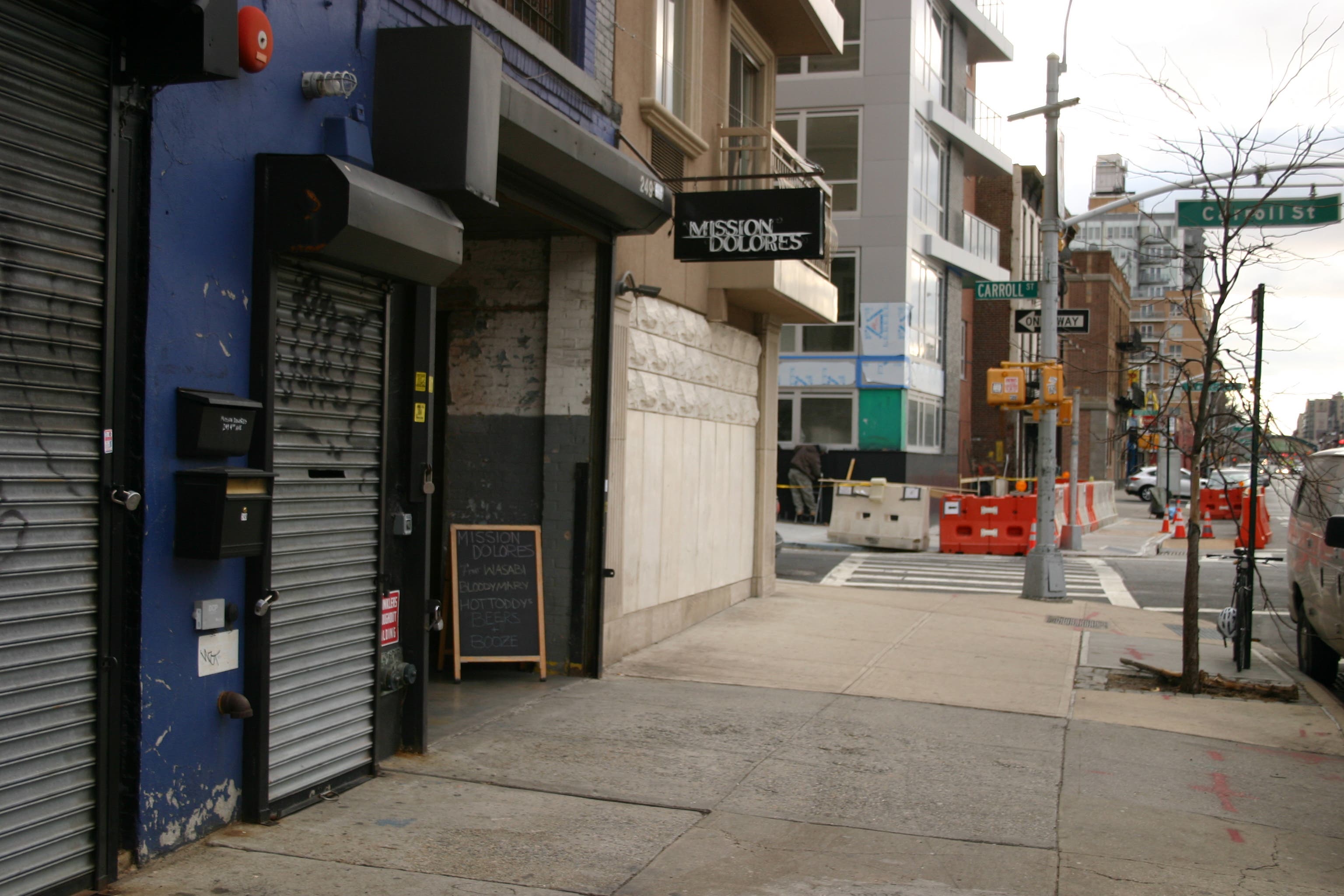
Today, little has been done for Fourth Avenue other than plan for its future. Still, new businesses like the Rock Shop, a music venue, and Mission Dolores, a craft beer bar, are beginning to creep onto the avenue and draw people not just to Fourth Avenue from Fifth, but from Manhattan as well.
Even in the few short months since Mission Dolores opened in April, owner Ben Wiley has seen progress on the avenue: stalled condominium developments have started construction again, new businesses have opened up and brought more people to the street.
"There's just a little more for people to come and do down here," said Wiley. "You do see little crews of people who come down Carroll off of Fifth Avenue, even though they could stay on Fifth and eat and drink at many places." Wiley hopes that the future will bring even more restaurants, bars, people, and "some cool, cute Park Slope shopping," noting it would be good for the businesses, the residents and neighborhood safety.
Said Wiley, "Anything is better than what we have now, but we're on the right trajectory."
Last year, Brooklyn Borough President Marty Markowitz partnered with NYU Wagner Graduate School to formulate a detailed, 84-page vision plan for the Fourth Avenue corridor, in hopes of transforming the avenue from a "a 'traffic chute' into a grand 'Brooklyn Boulevard.'"
He earmarked $2 million in funding to improve the intersection of Fourth Avenue and Ninth Street, in hopes of getting the ball rolling.
"It is my hope that this initial $2 million pilot project to improve the intersection of Fourth Avenue and Ninth Street will serve as a model, showcasing the potential to create safer conditions all along this roadway and make it a beautiful thoroughfare that better serves residents and communities," he said, imagining that the bleak roadway could become something akin to Park Avenue on the Upper East Side.
Markowitz's plan, more an academic study of what's possible than a call to action, envisions a better Fourth Avenue through measures similar to what the PSCC suggested: traffic-calming measures, streetscaping, the creation of retail opportunities, placemaking and wayfinding improvements, and community partnerships.
Josh Levy, a trustee on the PSCC and point man for Fourth Avenue at the PSCC, said that one of the main problems of the avenue is real estate that is insensitive to the need to foster a social community environment.
He points out buildings like the mega-condo The Argyle, which scrapped retail on the first floor in favor of a park garage, meaning huge metal ventilation grates face the street. He sees the Novo condos (in which he owns real estate) as the opposite example: the building is tasteful, features ground level retail, and the residents are an active part of the community, helping to maintain J.J. Byrne Park adjacent to the building.
Council Member Brad Lander (D-Park Slope) is even pushing for a zoning change for Fourth Avenue, requiring active ground floor uses on lots facing the avenue, as opposed to just driveways or parking garage entrances.
"We don't have any good retail stores. Something like a grocery store would be great," said John Rauschenberg, who opened the bar on Fourth Avenue and St. Marks Place in 2007. "It seems to me that the only plan is just housing."
For his part, Craig Hammerman, the District Manager for Community Board 6, agrees.
"The current city administration put their vision out their in 2003 when they rezoned the avenue. They thought that Fourth Avenue had potential to be a canyon of new residential areas," he said. "Unfortunately, a lot of these new building are not punctuating the area with usable space."
The city rezoned Fourth Avenue in 2003 to act as a sort of relief valve, giving big developers somewhere in Park Slope to build besides the neighborhood's brownstone blocks.
"I think that it was working fairly well if goal to was just to produce more housing units, but our goal is to balance the social and economic needs of the neighborhood and housing is just one component," said Hammerman.
Still, the rezoning was the first step in bringing development to the avenue, and can only be followed by residents, commerce, and other big developments, such as the recently announced Whole Foods, coming to nearby Third Avenue.
Carl Hum, president of the Brooklyn Chamber of Commerce, thinks that with recent hotel and restaurant developments, the avenue is already well on its way.
Nonethless, Fourth Avenue lies at the center of many complex developments—be it the Gowanus Canal, the Waterfront Plan or the Atlantic Yards arena, any future development will have to consider this complex matrix of progress.
"Fourth Avenue is going to continue to develop. The question is whether there is a greater purpose in design, or whether it just happens as the market dictates," said Hammerman. "My continuing mantra is that we can do better."
That, it seems, is the one thing everyone can agree upon.
Get more local news delivered straight to your inbox. Sign up for free Patch newsletters and alerts.