Crime & Safety
'Disgusted' Long Island Artist In Shock Over Sculpture's Theft
"I'm really disgusted someone would do this.": Artist says of stolen piece dedicated to respect for indigenous peoples' land sovereignty.


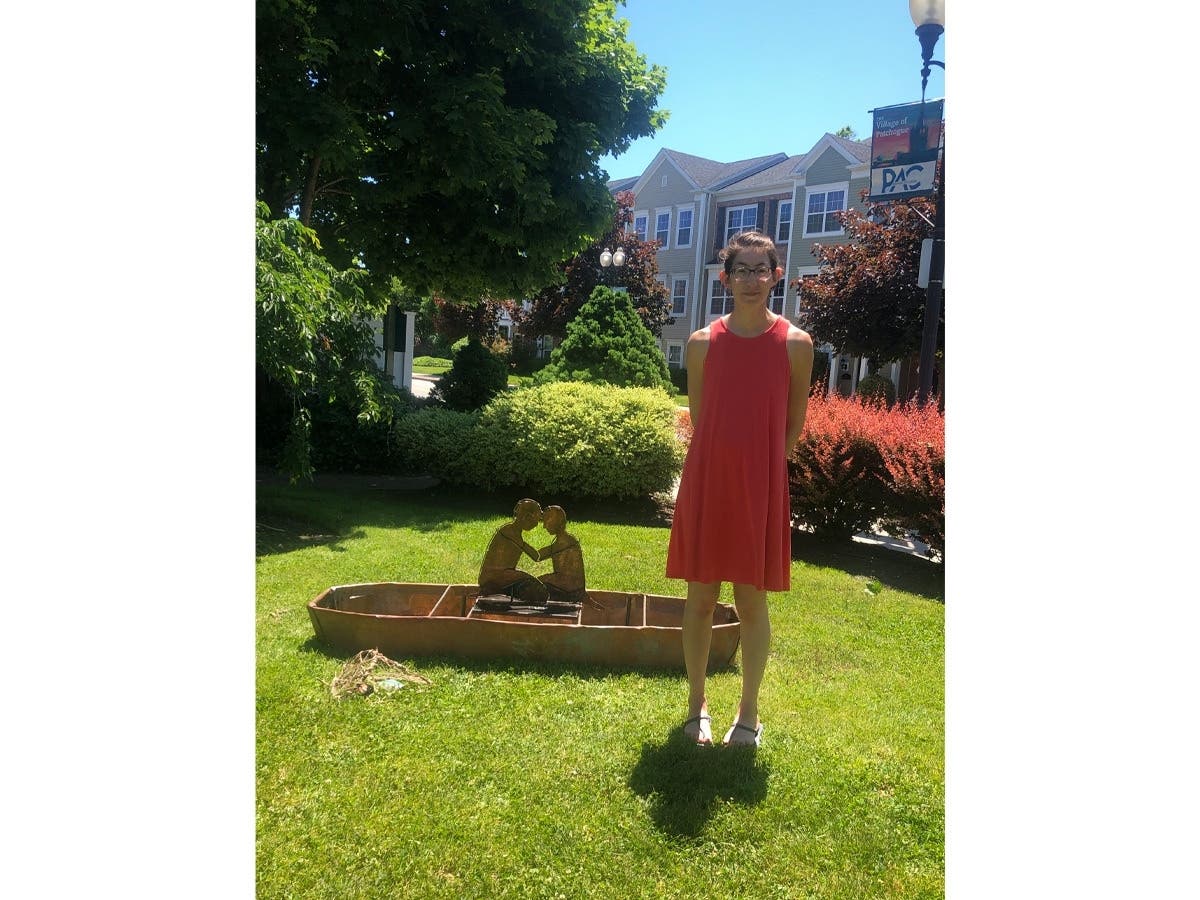
PATCHOGUE, NY — For three years, Hawaiian artist Pauline Leilani Badamo had a recurring dream of two people embracing as their foreheads touched one another while seated in a canoe on the water.
The pair had been performing an ancient greeting ritual called honi, and that exchange of breaths, or ha, is supposed to represent spiritual connection and one of responsibility.
"If you have traveled apart from your family, or your ohana, that's the way island people greet each other," Badamo, 33, of Deer Park recalled.
Find out what's happening in Patchoguefor free with the latest updates from Patch.
It was a scene that she wanted to bring to life.
"It was a really strong vision that I had for a long time," she added.
Find out what's happening in Patchoguefor free with the latest updates from Patch.
When a friend told Badamo about the Patchogue Arts Council's open call for submissions for its outdoor summer installation, she felt it was the "perfect opportunity to create the sculpture that I had in mind for some time."
The concept for her sculpture, "Kuleana," meaning responsibility, was beginning to take corporeal form and it took about two months to finish.
Badamo welded a steel frame for the piece and then used a combination of copper and rebar to take the shape of a canoe with the silhouette of two figures in their sacred exchange. Beneath the ridge of the vessel, Badamo used Sodium Chloride to etch a description of the piece in Hawaiian and English.
The rough English translation explains that there was a beginning, "and the beginning was darkness, and we were here in the beginning and the foreigners came, and they took our land."
"The rest of it is basically a call to action to gain back land sovereignty," she added.
Badamo was born in Hawaii, and generations of her grandmother's family can be traced back to the Hana people in Maui and Wailuku.
"Kuleana" was installed in a small pocket park at the corner of South Ocean Avenue and Terry Street in Patchogue as part of the village's annual outdoor art installation project, and it was meant to remain there until the fall. But when Badamo went to check on it about three weeks ago, the piece was not where she left it.
In hopes that maybe it was moved for some reason, Badamo checked with the arts council, but no one there had moved it.
She realized the piece that she put so much into, had been stolen and she filed a report with the Suffolk County Police Department.
"It was an incredibly personal piece," she said. "To be honest, I'm still, like, in shock about the whole thing. I am really disgusted that someone would do this."
To her, there's a level of disregard and disrespect that is strange.
"'Kuleana' is about appreciating indigenous cultures and values, which are about taking care of the lands," Badamo said.
"And that is why I made it a canoe because the Hawaiian people were seafarers and travelers and stewards of the land, and so are the Shinnecock Native Americans, you know, the native New Yorker tribes," she said. "The canoe kind of tied that whole tide."
The canoe was symbolic of the connection to water and how much depended on it, Badamo said.
"But also a big part of the sculpture was really to express this movement for land sovereignty, because currently in both Hawaii and here on Long Island, it's ongoing," Badamo said.
Kuleana is a high value in Hawaiian spirituality, Badamo explained.
"It's like your mana, which is your life energy, like your well-being," she said. "But also kuleana is a communal concept, as well, meaning you are supposed to take care of yourself and your community. And, that means that you do that by taking care of the land."
But the land is a combination of entities — it's the earth, ocean, the sky, and all creatures, according to Badamo.
"So, if you take land, or if you take food, or if you take someone's language from them, you are cutting off their spiritual connection to their way of life and way of being, which is something that is still being done in Hawaii," she explained.
Current issues Hawaii is facing includes a U.S. Navy jet oil spill that has seeped into the water in Oahu and the placement of telescopes on sacred land on Mauna Kea.
"There's big money involved," Badamo said. "And I feel like the same thing has happened here on Long Island where there's a lot of vineyards; there's a lot of golf. There's a lot of native land that has been stolen, basically, and people that are making money or other people that have exploited cultures and stolen this land and are profiting from it."
Janine Tinsley-Roe, of the Shinnecock-Sewanhaka Society in Bellport, said the area where the sculpture was located was once Algonquin land and the theft violates the agreement the British colonists made with the local leader at the time, Tobaccus.
The agreement provided that the native peoples in the area would be respected and allowed to continue their way of life.
For someone to take something with historical significance showed "disrespect to native people," Tinsley-Roe said.
Badamo said she is thankful that she had the opportunity to share "Kuleana," particuliarly at the Southampton Arts Center where she was in a show with artists from the Shinnecock Indian Nation.
"It was a really wonderful experience for me to connect with other indigenous artists, and to not feel so isolated," she said. "I think that being an artist can be very isolating ... I feel most comfortable working alone, when I am making my pieces and things like that. But I think that also having community or being in touch with other artists is really important to just like, share ideas, and to just feel."
Badamo imagines that whoever stole "Kuleana" did not make much from the scrapper as she bought her materials — mostly steel rebar — cheap.
"So, even more difficult for me to swallow is knowing that whoever stole it scrapped it," she said. "My only silver lining, trying to be positive is I really hope it was someone who really needed the money for something important."
At first, Badamo was angry, but now she is "more sad, very disappointed, and heartbroken."
But is she hopeful there's a chance she will get the sculpture back?
"That would be amazing," she said. "But I think at this point, I have already made my mind up that whoever took it, probably scrapped it and it's gone."
Badamo also said it is unlikely that she would make another one, as she is already involved with other projects.
And there is a lesson in all of this.
"You can't hang on so tightly to things," she said. "Of course, it hurt me very deeply, but I am not going to allow it to get me. I am going to use it as motivation."
Suffolk police are asking anyone with information about the theft of "Kuleana" to contact Crime Stoppers at 1-800-220-TIPS. A cash reward is being offered for information leading to an arrest in the case.
Get more local news delivered straight to your inbox. Sign up for free Patch newsletters and alerts.