Home & Garden
Air Quality Health Advisory Issued for Fathers Day
The Air Quality Index is forecast to go orange.


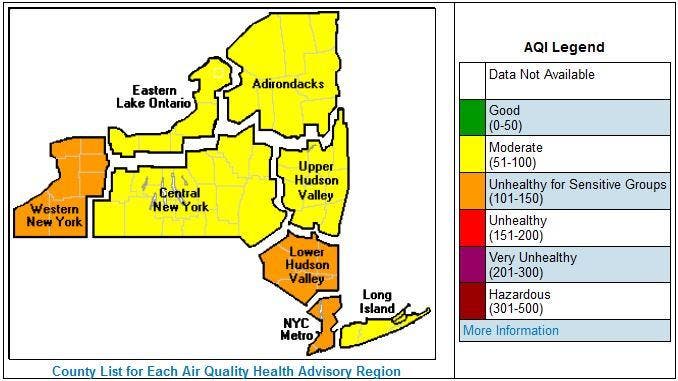
An Air Quality Health Advisory has been declared for Sunday in the Lower Hudson Valley by the New York Department of Environmental Conservation.
June 19 will be "unhealthy for sensitive groups" due to high ozone levels, officials said.
While high ozone levels are normally restricted to the warm season, fine particles can be high at any time of year. These pollutants arise from sources such as cars, trucks and power plants, with fine particle levels also enhanced by forest fires and residential burning. To help reduce pollution levels, refrain from unnecessary driving and use public transportation if available.
Although the general public is not likely to be affected at the Orange AQI range, people with lung disease, older adults and children are at a greater risk from exposure to ozone, and all of them as well as people with heart disease are at greater risk from the presence of particles in the air.
Find out what's happening in Peekskill-Cortlandtfor free with the latest updates from Patch.
The Air Quality Index is at moderate today -- yellow -- but expected to jump on Fathers Day.
Today and Tomorrow's Forecast
- Saturday, Jun 18: 51 AQI - Moderate (Ozone)
- Sunday, Jun 19: 120 AQI - Unhealthy for Sensitive Groups (Ozone)
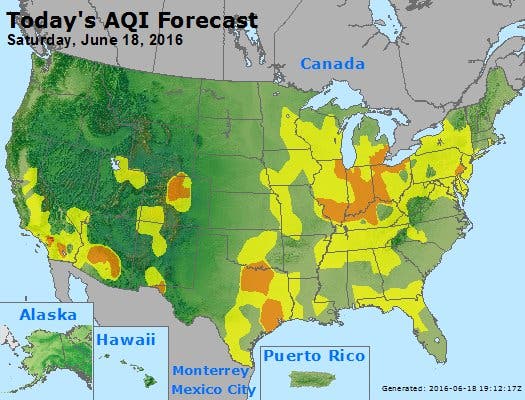
According to the Environmental Protection Agency, the AQI is an index for reporting daily air quality. It tells you how clean or polluted your air is, and what associated health effects might be a concern for you.
Find out what's happening in Peekskill-Cortlandtfor free with the latest updates from Patch.
The AQI focuses on health effects you may experience within a few hours or days after breathing polluted air. EPA calculates the AQI for five major air pollutants regulated by the Clean Air Act: ground-level ozone, particle pollution (also known as particulate matter), carbon monoxide, sulfur dioxide, and nitrogen dioxide.
For each of these pollutants, EPA has established national air quality standards to protect public health .Ground-level ozone and airborne particles are the two pollutants that pose the greatest threat to human health in this country.
How Does the AQI Work?
Think of the AQI as a yardstick that runs from 0 to 500. The higher the AQI value, the greater the level of air pollution and the greater the health concern. For example, an AQI value of 50 represents good air quality with little potential to affect public health, while an AQI value over 300 represents hazardous air quality.
An AQI value of 100 generally corresponds to the national air quality standard for the pollutant, which is the level EPA has set to protect public health. AQI values below 100 are generally thought of as satisfactory. When AQI values are above 100, air quality is considered to be unhealthy-at first for certain sensitive groups of people, then for everyone as AQI values get higher.
MAP: NYDEC
Get more local news delivered straight to your inbox. Sign up for free Patch newsletters and alerts.