Neighbor News
America at 250: Baseball as a National Archive
How Cooperstown reveals the national pastime as a record of rules, belonging, protest, and memory.


At Cooperstown, N.Y., a visit to the National Baseball Hall of Fame and Museum is not an escape from American history. It is one of the places where American history keeps taking the field. The museum makes that point quietly but unmistakably, arranging its exhibits so that visitors move from handwritten rules to segregation, from humanitarian heroism to national symbolism, and finally to the question of how a country remembers itself. The museum's recently installed America 250 Trail is not just a celebration of baseball. It is a study in how a national pastime becomes a national archive.
Place matters. Long before baseball arrived, Cooperstown was already a landscape of American memory. The shores of Otsego Lake carried Indigenous Haudenosaunee history before European settlement, with Council Rock associated with meeting, diplomacy, and decision‑making. During the Revolutionary War, General James Clinton's troops used the lake and the upper Susquehanna as part of the Sullivan‑Clinton Campaign, a military expedition that also reminds us of the devastation the Revolution brought to many Haudenosaunee communities that sided with the British. In the early republic, William Cooper helped establish the village, and his son, James Fenimore Cooper, gave the region a lasting place in American literature. Cooperstown has always been a place where Americans have tried to understand who they were, what they valued, and how their stories would be told.
The Hall of Fame extends that tradition. The recently installed The Rules of Base Ball exhibit, which showcases handwritten early baseball rules, is a good place to begin. In 1857, before baseball had fully become the game Americans would come to recognize, members of the Knickerbocker Base Ball Club helped prepare rules for match games. The pages are beautiful, but what makes them powerful is not their elegance; it is their messiness. They are full of edits, additions, revisions, and arguments made visible on the page.
Find out what's happening in Pelhamfor free with the latest updates from Patch.
That messiness matters. Like the founding documents themselves, the rules did not emerge fully formed. They were drafted, revised, argued over, and changed before they became a framework others would agree to follow. Baseball did not become orderly because someone wrote rules once. It became orderly because people gathered, debated, revised, adopted, and agreed to be governed by a shared framework. The ball had to be defined, the bases had to be placed, and the pitcher's position had to be measured. Innings, outs, foul balls, fair balls, substitutions, umpires, and disputes all had to be put into language. The game became legible because people did the work of making it legible.
That is a civic story as much as a sporting one. A shared game requires more than enthusiasm or affection. It requires rules, trust, enforcement, and a common understanding of what counts. In that sense, the 1857 rules are not merely a baseball artifact. They are evidence of Americans doing what institutions always require: turning custom into structure.
Find out what's happening in Pelhamfor free with the latest updates from Patch.
But Cooperstown does not let the story remain simple. If the rules show baseball learning how to build a system, Jackie Robinson's 1947 debut tested whether that system could include everyone. His plaque in Cooperstown is understated, but the implications are not. Robinson forced the national pastime to confront the contradiction between its language of fair play and its long practice of exclusion.
The Negro Leagues materials nearby deepen that lesson. They show how Black communities built parallel institutions when the official system shut them out. They created leagues, teams, businesses, traditions, and forms of excellence that were athletic, cultural, and civic. The question was never only how baseball's rules worked. It was who would be allowed to stand inside them.
The bridge from exclusion to the American mainstream is embodied by Willie Mays. Before he became the "Say Hey Kid," Mays began his professional career with the Birmingham Black Barons of the Negro Leagues. His rise into the major leagues revealed what segregation had long concealed: some of the country's most brilliant baseball talent had been developing outside the official system. Mays did not simply enter the national pastime. He helped redefine it. His speed, power, defense, imagination, and joy became a new standard of excellence, forcing a changing nation to recognize greatness on equal terms. With Mays, the story is not only about integration. It is about transformation. The game itself became larger because of the talent it had once tried to keep outside its gates.
Roberto Clemente's legacy expands the story further. His career and humanitarian work connect baseball to Latin America, public service, and the idea that excellence carries obligations beyond the field. His death while delivering earthquake relief to Nicaragua gives his story a civic dimension that transcends statistics. Clemente's presence in Cooperstown is a reminder that the national pastime has a history of being shaped by people whose identities and commitments extended far beyond the diamond.
Then there is the Rick Monday flag.
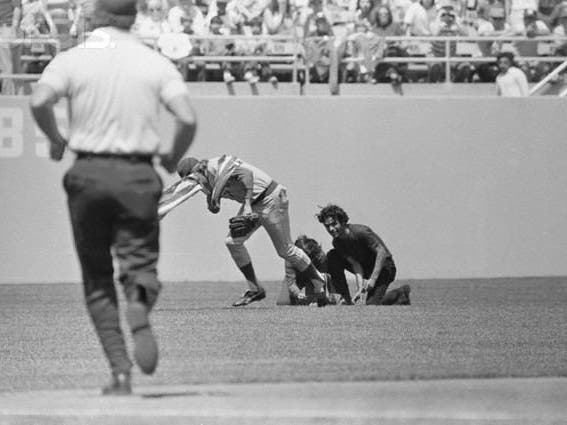
On April 25, 1976, during the nation's bicentennial year, a routine game between the Chicago Cubs and Los Angeles Dodgers became an unexpected civic moment. Two people ran onto the Dodger Stadium outfield, unfurled an American flag, and began dousing it with lighter fluid. Monday, a Marine Corps Reserve veteran playing center field for the Cubs, sprinted toward them and grabbed the flag before it could be set on fire. The crowd began singing "God Bless America," and the scoreboard later told him, "Rick Monday, you made a great play."
The Hall of Fame now displays the very flag he rescued, loaned by Rick and Barbaralee Monday, as part of its America 250 programming. The flag is not presented as a patriotic souvenir. It is interpreted as a moment when a baseball field became a civic arena, and when a player's instinctive act entered the country's symbolic vocabulary. The continuity is striking. The flag belonged to America at 200. Now it is being shared with America at 250. It carries with it a half‑century of argument, memory, patriotism, protest, and preservation.
Seen together, these exhibits trace a civic arc and a sports chronology. Cooperstown itself reminds us that American memory is layered before the visitor ever enters the museum. The 1857 rules show the game becoming a system. The Negro Leagues show how excluded communities built their own institutions. Jackie Robinson shows that the system was being tested. Willie Mays shows how hidden excellence entered the mainstream and transformed the standard by which the game understood greatness. Roberto Clemente shows how baseball's meaning expanded across language, geography, service, and identity. Rick Monday's flag rescue shows how national symbols can become contested ground even in a ballpark. The argument over national symbols did not end in 1976. It continues wherever Americans gather, remember, protest, and ask what the flag is supposed to mean.
Cooperstown is, in its own way, a national Field of Dreams—a place where the country's past keeps returning to the field, not as nostalgia, but as civic memory.
That is the larger America 250 lesson. Baseball became the national pastime not because it stood apart from the nation's conflicts, but because it absorbed them. Its history contains rulemaking, exclusion, belonging, protest, patriotism, courage, and memory. It is preserved in bats, balls, jerseys, plaques, scorecards, handwritten rules, and flags, but also in the arguments Americans keep having about what those objects mean.
The Hall of Fame's curators, archivists, donors, and visitors all participate in preserving and interpreting that history. A national pastime does not maintain itself. It is stewarded.
At America's 250th, Cooperstown reminds us that baseball is not only a game. It is a civic institution rooted in a civic landscape. The place itself carries stories of Native presence, Revolution, settlement, literature, memory, and myth. Inside the Hall of Fame, baseball carries those questions forward onto the field.
The flag Rick Monday saved at America's 200th birthday now stands in Cooperstown at America's 250th, reminding us that the nation's arguments, symbols, and memories do not stay in the past. They keep taking the field with us, shaping how the nation understands itself.