Neighbor News
America at 250: Flag Day and the Birth of a National Brand
The Declaration Gave Us Ideals. The Flag Gave Us Identity.

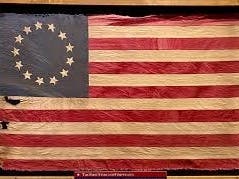
On June 14, 1777, nearly a year after declaring independence from Great Britain, the Second Continental Congress adopted a simple resolution:
"Resolved, That the flag of the United States be thirteen stripes, alternate red and white; that the union is thirteen stars, white in a blue field, representing a new constellation."
Today, we know that symbol simply as the American flag.
Find out what's happening in Pelhamfor free with the latest updates from Patch.
As the United States approaches its 250th anniversary, Flag Day offers an opportunity to reflect on something easy to overlook. The nation declared independence before it created a national flag. The idea came first. The symbol came later. That sequence matters because the Declaration of Independence gave Americans a shared political purpose. In contrast, the flag gave that purpose a visual identity.
In modern terms, the United States spent 1776 defining its mission and 1777 defining its brand. In an era before mass media, a flag was not marketing. It was infrastructure, a tool for diplomacy, naval identification, and military coordination. Congress adopted the flag resolution at a moment when the Continental Army was reorganizing, and the new nation needed consistent symbols for military, diplomatic, and maritime use.
Find out what's happening in Pelhamfor free with the latest updates from Patch.
For nearly a year after independence was declared, there was no official national flag. Through the first months of the war, George Washington's forces often flew the Grand Union Flag, a banner featuring thirteen stripes but still displaying the British Union Jack in the corner. It reflected a moment of transition, when the colonies were moving toward independence but had not yet fully established a separate national identity.
The resolution adopted on June 14, 1777, completed that break. The British symbol disappeared. In its place appeared thirteen stars representing what Congress described as a "new constellation." That phrase may be one of the most overlooked pieces of founding language. The founders did not choose a crown, a coat of arms, or a royal emblem. They chose stars, separate entities connected in a common design. Distinct states united in a larger project.
The flag was not merely a decoration. It was a statement about how the new republic understood itself.
Like many American stories, however, the flag's history is accompanied by a legend. For generations, schoolchildren learned that Betsy Ross designed and sewed the first American flag after receiving a visit from George Washington. Historians today view that story with caution. While Ross was certainly a real Philadelphia upholsterer and flag maker, the evidence that she designed the first national flag is surprisingly thin.
Yet the endurance of the Betsy Ross story tells us something important. Nations need stories as much as they need symbols. Whether or not she designed the first flag, Betsy Ross became part of the nation's civic memory. Her story transformed the creation of a national emblem into a human story about craftsmanship, service, and ordinary citizens contributing to an extraordinary cause. In that sense, she helped keep the flag's story alive for generations of Americans.
If Betsy Ross became the story, another founder may have been responsible for much of the design work itself. Francis Hopkinson, a signer of the Declaration of Independence, is widely credited by historians as a principal designer of the early American flag. A lawyer, musician, writer, artist, and public servant, Hopkinson helped create several of the visual symbols of the new republic, including early government seals and currency.
In 1780, Hopkinson even submitted a bill to Congress seeking compensation for his design work, including "the flag of the United States" among other contributions. According to the historical record, he initially requested payment in the form of a quarter cask of public wine. Congress ultimately declined to pay him, citing procedural reasons and the involvement of others in the design process. The government may have denied his invoice, but history preserved his contribution.
Looking back from 2026, it is difficult not to see Hopkinson as something of the republic's first graphic designer. Long before branding became a field of study, he understood that a nation needed visual symbols capable of expressing political ideas.
That is what makes this story feel surprisingly modern. We often think of branding as a business concept. Still, public and nonprofit organizations understand that mission, identity, trust, and recognition are deeply connected. The founders may not have used that vocabulary, but they understood the principle. Ideas travel farther when attached to memorable symbols. People unite around stories and images as much as around documents and speeches.
The American flag became one of the most successful examples of public branding in history. For 249 years, it has accompanied moments of triumph and tragedy, unity and division. Soldiers carried it into battle. Reformers carried it into marches. Immigrants carried it into citizenship ceremonies. Generations of Americans have argued passionately about what the nation should be while standing beneath the same constellation of stars.
That may be the flag's greatest achievement. It did not eliminate disagreement. It created a common symbol through which disagreement could occur. As America approaches its 250th birthday, Flag Day reminds us that republics require more than ideals and more than institutions. They also require symbols that can connect people across geography, generations, and differences.
The Declaration gave America its words. The Constitution eventually established America's system of government. The flag gave America something else: a shared image of the project itself.
In 1777, Congress described the United States as a "new constellation." Two hundred and forty-nine years later, Americans still debate the meaning of the republic, the reach of its promises, and the direction of its future. Yet the constellation remains.
As the nation approaches its 250th birthday, that may be the most remarkable part of the story.