Neighbor News
America at 250: The Founders Feared a King. They Built a Presidency Anyway.
America must ask whether constitutional design can still restrain executive power in an age of party loyalty and presidential expansion.

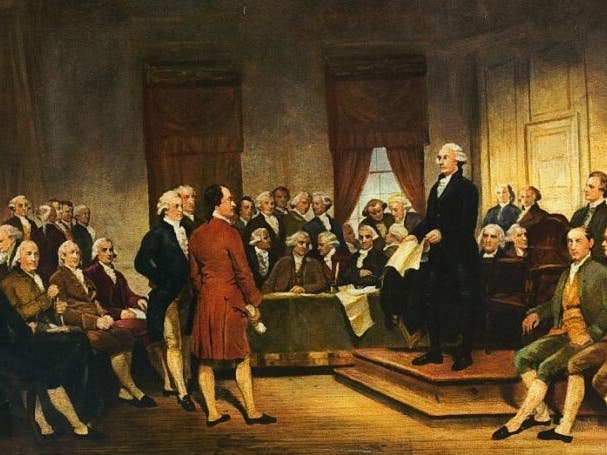
Two hundred and fifty years after the Declaration of Independence, the United States is confronting a constitutional irony the framers themselves anticipated but never fully solved: the presidency was designed to be powerful, but safe only if the people operating the system accepted restraint.
The founders did not stumble into this tension. They engineered it by trying to solve one of the central problems of republican government: how to create an executive strong enough to act, but limited enough to prevent the return of monarchy.
At the Constitutional Convention, Benjamin Franklin warned that executive power, once created, would "always be increasing… till it ends in a monarchy." In a letter written the same year, he cautioned that "the first man put at the helm will be a good one. Nobody knows what sort may come afterwards." (Founders Online)
Find out what's happening in Pelhamfor free with the latest updates from Patch.
Alexander Hamilton, by contrast, argued that the republic needed "energy in the executive," a president capable of decision, speed, unity, and force. James Madison cautioned that "the accumulation of all powers, legislative, executive and judiciary, in the same hands" may "justly be pronounced the very definition of tyranny."
These were not abstract philosophical disagreements. They formed the central design tension of the American presidency: how to build an office strong enough to govern, but constrained enough to prevent a king.
Find out what's happening in Pelhamfor free with the latest updates from Patch.
The framers wanted something the world had not yet seen. They rejected monarchy, but they also rejected a feeble executive unable to act. They wanted a president less powerful than the king they had rebelled against, but more effective than the weak executives that had left many state governments fragmented and unstable. Their answer was not to eliminate executive power. It was to create it, define it, and surround it with restraints.
Those restraints were both structural and behavioral. Congress was expected to defend its own institutional authority. Impeachment was not designed as a routine political weapon. It was meant to be a constitutional circuit breaker. Senators were originally chosen by state legislatures, in part to insulate them from passing political passions. Electors were expected to exercise judgment in selecting the president, not simply ratify the outcome of party machinery.
Whether one admires those mechanisms or not, their purpose was clear. The framers feared executive ambition, but they also feared demagoguery, faction, and sudden public passion. They built a system that assumed ambition would check ambition, institutions would protect their own authority, and civic virtue would shape the conduct of public officials.
Over time, many of those original filters weakened or disappeared. Senators are now directly elected. The Electoral College no longer functions as a deliberative body. Impeachment has become less an institutional remedy than a partisan test. Congress still possesses enormous constitutional authority, but party loyalty often makes that authority harder to use.
That is one of the great complications of the American constitutional system. The founders anticipated ambition and faction, but they did not fully anticipate a party system strong enough to make Congress less jealous of executive power than protective of its own president.
This matters because the modern presidency is far larger than the office described in 1787. The framers designed an executive for a small republic. The modern presidency now operates a global military, a permanent national security apparatus, a vast administrative bureaucracy, and a media platform capable of turning presidential speech into national command. The office has grown faster than many of the norms meant to restrain it.
This is not simply about any one president. It is about the structural reality of an office whose power has expanded across centuries while many of its original guardrails have become weaker, more partisan, or more symbolic.
That does not mean the founders were naïve. They understood the danger of concentrated power. They feared demagogues. They debated monarchy openly. Their mistake was not that they failed to see the risk. Their mistake was believing that institutional design could reliably restrain political actors once party loyalty, public passion, and presidential power began reinforcing one another.
A constitutional system is only as strong as the people willing to enforce it. That is why America at 250 should be more than a celebration. The anniversary is not only a commemoration of origins. It is a civic audit.
The founders built a presidency with enormous potential energy. They assumed Congress, impeachment, institutional ambition, and civic virtue would supply the restraint. Some of those assumptions no longer hold. The question for America at 250 is the same one Franklin placed before the Convention in 1787: Can a republic keep the executive from becoming a monarch—not in theory, but in practice?