Neighbor News
America at 250: The Founders Were Reading the Sky
How Jefferson, Washington, and Franklin turned weather observation into a habit of reason, survival, and nation-building

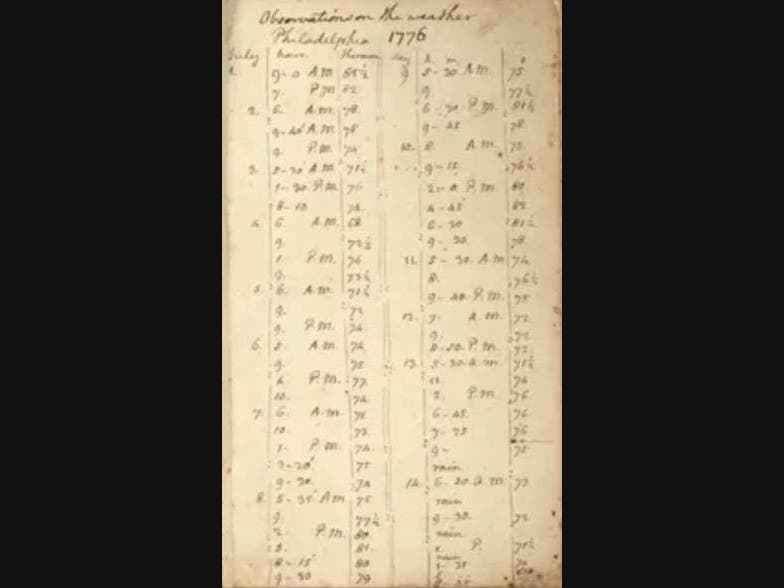
At first glance, it seems like a charming historical oddity, the kind of footnote that makes the larger-than-life figures of the American Revolution feel more human. In the summer of 1776, while Americans were declaring independence from the British Empire, Thomas Jefferson was recording the temperature. George Washington kept weather notes across much of his life, tracking wind, snow, rain, and daily conditions with remarkable discipline. Benjamin Franklin studied storms, lightning, ocean currents, and the movement of weather systems.
It is easy, from a modern vantage point, to treat these habits as eccentric pastimes. But that gets the intellectual history of the American founding exactly backward. The founders' interest in weather was not a distraction from the Revolution. It was part of the same intellectual world that made the Revolution possible. Jefferson, Washington, and Franklin were products of the Enlightenment. They belonged to a generation that believed nature could be observed, measured, and understood through human reason. Knowledge was not only something handed down by inherited authority. It could be gathered through evidence, tested through experience, and refined over time.
That belief mattered politically. The same generation that questioned monarchy also questioned old assumptions about the natural world. The same minds that argued for self-government believed that human beings could study the world carefully enough to improve life within it. In this light, the founders' weather records were more than private habits. They reflected a larger faith in disciplined observation. They were building a republic, but they were also trying to understand the continent on which that republic would have to survive.
Find out what's happening in Pelhamfor free with the latest updates from Patch.
At this 250-year milestone, that connection matters. The founding was not only a political event. It was also an Enlightenment project built on disciplined attention to the physical world. Thomas Jefferson offers the clearest example. On July 1, 1776, as the Continental Congress moved toward independence, Jefferson began a record of weather observations that would continue, with gaps, for nearly fifty years. Three days later, on July 4, while Congress was adopting the Declaration of Independence, Jefferson visited John Sparhawk's London Book-Store on Second Street in Philadelphia. Sparhawk was an apothecary, bookseller, and merchant whose crowded shop offered medicines, literature, scientific instruments, and, as he advertised, "an assortment of curious hardware." Jefferson's memorandum book records the transaction simply: he paid Sparhawk three pounds and fifteen shillings for a thermometer.
The details are small, but revealing. On the day the colonies formally declared their political independence, Jefferson was also acquiring an instrument designed to measure the physical world more precisely. He noted a cool 68 degrees at 6 a.m., rising to 76 by early afternoon. The author of American liberty was also taking the measure of the world around him. Jefferson's records were not casual notes. He recorded temperature, wind, precipitation, pressure, and seasonal signs. He watched when plants bloomed and when birds appeared. At Monticello, even the architecture reflected this habit of attention: a wind vane on the roof was connected to a compass rose inside the house, allowing Jefferson to read the wind direction from within.
Find out what's happening in Pelhamfor free with the latest updates from Patch.
He wanted to understand climate not as rumor, impression, or inherited belief, but as evidence gathered patiently over time. That habit belonged to the same mind that helped write the Declaration. Jefferson believed that truth could be pursued through observation, comparison, and reason. Weather was one place where that philosophical belief became a daily practice.
For George Washington, weather observation was less a scientific project than a form of practical judgment. As a farmer, surveyor, and military commander, he understood that weather could alter plans, delay movement, shape harvests, and decide whether an army survived. Washington lived in a world where a storm could turn roads into mud, where wind could affect travel and supply, and where frost, drought, rain, and snow could determine the success of a farm. Paying attention to the sky was not a hobby. It was part of leadership. That habit followed him throughout his life. Even near the end, Washington continued to record weather conditions. His final diary entry, written on December 13, 1799, the day before he died, was a weather note describing snow, wind, and clearing skies. It was a fitting final entry for a man who spent much of his life managing uncertainty through discipline and attention.
Benjamin Franklin pushed this habit of observation even further. He did not merely record the weather or respond to it. He experimented with it. Franklin treated storms, lightning, winds, and ocean currents as systems that followed patterns, even when those patterns were not yet fully understood. His most famous experiment involved lightning, but his interest in the atmosphere went far beyond that. He studied storm movement, published weather forecasts, and investigated the Gulf Stream by measuring ocean temperatures. On a 1775 Atlantic crossing, Franklin found the Gulf Stream about 6 degrees warmer than the surrounding water, a practical observation with enormous implications for navigation, commerce, and travel. Franklin believed that nature was not a random mystery. It was a set of forces that could be studied. His curiosity could even become reckless. Franklin once chased a whirlwind on horseback, striking at it with his whip to see how it behaved. The image is almost comic, but it captures something essential about him. Franklin did not simply accept the world as it appeared. He tested it.
This habit extended far beyond Jefferson, Washington, and Franklin. Across the colonies and the early republic, a wider network of physicians, scholars, and public figures was asking similar questions. James Madison kept weather records that could be compared with Jefferson's. Hugh Williamson, a physician and future signer of the Constitution, wrote about how clearing forests might alter the local climate.
In Charleston, John Lining began instrument-based observations as early as 1738, and Lionel Chalmers later tracked weather and disease to understand patterns of illness. In Salem, Edward Augustus Holyoke maintained a weather log spanning seventy-five years. For a generation tasked with inventing a country, data was not a side interest. It was an anchor in uncertainty. Seen in this context, the founders' interest in weather was never a side story. It reveals a central aspect of the intellectual culture of the American Revolution. To study weather was to study the conditions under which people lived, worked, traveled, fought, farmed, and governed.
At America's founding, weather was not small talk. It was information. It shaped agriculture, war, maritime commerce, public health, settlement, and survival. Long before satellites, radar, or smartphone alerts, weather was one of the most important forms of knowledge a society could gather.
Two hundred and fifty years later, we still begin many of our civic rituals by checking the sky. We check the forecast before parades, ballgames, flights, school closings, beach days, and Fourth of July fireworks. The tools have changed beyond anything the founding generation could have imagined. Handwritten diaries and fragile instruments have been replaced by satellites, radar, computer models, and instant alerts. But the underlying habit predates the technology. At America's 250-year mark, that is part of the lesson. A republic requires ideals, declarations, and principles. But to survive, it also requires disciplined attention to reality.
The founders understood that building a country required more than announcing independence. It required watching the world carefully enough to live in it.