Neighbor News
America at 250 Hero Series: 40 Victories, One Sweetheart
The recovered wingtip of Richard Bong's P-38 brings the story of America's greatest fighter ace home to Wisconsin.


The Wing Comes Home
Every so often, a newspaper article introduces you to a piece of history you thought you knew and then gives you a reason to look again.
That happened to me when I read Ishani Desai's recent New York Times article about the return of part of a World War II airplane from the jungles of Papua New Guinea to Wisconsin. The aircraft was a Lockheed P-38 Lightning called Marge. Its pilot had once been one of the most celebrated young men in America, although his name may be unfamiliar to many Americans today.
Major Richard Ira "Dick" Bong was the leading American fighter ace of World War II. It would be natural to call him an Air Force pilot, but we would be two years early. Bong entered military aviation through the U.S. Army Air Corps and flew in combat with the U.S. Army Air Forces, the wartime air arm of the Army. The independent United States Air Force was not established until 1947, two years after his death.
Find out what's happening in Pelhamfor free with the latest updates from Patch.
Flying the P-38 Lightning, Bong was officially credited with shooting down 40 enemy aircraft in the Southwest Pacific Area, more than any other American pilot during the war. His decorations included the Medal of Honor, the Distinguished Service Cross, and the Silver Star. He became known across the country as America's "Ace of Aces."
Yet it was not the number 40, nor even that extraordinary list of decorations, that first drew me into Desai's story. It was the image of a battered piece of aluminum emerging from the jungle after more than 80 years.
Find out what's happening in Pelhamfor free with the latest updates from Patch.
A search team led by Justin Taylan of the nonprofit Pacific Wrecks located the remains of Marge in Papua New Guinea's Madang Province on May 15, 2024. Beneath the dense canopy, the team found twisted metal edged in red paint, covered with moss, and marked with identifying numbers. Among them were the final digits of the aircraft's military serial number, 42-103993, which helped establish that the wreckage really was Marge.
In July 2026, members of the Wisconsin Air National Guard transported an approximately six-foot section of the airplane's right wingtip across the Pacific. It was then brought to the Richard I. Bong Veterans Historical Center in Superior, Wisconsin, returning to within miles of the small farming community where Bong grew up.
The Name on the Airplane
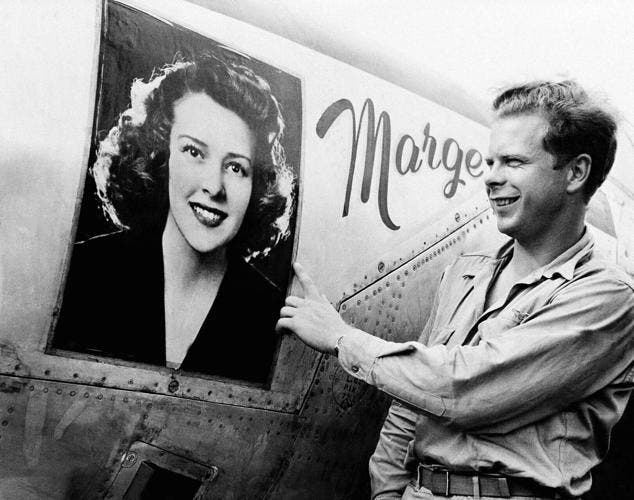
There is something about the name Marge that changes the way we see the aircraft. Marjorie Vattendahl was Bong's sweetheart and later his wife. Her photograph appeared on the nose of the P-38, along with her name. In the middle of an enormous and impersonal war, Bong carried a visible reminder of one particular person waiting for him at home.
Bong earned his 40 credited victories while flying several P-38 Lightnings, not solely in the aircraft called Marge. Still, it was Marge who became inseparable from his public image. The airplane joined the reputation of America's greatest fighter ace to the private hopes of a young man who wanted to return home and marry the woman whose photograph he carried into battle.
The story of the aircraft did not end with Bong. On March 24, 1944, Lieutenant Thomas Malone was flying Marge on a weather-reconnaissance mission when the airplane experienced mechanical and electrical failures. Malone bailed out safely, but the P-38 crashed into the jungle and disappeared beneath the vegetation.
Bong and Marjorie continued with their lives. The airplane bearing her name remained behind, waiting for history to find it again.
The Making of an Ace
Before he became the "Ace of Aces," Bong was a Wisconsin farm boy, the eldest of nine children. His father had immigrated from Sweden, and the family lived near Poplar, Wisconsin.
As a boy, Bong watched airplanes fly overhead carrying mail to President Calvin Coolidge's summer residence near Superior. Those flights awakened his fascination with aviation. While attending Superior State Teachers College, he entered the federal Civilian Pilot Training Program, one of the programs through which the United States began developing the pilots it would soon need.
There is something distinctly American in that progression. A farm boy watched airplanes cross the Wisconsin sky, learned to fly through a public training program, and, within a few years, became the most successful American fighter pilot of the war.
In May 1941, months before the United States entered World War II, Bong joined the Army Air Corps Aviation Cadet Program. He earned his pilot's wings and was commissioned a Second Lieutenant in January 1942. By then, the Army Air Forces had been created to direct the rapidly expanding aviation forces that would fight the war.
His ability was evident early, although his judgment occasionally needed time to catch up. During military training in California, Bong was disciplined for dangerous low-level flying. General George C. Kenney recognized both the recklessness and the extraordinary talent. The Army Air Forces would have to discipline Bong's daring without extinguishing it.
Sent to the Southwest Pacific, Bong flew the twin-engine P-38 Lightning with the 49th Fighter Group. He recorded his first two aerial victories over Buna, New Guinea, on December 27, 1942. He was 22 years old.
Bong later acknowledged that he was not a naturally precise aerial gunner. His solution was simple, effective, and alarmingly direct: he flew closer!
He sometimes approached enemy aircraft at such close range that his P-38 passed through their exploding debris. It is difficult to decide whether this makes his method more impressive or more terrifying. It was certainly both.
What had once looked like youthful recklessness became, under the discipline and pressure of combat, a method of fighting. The military did not give Bong his extraordinary instincts, but it taught him to direct them toward a larger purpose.
Bong received the Silver Star and Distinguished Service Cross for his combat service. Those honors came before the Medal of Honor and remind us that his reputation developed over years of dangerous missions, not through a single act of heroism.
By April 1944, his 27th victory had carried him past Eddie Rickenbacker's American record from World War I (think World War I Flying Ace, Snoopy, navigating the skies in his doghouse, aka the Sopwith Camel). Bong was then brought home for a 15-state war-bond tour, where the young major was presented to the country as one of its great wartime heroes.
He returned to the Pacific later that year as a gunnery instructor. Although he was neither required nor expected to fly combat missions, Bong repeatedly volunteered to do so. Those additional missions carried his total from 28 credited victories to 40, the highest number credited to any American fighter pilot.
The record is astonishing, but it should not make us forget how young he was. Bong was only 24 when he completed his final combat tour.
The Hero Returns
General Douglas MacArthur presented Bong with the Medal of Honor in December 1944. The citation did not recognize only the number of aircraft he had destroyed. It emphasized that Bong had continued entering combat voluntarily after becoming a gunnery instructor and was no longer required or expected to expose himself to those dangers.
The Medal of Honor joined a remarkable list of decorations that already included the Distinguished Service Cross and Silver Star. Yet Bong remained modest about his record. He credited the P-38, his fellow pilots, and the mechanics who kept the aircraft flying.
That humility matters. The country saw an individual hero, but Bong understood that even the most gifted pilot depended upon an entire system of people, training, and machinery every time he left the ground.
General Kenney finally ordered him out of combat. The United States had spent years developing Bong's ability, and its commanders were no longer willing to risk the life of their most successful fighter pilot.
Bong returned home to Wisconsin and married Marjorie (Marge) on February 10, 1945. The wedding attracted so much public interest that hundreds of people reportedly gathered inside and outside the church.
For a brief time, the name on the airplane and the young woman behind it were reunited with the pilot who had carried them across the Pacific. But Bong had not come home to retire.
The War's Final Days
By the summer of 1945, Bong was working at Lockheed's plant in Burbank, California, as an Army Air Forces acceptance pilot for the new P-80 Shooting Star. The P-80 was an early American jet fighter, a machine pointing toward the next era of military aviation.
Bong had mastered the P-38, one of the defining American fighters of the Pacific War. The P-80 was different. He had accumulated only a few hours of experience in the jet, and the technology itself remained new.
On August 6, 1945, Bong took off in a P-80 from Lockheed Air Terminal. Shortly after takeoff, the aircraft's primary fuel pump failed. With the jet losing power while still close to the ground, Bong attempted to bail out. He escaped the cockpit, but there was not enough altitude for his parachute to open fully.
Richard Bong died at 24, but World War II was still being fought. He had survived three combat tours and returned from the Pacific, yet he did not live to see the war end.
On that same day, half a world away, the United States dropped an atomic bomb on Hiroshima. American newspapers reported the death of the nation's leading fighter ace, alongside news of a weapon that announced the arrival of the Atomic Age.
The coincidence hardly needs our help. A young pilot who had mastered the great American fighter of the Pacific war died flying one of the jets that represented the future on the very day the world entered an even more consequential and dangerous age.
Japan announced its acceptance of the surrender terms little more than a week later. The formal surrender documents were signed aboard the USS Missouri on September 2, 1945.
Bong died during the war's final days, on the cusp of the peace he had helped make possible.
The Circle Closes
That is why the return of Marge's wingtip to Wisconsin feels like more than the recovery of an old piece of military equipment.
The wingtip is bent, broken, and weathered by more than 80 years in the jungle. It does not present a polished version of history. That is precisely why it has such power.
It reconnects Richard Bong's public achievements with the private life behind them. There were 40 victories, the Medal of Honor, the Distinguished Service Cross, and the Silver Star. But there was also a farm boy fascinated by airplanes, a young officer whose talent initially outran his judgment, and a husband who had been married for less than six months when he died.
And there was Marjorie, whose name remained attached to the airplane long after both the aircraft and the young man who made it famous were gone.
At America's 250th anniversary, we naturally return to the celebrated names and defining moments of our history. But Ishani Desai's reporting reminded me that history sometimes comes back to us in less imposing ways. Sometimes it returns as a battered piece of aluminum, carried out of a distant jungle and brought home.
The wingtip cannot complete the life Richard Bong was denied. What it can do is make that life present again. It asks us to look beyond the title "Ace of Aces" and remember the young American beneath it: 40 victories, one sweetheart, and only 24 years.