Neighbor News
America at 250 Hero Series: Snowbird 1 & the Crew That Flew into the Antarctic Night
An Australian crew, an American in peril, and the international partnership that made a midwinter rescue possible

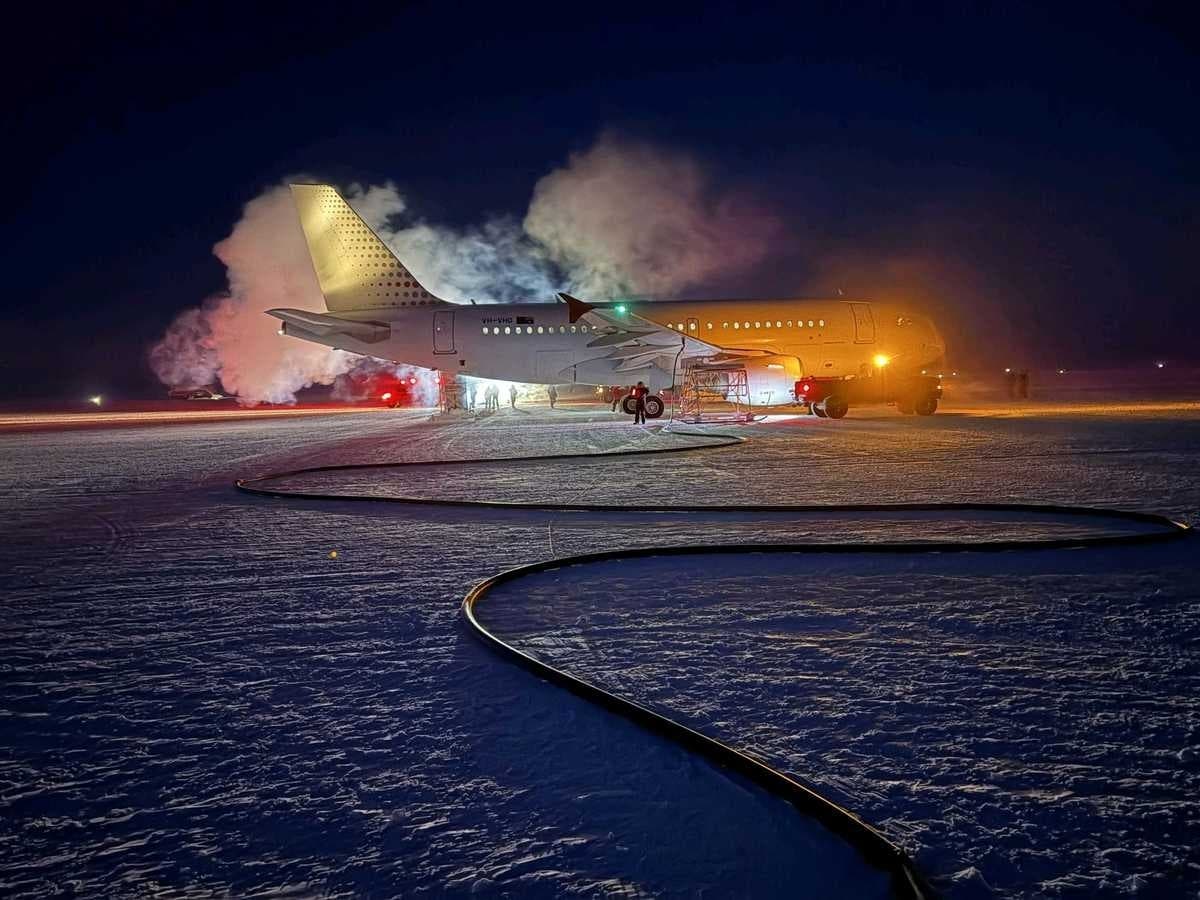

At 2:44 on the morning of July 31, 2026, an Airbus A319 known as Snowbird 1 departed Hobart, Tasmania, carrying four pilots, a medical team, and enough fuel to fly to Antarctica without depending upon refueling there. Captain Al Wallach led the flight crew, which included married captains Rod and Louise Robertson. More than five hours later, they approached Phoenix Airfield near the American research station at McMurdo.
The runway appeared out of the darkness as little more than a suspended line of lights. The temperature was minus 43 degrees Celsius, or approximately minus 45 Fahrenheit. In almost complete polar darkness, the pilots could not rely upon ordinary visual references to judge height and distance. They had to use the aircraft's instruments while monitoring operating limits that grew more restrictive as the plane cooled.
After the seriously ill American expeditioner was placed aboard, Snowbird 1 remained on the ice for less than an hour. Hydraulic fluid and other critical aircraft systems could not be allowed to remain exposed indefinitely to such extreme cold. As the weather began to deteriorate, the crew departed for Christchurch, where the unidentified patient was admitted to hospital in serious condition.
Find out what's happening in Pelhamfor free with the latest updates from Patch.
The America at 250 Hero Series has generally told stories of Americans whose courage helped shape or defend the country. The crew of Snowbird 1 invites us to widen that frame. Australian pilots and medical specialists flew into the Antarctic night to rescue an unnamed American, aided by ground personnel at an American station and a receiving network in New Zealand. Their mission reminds us that national strength is measured not only by what a country can do alone, but also by the relationships it has built with nations willing and able to answer when help is needed.
Wallach later directed attention beyond the cockpit to the larger team that made the rescue possible. Meteorologists tracked a narrow weather window. Engineers and operational planners calculated what the aircraft could withstand. McMurdo's winter crew prepared and illuminated a runway built on compacted snow over glacial ice. Medical personnel planned how to stabilize and transfer a patient to a location thousands of miles from ordinary emergency care.
Find out what's happening in Pelhamfor free with the latest updates from Patch.
This was collective heroism supported by institutional capacity. Courage put Snowbird 1 into the Antarctic night, but law, infrastructure, technical knowledge, and administrative coordination made that courage actionable. The system behind the crew had accumulated over generations, beginning not with modern aviation but with wooden huts placed along the Antarctic coast.
Robert Falcon Scott's British expedition constructed the Discovery Hut on Ross Island in 1902, near the location where McMurdo Station would later be established. In 1904, Argentina assumed operation of a meteorological station established the previous year by the Scottish National Antarctic Expedition on Laurie Island in the South Orkneys. Now known as Orcadas Station, it became the first continuously occupied station in Antarctica.
These early outposts established the possibility of maintaining a human presence through an Antarctic winter. They did not yet constitute a continental transportation or emergency-response system. Their inhabitants remained dependent upon ships, seasonal access, supplies brought from distant ports, and their own ability to survive until outside help could reach them.
The Second World War began to transform Antarctic occupation from episodic exploration into an instrument of national policy. In 1943, Britain organized Operation Tabarin, establishing occupied bases at Deception Island and Port Lockroy in 1944 and at Hope Bay in 1945. The operation gathered weather information and sought to prevent enemy ships from using Antarctic harbors, but it also strengthened Britain's territorial position. The British Antarctic Survey traces its institutional origins to that wartime mission.
The United States followed with Operation Highjump in 1946 and 1947. The expedition involved approximately 4,700 personnel, 13 ships, and numerous aircraft, with Rear Admiral Richard Byrd serving as officer in charge of the Antarctic project. It conducted extensive aerial photography, tested personnel and equipment under polar conditions, and demonstrated the scale at which a modern state could project logistical power into Antarctica.
Highjump was temporary, however. The decisive transition to a continuing American presence came with Operation Deep Freeze.
Beginning in the mid-1950s, the United States used naval personnel, ships, aircraft, construction units, and engineering expertise to establish permanent facilities in preparation for the International Geophysical Year of 1957–58. McMurdo Station was established in December 1955 and opened the following year. An 18-man Navy construction crew built the first Amundsen-Scott South Pole Station, which also opened in 1956.
The International Geophysical Year brought scientists from numerous countries together to study the atmosphere, oceans, glaciers, magnetism, and the physical structure of the Earth. Yet the science depended upon enormous logistical machinery. Laboratories could not operate unless governments could construct buildings, transport fuel, maintain communications, generate electricity, deliver food, and move personnel across oceans, ice, and snow.
Antarctica's scientific age was therefore built with many of the instruments of military power. That apparent contradiction was incorporated into the Antarctic Treaty.
Signed in Washington in 1959 and entering into force in 1961, the treaty reserved Antarctica for peaceful purposes. Article I prohibited military bases and fortifications, military maneuvers, and weapons testing, but expressly permitted military personnel or equipment to be used for scientific research or another peaceful purpose.
The treaty did not abolish the seven existing territorial claims. Instead, Article IV preserved the parties' respective legal positions without requiring those disputes to be settled. It also prevented activities undertaken while the treaty was in force from establishing a new claim or enlarging an existing one.
The treaty, therefore, did more than demilitarize Antarctica. It redirected certain forms of military capacity toward peaceful administration and scientific support. Aircraft designed to carry troops or cargo could move researchers and supplies. Icebreakers could open a path for annual resupply. Military-trained pilots could operate under conditions that most civilian aviation ordinarily avoided.
For decades, the U.S. Navy performed much of this work through Operation Deep Freeze. Antarctic Development Squadron Six, eventually known as VXE-6, operated ski-equipped LC-130 aircraft capable of landing on snow and ice. It connected McMurdo with the South Pole and with remote field camps across the continent.
During the 1990s, responsibility for the ski-equipped airlift mission gradually passed from the Navy to the 109th Airlift Wing of the New York Air National Guard, the only other American unit operating the LC-130. The transfer was completed when VXE-6 was disestablished, and the Navy ended its direct Antarctic support role in 1999.
Civilian contractors simultaneously assumed a larger share of the work previously performed directly by military personnel. The machinery supporting the American presence in Antarctica did not disappear. It became a hybrid of civilian agencies, military capabilities, international partners, and specialized companies.
The history of Antarctic medical emergencies records the gradual development and persistent limits of that system.
The history of Antarctic medical emergencies records the gradual development and persistent limits of that machinery.
In 1961, Leonid Rogozov was the only physician among 12 men wintering at the newly established Soviet station at Novolazarevskaya. When he developed acute appendicitis, evacuation was impossible. With assistance from a meteorologist and a driver, Rogozov administered local anesthesia and operated on himself. He removed his appendix during a procedure lasting nearly two hours and returned to regular duties approximately two weeks later.
The episode is commonly remembered as an almost superhuman act of endurance. It was also evidence of institutional limitation. The Soviet Union possessed rockets, nuclear weapons, long-range aircraft, and one of the most extensive state bureaucracies in the world. None of that capacity could place a rescue aircraft at Novolazarevskaya during the Antarctic winter.
By 1999, communications and aviation had improved substantially, but they had not eliminated isolation at the geographic South Pole. Dr. Jerri Nielsen discovered a lump in her breast while serving as the physician at Amundsen-Scott station. After consulting doctors in the United States, she conducted a biopsy with assistance from other members of the winter crew.
Aircraft could reach the station from above before they could safely land. In July, a U.S. Air Force C-141 dropped medical equipment and chemotherapy drugs. Nielsen began treating herself while waiting for temperatures to rise sufficiently for an evacuation. A ski-equipped LC-130 operated by the 109th Airlift Wing finally landed on October 16, months after she had discovered the lump.
Nielsen's ordeal marked an intermediate stage in the development of Antarctic capacity. American institutions could communicate with an isolated patient, deliver sophisticated medical supplies, and help guide treatment from thousands of miles away. They could not yet retrieve her during the deepest part of the polar winter.
The Snowbird 1 mission might initially appear to complete that progression. Rogozov could not be reached. Nielsen could receive supplies but had to wait for evacuation. In July 2026, Wallach and his crew reached the patient at McMurdo with a long-range civilian jet. The comparison is powerful, but it requires an important geographic qualification.
The comparison is useful, but it requires an important geographic qualification. McMurdo Station is on Ross Island near the Antarctic coast. Phoenix Airfield provides a prepared runway capable of accommodating wheeled aircraft. Amundsen-Scott station sits at the geographic South Pole, approximately 2,835 meters (9,301 feet) above sea level. Winter temperatures there can fall below -80 Celsius...burr!
Aircraft performance at the South Pole is affected by the combination of extreme cold, altitude, isolation, and a snow runway rather than a conventional paved surface. The 2026 flight, therefore, did not abolish the Antarctic winter as a barrier. It extended the demonstrated boundary of possible intervention at one of the continent's best-supported locations.
It was not the first time an Australian-operated Airbus had evacuated a patient from McMurdo during the broader winter period. In August 2012, the Australian Antarctic Division and Skytraders conducted an A319 evacuation at the request of the National Science Foundation. That earlier mission also relied upon cooperation among Australia, the United States, New Zealand, medical personnel, and McMurdo's runway crew.
The July 2026 operation moved that boundary further. It took place earlier in the season, before the customary late-August winter fly-in period, under almost complete darkness and at temperatures close to the aircraft's operating limits. Louise Robertson said that a mission of this kind had not previously been conducted in July. State capacity rarely advances in a single dramatic leap. More often, a capability demonstrated under more favorable circumstances is repeated, refined, and eventually attempted under more difficult ones.
That progression does not diminish what the Snowbird 1 crew did. Institutions can provide an aircraft, a runway, forecasts, procedures, and diplomatic channels, but people must still decide to use them under dangerous conditions. Wallach, Rod, and Louise Robertson, the fourth pilot, the medical specialists, and the teams supporting them accepted responsibility for an outcome that could not be guaranteed.
The identity of the person evacuated in 2026 has not been disclosed. Nor has the person's occupation. That absence of information should prevent us from assuming that the patient was a scientist simply because the emergency occurred at a research station.
McMurdo exists to support science, but it operates much like a small municipality. Its winter population includes mechanics, electricians, plumbers, carpenters, cooks, communications technicians, firefighters, equipment operators, medical personnel, and many others needed to maintain buildings, power, heat, water, transportation, and emergency services.
The balance between researchers and support personnel varies by season and year. During the winter of 2018, for example, an official McMurdo account reported that only two research grantees remained among a station population of approximately 133. Other winters, especially those involving substantial construction or maintenance projects, have produced different staffing levels. The larger point is not a fixed percentage. It is that scientific work depends upon a much broader community of operational personnel.
This is another dimension of state capacity that dramatic accounts often overlook. Scientific achievement is associated with discoveries and the people whose names appear on published papers. But no telescope, atmospheric instrument, or glaciological project operates for long without technicians, supply workers, mechanics, and facilities personnel.
The patient may have been a scientist. The patient may also have been one of the people who kept the heat running. Either way, the mission was assembled for an unnamed person whose work and medical condition remained private.
Government agencies and their partners did not need public recognition of the patient before acting. The absence of a famous name, an academic title, or a public biography did not make the emergency less real.
That does not mean every Antarctic emergency will result in an evacuation. Weather, distance, aircraft limitations, the patient's condition, and the danger to rescuers all enter the calculation. Even the most capable government cannot guarantee rescue from every location under every circumstance.
State capacity is not omnipotent. It is the ability to determine what can be done, assemble the necessary institutions, and execute a decision under difficult conditions. Heroism begins where that system meets human judgment, when people accept the remaining uncertainty and act on behalf of someone else.
Snowbird 1 at Phoenix Airfield was the visible end of a system built over more than a century. Behind the crew stood the first overwintering stations, wartime territorial operations, Operation Highjump, the naval infrastructure of Operation Deep Freeze, the scientific cooperation of the International Geophysical Year, the legal framework of the Antarctic Treaty, the LC-130 crews of VXE-6 and the 109th Airlift Wing, Australian aviation investment, New Zealand medical infrastructure, and the largely anonymous workforce maintaining McMurdo through the winter.
None of those institutions flew the airplane by itself. Captain Al Wallach and the Snowbird 1 team had to enter the darkness, find the illuminated strip on the ice, manage a civilian jet near its operating limits, receive a critically ill patient, and leave before the weather closed around them. Their courage was collective rather than solitary, and its success depended upon many people whose names may never become public.
At the edge of the inhabited world, American strength was not represented by a flag or a declaration of sovereignty. It appeared in a request for help and in the allies' willingness to answer. Australia supplied the aircraft, pilots, medical expertise, and operational leadership. Americans at McMurdo prepared the way. New Zealand received the patient. Together, they turned more than a century of accumulated capacity into one act of rescue.
The heroes of Snowbird 1 remind us that courage does not become less heroic when it is shared, and that an American hero story need not belong only to Americans.