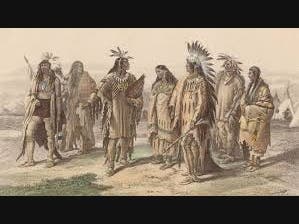
Every Fourth of July begins with a familiar story: thirteen colonies declared independence from the British Crown and announced a new republic built on liberty, consent, and self-government. But that story depends entirely on where you stand on the map. From Philadelphia, independence looked like liberation from imperial tyranny. From Native ground, it looked like the collapse of one of the last external checks on colonial expansion.
The American Revolution did not unfold on an empty continent waiting to become American. It unfolded on an Indigenous continent shaped by sovereign Native nations with their own diplomacy, trade networks, territorial claims, and military power. The thirteen colonies were not the whole map. They were an expanding force inside a much older continental order. That is why the baseline question for the 250th anniversary in 2026 cannot simply be, "What did independence mean to the founders?" It must also be, "What did independence unleash westward?"
For Native nations, freedom was not an Enlightenment theory debated in a hall. It was the lived reality of governing their own homelands, sustaining their own alliances, and balancing foreign powers against one another. The Revolution shattered that equilibrium and forced Indigenous leaders into a series of impossible strategic calculations. They were not background characters in a British-American dispute. They were sovereign political actors navigating a collapsing imperial order, and their choices were strategies for survival rather than signs of confusion or unquestioning loyalty.
Find out what's happening in Pelhamfor free with the latest updates from Patch.
The Haudenosaunee, often called the Iroquois Confederacy, illustrates this dynamic with clarity. For generations, they had used diplomacy, trade, and military power to balance European empires against one another. The Revolution tore that system apart from the inside. Mohawk leaders such as Joseph Brant calculated that a British alliance offered the best remaining leverage to preserve land and sovereignty. Oneida figures such as Han Yerry and Tyonajanegen supported the Americans, betting that wartime cooperation might secure their people's standing in the postwar order. Neither path guaranteed safety. Brant's choice led to scorched-earth retaliation and exile. Han Yerry's choice ultimately failed to stop the tide of New York State land seizures. Both were attempting to preserve their nations in a world where every available option carried danger.
The structural pivot of this entire conflict was the British Proclamation Line of 1763. Britain's restriction on settlement west of the Appalachians was born of imperial self-interest and a desire to reduce postwar military costs, not humanitarian concern for Native sovereignty. However poorly enforced, the line represented a legal barrier. To colonial land speculators and settlers, it was an intolerable restraint. To many Native nations, it was a fragile buffer against unchecked encroachment. American independence broke that buffer, and that is the central paradox of 1776. The mechanism that expanded self-government for American colonists accelerated the dispossession of Indigenous nations.
Find out what's happening in Pelhamfor free with the latest updates from Patch.
The geopolitical explosion that created the republic also dismantled the balance-of-power diplomacy that had protected Native ground for generations. The Revolution did not merely separate the colonies from Britain. It changed the rules of power across the continent. The objective of viewing the Revolution through Native eyes is not to diminish the achievement of 1776, but to accurately map its consequences. If we are going to evaluate the American founding at 250, we have to be willing to read the entire ledger, including the costs paid by the nations that were already here.