Neighbor News
America at 250: The Map We Learn by Heart
One Cat in the Hat, one U.S. map, 50 states, and one small "boo-boo" about what it takes to hold a country together

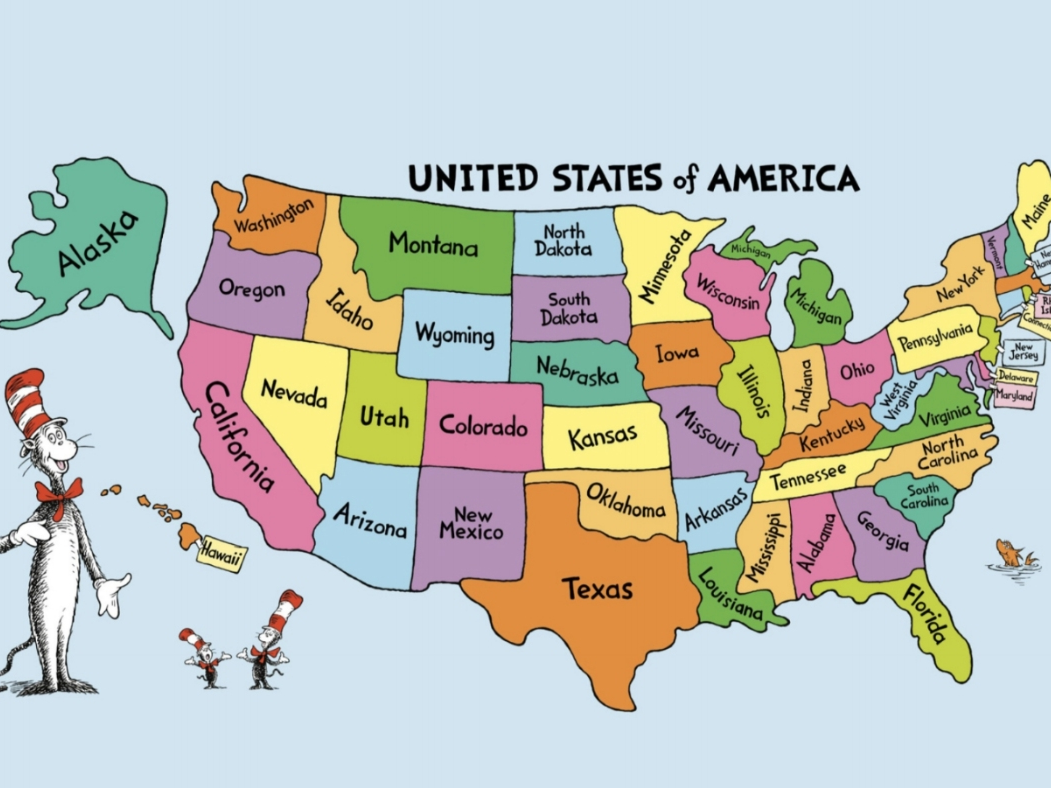
The Cat in the Hat Was My Editor
Dr. Seuss
A newly discovered Dr. Seuss manuscript was released this month, just in time for America's 250th anniversary. The book, Sing the 50 United States! turns the map into a rhyme and the states into a memory exercise. It reminded me that before Americans learn the country's arguments, many first learn its shape.
Find out what's happening in Pelhamfor free with the latest updates from Patch.
I was lucky enough to have the Cat in the Hat as my editor for this America at 250 reflection. Here's Cat's notes as we discussed the final edit:
"Now, Brian," said Cat,
with a tap of his Hat,
"you are thinking too big.
Let us start where we're at.
Find out what's happening in Pelhamfor free with the latest updates from Patch.
Not battles, not factions,
not laws in a stack.
Start with the states
and the shape of the map.
Before people argue,
debate, or explain,
they first learn the country
with rhythm and brain.
You found the small truth
where the bigger truths start:
a map learned by memory
becomes held by heart.
And yes, you were right
to notice my flaw.
A map missing one state
is no union at all.
So, share it," said the Cat,
"for the milestone is here.
A country worth learning
is worth holding dear."
America at 250: The Map We Learn by Heart
"To sing the 50 United States," the Cat in the Hat announces, "you have to use your brain."
It is a characteristically playful line from a newly discovered, posthumous Dr. Seuss manuscript published this June. Written by Theodor Seuss Geisel before he died in 1991, preserved in an archive at UC San Diego, and released just in time for the United States Semiquincentennial, Sing the 50 United States! asks young readers to do something deceptively simple: recite the states, rhyme the states, and fit their jagged shapes into a puzzle of the American map.
On its surface, a rhyming children's book may seem like a light artifact to place beside the weight of America's 250th anniversary. The Cat in the Hat does not explain federalism, the Revolution, the Civil War, the Constitution, or the long arguments that have shaped American life.
Instead, he starts somewhere more basic. He starts with the cadence of our geography.
That is the book's charm, but it is also what makes it feel surprisingly timely. America has always required mental and imaginative effort. It is not an easy country to hold together. It is too large, too regional, too contradictory, and too restless. To "sing" the United States is to turn many places into one remembered whole.
As we approach the Semiquincentennial, our national reflections naturally look backward to 1776, the Declaration of Independence, the Revolutionary generation, and the constitutional system that followed. But this rediscovered manuscript reminds us that the American story also begins anew each time a child first encounters the map.
Before children are old enough to understand constitutional theory, political ideology, or civic identity, many first learn America as a pattern of sounds. The country arrives not as an argument, but as a rhythm. This is geography transformed into memory; a sprawling continental nation turned into something a child can recite, picture, and eventually question.
There is an understated beauty in that sequence. Before children inherit our disagreements, they inherit our names. They learn the shape of the container before they learn to debate what belongs inside it.
The American Revolution created a radical political project, and the Constitution built its framework. But it is the states themselves, the physical places where Americans live and work, argue and vote, settle, leave, and return, that give that project its lived shape. By learning the puzzle of the map, children participate in a foundational civic ritual. They are learning to visualize a union.
Toward the end of the book's companion song, the Cat in the Hat makes a characteristically chaotic mistake. He assumes he is finished, only to discover that he has named 49 states. One piece of the puzzle is still missing.
It is a clever device for a children's book, but it also works as an accidental metaphor for the American experiment itself. The union is always a work in progress. It is easy to miscount, easy to leave someone out, and easy to forget that the map is only whole when every piece is included.
That may be the deeper lesson of a playful book arriving at a serious national milestone.
At 250, America remains a complicated, difficult song to sing. Some of its verses are joyful. Some are painful. Some are unfinished. Many are still being argued over.
But the quiet act of teaching the next generation the names of all fifty states carries an enduring hope: that the country is still worth learning, still worth remembering, and still worth trying to hold together.
"To sing the United States, you need your brain. To keep it, you need your heart."