Neighbor News
America at 250: The Postal Network That Made a Nation
How The Postal Network Became The First Infrastructure Of American Nationhood

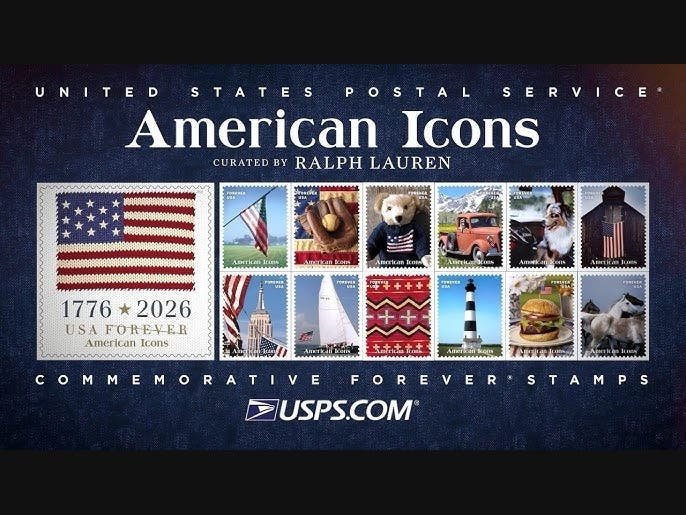
The United States Postal Service recently unveiled its American Icons commemorative stamp collection, curated by Ralph Lauren, to mark the nation's 250th anniversary. The pane includes 13 stamps, with images of flags, barns, lighthouses, baseball, horses, and other familiar pieces of Americana surrounding a knitted interpretation of the American flag at the center, framed by blue denim and marked with the years "1776 to 2026." It is easy to see the collection as a stylish tribute to Americana, but the deeper story lies beyond what appears on the stamps. It is the institution carrying them.
In one sense, the Postal Service arrived at America's 250th before the country did. The American postal system traces its origins to July 26, 1775, when the Second Continental Congress created a postal system for the United Colonies and appointed Benjamin Franklin as Postmaster General. That was nearly a year before the Declaration of Independence. Before the United States existed by name, before it had a national flag, and before it had a Constitution, Congress had already begun building one of the systems of independence it would require.
The Revolution was not only a war of ideas. It was also a war of communication. Arguments had to travel, warnings had to move, newspapers had to circulate, and Congress had to reach armies, colonies, printers, postmasters, merchants, and local leaders. A revolution spread across thirteen colonies could not survive on sentiment alone. It needed routes, riders, offices, trust, and speed. Before independence could be declared, it had to be communicated.
Find out what's happening in Pelhamfor free with the latest updates from Patch.
Imagine a rider changing horses at an inn, a printer waiting for news from Philadelphia, or a letter moving along a muddy road between colonies that still thought of themselves as Massachusetts, Virginia, Pennsylvania, or New York. That was not background scenery. That was the operating system of Revolution.
The British understood this, too. The Crown's postal system was not a neutral convenience. It was a tool of imperial administration, and Patriot leaders knew that letters moving through British-controlled channels could be intercepted, opened, and read. They could not safely build a revolutionary movement while relying on the government's mail system, which they were resisting. A new cause required a new network.
Find out what's happening in Pelhamfor free with the latest updates from Patch.
That is where William Goddard comes in. Goddard, a Patriot printer, helped advance the idea of a Constitutional Post, a rival postal system rooted in communication, trust, and freedom from imperial interference. In July 1775, Congress adopted the system and placed it under Franklin's leadership. Goddard imagined the network; Congress authorized it; Franklin made it work. This was not peripheral. It was revolutionary infrastructure.
The new post helped connect the colonies at precisely the moment they were becoming something more than colonies. Even the language of the moment shows the shift. To the British government, these were colonies in rebellion. To many colonists, identity still ran through Virginia, Pennsylvania, Massachusetts, New York, or South Carolina. But Congress increasingly spoke in the name of the United Colonies. The post helped make that phrase operational and turned political imagination into a working network.
By the end of 1775, the Crown Post had been severely weakened in revolutionary America. The Patriot Post did not simply carry letters. It helped shift authority. It gave the revolutionary movement its own communication system months before the Declaration of Independence gave it a national name. That is why the Postal Service's role in America's 250th anniversary feels so fitting. Stamps are symbols, but the postal system is a structure. A stamp is small; the network behind it is not.
The later history only deepens the point. In 1792, under President George Washington, Congress enacted the first major postal law under the Constitution. The law expanded the postal system, protected the privacy of the mail, and allowed newspapers to travel at low rates, helping expand the circulation of political information across the states. That was not an accident. The early republic understood that self-government required an informed public, and an informed public required systems for circulating information.
The post office was never merely about mail. It was about connection, citizenship, commerce, privacy, news, distance, and trust. Seen that way, the Ralph Lauren-curated American Icons stamps are more than just a commemorative product. They are a modern expression of an old American pattern. The country turns its ideals into objects: flags, stamps, documents, monuments, uniforms, songs, seals, coins, and public ceremonies. But those objects only become national memory when systems carry them into everyday life.
In 1775, the post carried the Revolution. In 2026, it carries the memory of the Revolution. That does not mean every commemorative image tells the whole story. No stamp pane can carry all of America's contradictions, exclusions, conflicts, or unfinished promises. A country this large and complicated cannot be reduced to denim, flags, baseball gloves, lighthouses, teddy bears, or any single set of icons. But that is also the value of looking closely. Commemoration should not end with the symbol. It should invite us to ask what systems made the symbol possible, who was included in its meaning, and who had to fight to be recognized by it.
At America's 250th, the Postal Service reminds us that nations do not hold together by ideals alone. They require infrastructure, communication, and trust. They require systems capable of carrying words across distance and meaning across generations. Today, most messages move faster than Franklin could have imagined. They cross the country in seconds, not days. But speed is not the same as connection, and transmission is not the same as trust. Before there was a United States, there was a postal network helping it come into being.
Two hundred fifty years later, the question is not whether America still sends letters. It is whether we still understand how much a republic depends on the systems that hold our common life together.