Neighbor News
America at 250: A Republic Needs Ideals. A Revolution Needs Systems.
Historical Commentary | America at 250: Origins, Assumptions, and Obligations

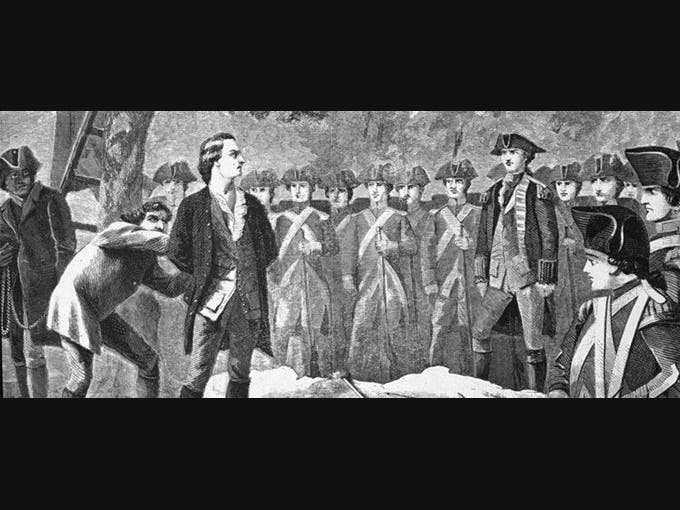

The American Revolution is routinely remembered through the poetry of its public declarations, the geometry of its battlefield maneuvers, and the marble profiles of its most famous founders. We treat 1776 as an explosion of pure political philosophy. But high-minded rhetoric in Philadelphia could not survive without operational execution on the ground.
As the nation marks its 250th anniversary, the urgent work of citizenship is not passive nostalgia, but a rigorous civic audit of our founding. If we look closely at the gears of the Revolution rather than its costumes, we discover a sobering truth: a republic needs ideals, but a revolution needs systems.
Nowhere is this clearer than in the evolution of the war's hidden infrastructure.
Find out what's happening in Pelhamfor free with the latest updates from Patch.
After early intelligence failures, including the capture and execution of Captain Nathan Hale in 1776, General George Washington recognized the need for a more durable system. While the British military occupied New York City, the nerve center of its North American command, Washington operated with a severe information deficit. In an environment where bad data or delayed reporting could expose the Continental Army to catastrophic risk, individual bravery could not substitute for institutional infrastructure.
To survive, the movement required a sustainable, secure information supply chain. When the Culper Spy Ring was organized in 1778 under the direction of Washington and Major Benjamin Tallmadge, its work over the following years became a case study in administration under pressure.
Find out what's happening in Pelhamfor free with the latest updates from Patch.
Historically, this network is often romanticized as an adventure story of invisible ink and hidden signals from a clothesline. In modern organizational language, however, it serves as something resembling a zero-trust security architecture: compartmentalized, coded, and deliberately designed to limit damage if one participant were exposed.
Tallmadge built a decentralized system based on strict risk controls. Operatives were stripped of their names and assigned numerical ciphers. Washington himself was simply 711. Messages were written in chemical sympathetic stains between the lines of ordinary correspondence, then moved across a relay stretching from New York City through Long Island and across the Sound into Connecticut. The system was designed so that if any single node in the chain failed, the remaining operatives remained blind to the rest of the network, protecting the integrity of the flow of intelligence. This was not theatrical spycraft. It was a highly managed risk-control infrastructure.
The payoff of this operational discipline was immense. When the ring helped uncover a British counterfeiting effort involving paper intended to imitate Continental bills, the intelligence contributed to Congress's decision to recall the notes in 1780. While the currency was already badly weakened and the recall was part of a broader collapse response, the episode showed that information management was central to systemic survival. Culper intelligence also played a vital role in the broader intelligence web surrounding British plans and the events of the Arnold-André affair at West Point.
Yet the most instructive lesson for the Semiquincentennial lies not in the machinery, but in the human infrastructure that powered it.
The Culper Ring did not rely on professional operatives, but on ordinary people absorbing extraordinary personal risk: Abraham Woodhull, a farmer; Robert Townsend, a merchant; Austin Roe, a tavern keeper; and Caleb Brewster, a whaleboat captain. Local tradition credits figures like Anna Strong with guiding couriers through the choreography of her clothesline, though historians continue to debate the evidence.
The surviving records also contain a shadowy reference to "355", a coded reference to a woman associated with the ring, whose exact identity and role remain unconfirmed by history. These people were ordinary citizens who became part of the physical infrastructure of survival, enduring the daily hazards of operational execution.
At 250, we tend to treat our democratic institutions as a permanent inheritance, a self-sustaining warranty guaranteed by the genius of the text.
The Culper Spy Ring reminds us that the founding was an operational achievement, not just a philosophical one. The American experiment survived because its leaders learned how to build systems under pressure, manage risk in deep uncertainty, and establish networks of trust where none existed. The Revolution was not only argued. It was administered, protected, transmitted, and sustained.
If we are to maintain the republic they designed, we must do more than admire the poetry of the ideals. We must commit ourselves to the heavy, unglamorous work of maintaining the machinery.
Series Anchor: This piece is part of the series, America at 250: Origins, Assumptions, and Obligations, a civic audit of the American experiment examining our founding institutions not as historical artifacts, but as a living system under stress.