Neighbor News
America at 250: Who Doesn't Love a (Knicks) Parade?
From George Washington to Jalen Brunson: Celebrating the Knicks at 250—how New York's parade route holds the weight of our national past.


Who doesn't love a parade? The question sounds light, almost too easy. But in America, parades have never been only about entertainment. They are one of the ways we turn moments into memories. A parade takes something a community feels and moves it through the street so everyone can see it together. That is why the New York Knicks' championship parade belongs in the America at 250 conversation.
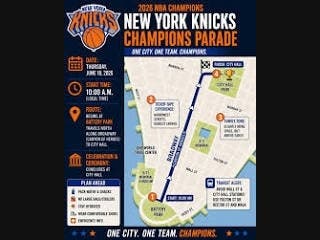
On Thursday, the Knicks are scheduled to begin their celebration near The Battery, roll north up Broadway through the Canyon of Heroes, and finish at City Hall. It is a sports parade, of course, a roaring release for a city that has waited fifty-three years to see the Knicks on top again. It is about Jalen Brunson, flying confetti, and a modern community making its joy visible. But look beneath the ticker tape, and the route reveals a much older inheritance.
The Battery is not just a scenic starting point. It sits at the southern tip of Manhattan, where New York Harbor made the city a strategic prize during the American Revolution. The British occupied Lower Manhattan from September 1776 until November 1783. Nearby Bowling Green became one of the Revolution's most vivid symbolic stages when patriots pulled down the statue of King George III on July 9, 1776, after the Declaration of Independence was read in New York. The statue's lead was later melted into musket balls for the Continental Army.
Find out what's happening in Pelhamfor free with the latest updates from Patch.
A few years later, that same city witnessed one of the Revolution's great symbolic endings. On November 25, 1783, British forces evacuated New York. George Washington entered the city with American troops in a ceremonial procession that marked New York's return to American control. For decades afterward, New Yorkers celebrated November 25 as Evacuation Day, a local holiday marking the end of British occupation.
Before Broadway became a canyon of ticker tape, it was part of a landscape of occupation, evacuation, return, and public memory. Long before this route became a theater of celebration, the American experiment understood that movement through a city could broadcast something larger than the movement itself.
Find out what's happening in Pelhamfor free with the latest updates from Patch.
Consider August 24, 1777. After British forces landed at the head of the Chesapeake and advanced toward Philadelphia, Washington marched roughly 11,000 Continental soldiers through the streets of the city. The soldiers were not dressed for spectacle. Lafayette described them as poorly armed and poorly clothed. Yet the march mattered because it made resolve visible. It asked civilians to watch a fragile cause move through their streets.
A few years later, Washington's entry into New York marked another kind of procession. Not anxiety before battle, but liberation after occupation.
The Canyon of Heroes belongs to that same American habit. Since the dedication parade for the Statue of Liberty on October 28, 1886, New York has used Lower Broadway to turn achievement into civic memory. Astronauts, generals, presidents, foreign leaders, essential workers, and championship teams have passed through it. The route is not just pavement. It is a public archive.
Now the Knicks join that lineage.
That does not mean a basketball championship is the same as a revolution. It is not. But the ritual is familiar: a community experiences something together, then gathers in the street to prove that it happened. The crowd becomes the witness. The route becomes the monument. The celebration becomes a memory.
At America's 250th, that matters. A republic does not remember only in its founding documents, monuments, museums, or speeches. Sometimes it remembers with folding chairs, barricades, brass bands, confetti, fire trucks, school groups, veterans, athletes, and neighbors leaning over the curb to see what comes next.
Before America had championship parades, it had survival parades. Before the Canyon of Heroes had ticker tape, Lower Manhattan had Revolution, occupation, evacuation, and return.
So yes, cheer the Knicks. Let New York have its moment. Let the confetti fall. But as the parade moves from The Battery up Broadway, it is also moving through one of America's oldest civic instincts: the need to gather in public, honor a shared story, and say together that this mattered.
At 250, America is still marching its memory down the street.