Neighbor News
America at 250: Why June 11, 1776 Should Ring a Bell
Abigale Adams Interview with Thomas Jefferson and John Adams

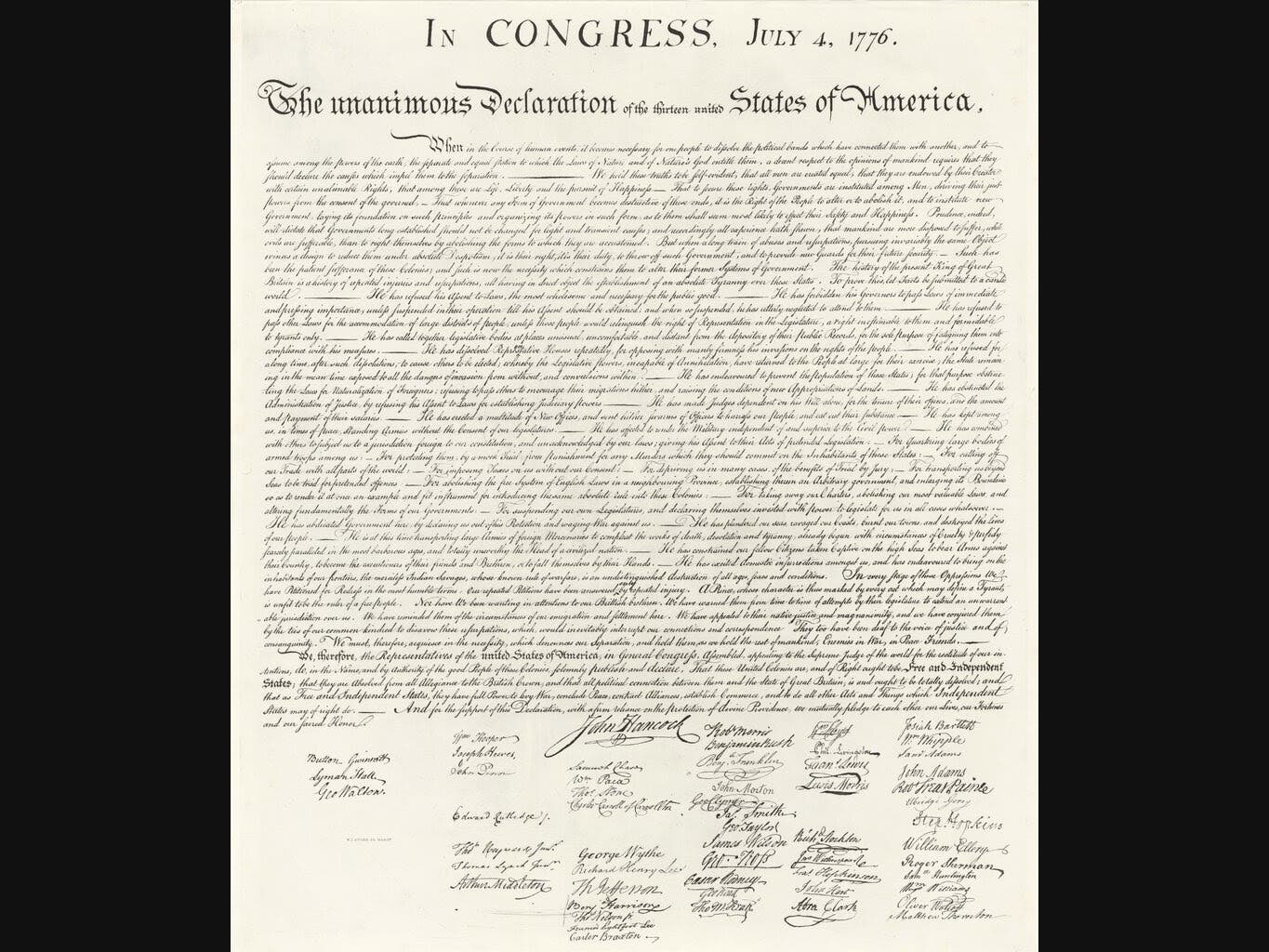
On the road to July 4, we often focus on the finished product, the Declaration of Independence, rather than the institutional machinery that produced it. But 250 years ago, on June 11, 1776, the Continental Congress made a procedural move that shaped everything that followed. It formed a committee.
The delay was the point. Several colonial delegations still lacked authorization from their home governments to vote for independence. Congress could not act until the colonies themselves acted. But while the vote waited, the system kept moving. The result was the Committee of Five, Thomas Jefferson, John Adams, Benjamin Franklin, Roger Sherman, and Robert Livingston, tasked with drafting a public explanation for independence if the colonies ultimately authorized it.
Their mandate was not to declare independence. Their mandate was to explain it, defend it, and provide the political vocabulary that delegates would soon need to justify separation to their own constituents.
Find out what's happening in Pelhamfor free with the latest updates from Patch.
So imagine, for a moment, what the room sounded like the night before that assignment became official. Imagine Abigail Adams, a political actor in her own right, interviewing the men who would soon write the nation's founding argument.
What would she ask Jefferson, a slaveholder preparing to write about equality?
Find out what's happening in Pelhamfor free with the latest updates from Patch.
What would she ask John Adams, a revolutionary insisting on liberty while excluding women from the political system he was helping design?
Those questions are not anachronistic. They are the contradictions the founding generation debated in real time. And they are the contradictions the drafting committee had to navigate as it prepared a document meant to speak for a continent.
The Declaration that emerged weeks later was not a spontaneous miracle. It was the product of delay, committee work, political authorization, compromise, and the urgent need to explain why resistance had become independence. June 11 is the hinge, where wartime governance met political process, and where the machinery of a new nation began to take institutional shape.
That is why June 11 matters. The full transcript of the imagined interview is noted below:
MEET THE COLONIES: PHILADELPHIA
Broadcast Date: June 10, 1776
Location: Pennsylvania State House (Independence Hall)
Moderator: Mrs. Abigail Adams
ABIGAIL ADAMS:
Good evening. We are broadcasting live from Philadelphia, where a brutal heatwave has settled in. Inside the State House, the political climate is even more stifling.
Just three days ago, Virginia's Richard Henry Lee introduced a radical resolution to dissolve all ties with Great Britain legally. Today, June 10, following an intense and polarized debate, the Continental Congress came to a temporary halt. Because several delegations still lack clear authority from their home assemblies, Congress has officially voted to delay the final independence vote until early July.
But leadership is not waiting passively. To prepare for that possibility, Congress has already scheduled the appointment of a special drafting committee for tomorrow morning. Their mandate will be to prepare a public declaration explaining the case for independence, just in case the vote passes next month.
Joining us tonight are two of the political figures at the center of these ongoing congressional negotiations. From Virginia, Mr. Thomas Jefferson. And from Massachusetts—my husband, Mr. John Adams. Gentlemen, welcome.
JOHN ADAMS:
Thank you, my dear. Though I must protest, sitting in this interview chair tonight is an operational waste of precious time! Delaying the vote today was a tragedy! The period for debate expired when British lead met American flesh at Lexington! We should be voting, not waiting for instructions!
ABIGAIL ADAMS:
You will have your turn to bluster, John. Let us begin with Mr. Jefferson. Sir, because of today's delay, Congress is expected to appoint you to this new drafting committee tomorrow morning, June 11. If you are tasked with writing this document over the next few weeks, what is your core strategy? Are you drafting a legal brief or a declaration of War?
THOMAS JEFFERSON:
(Speaking softly, leaning forward) Neither, Mrs. Adams. It is not our purpose to find new principles or arguments never before thought of. My goal, should the Committee assign me the principal writing tomorrow, will be to place before humankind the common sense of the subject. It must be an expression of the American mind. When a government becomes systematically destructive of human rights, it is the absolute duty of the people to alter or abolish it. I intend to put our shared internal convictions on paper.
ABIGAIL ADAMS:
Mr. Jefferson, let us look closely at those convictions. You have frequently spoken of a political philosophy that asserts all men are created equal. Let us address the operational hypocrisy here. You are a Virginian plantation owner. You hold hundreds of human beings in hereditary bondage. How do you reconcile a sentence about universal equality with a system built on human slavery?
THOMAS JEFFERSON:
(Visibly tense, shifting his stance) The principle represents our highest ideals, ma'am. Indeed, our current laws do not yet match those words. But in the document I intend to frame, I plan to include a fierce clause directly challenging the Crown for its role in keeping the African slave trade open. The King has waged a war against human nature itself by protecting that traffic, and I intend to say so. I only hope Congress dares to stand by a thorough condemnation of that trade when we finally vote in July.
ABIGAIL ADAMS:
John, let us bring you in on this. As you lobby delegations, your colleagues from South Carolina and Georgia are already whispering that if a clause attacking the slave trade stays in a final text, they will walk out of this Congress. They will break the union before it even starts. Will you force them to accept it anyway?
JOHN ADAMS:
(Banging his fist on the table) Abigail, look at the horizon! General Howe is massing tens of thousands of British regulars and Hessian mercenaries! We are facing total military annihilation if we do not achieve a unified front!
Do I wish to see the malignant disease of slavery extirpated from this continent? You know I do! But if I must choose between an imperfect union that survives the summer, or a perfectly moral document that gets us all hanged by the King next month, I choose survival! We will have to audit our system later. First, we must secure the right to exist!
ABIGAIL ADAMS:
A convenient deferral, John. But speaking of auditing the system, you are busy planning a new code of laws for a new nation. Yet, you continue to exclude half the population. When I wrote to you this past spring, I explicitly warned you to "Remember the Ladies" and be more generous to them than your ancestors. I noted then that if particular care is not paid to the ladies, we are determined to foment a rebellion of our own, and will not hold ourselves bound by any laws in which we have no voice or representation.
Why is the machinery of your new government ignoring the rights of women?
JOHN ADAMS:
(Laughing nervously, wiping his brow) As to your extraordinary code of laws, I cannot but laugh! We have been told that our struggle has loosened the bands of government everywhere—that children, apprentices, and Indians are growing turbulent. But your letter from April was the first intimation that another tribe, more numerous and powerful than all the rest, has grown discontented!
We know better than to repeal our masculine systems. Although they are in full force, you know they are little more than theory. We are completely at the mercy of the ladies; the masculine system is all we have left to protect our pride!
ABIGAIL ADAMS:
Spoken like a true politician, John—using humor to evade justice. Mr. Jefferson, let us close with you. If Congress indeed appoints your Committee tomorrow, and you spend the rest of June writing this text, what is the ultimate shelf-life of the words you are preparing?
THOMAS JEFFERSON:
(Pausing, looking down at his pocket watch) The words will outlast us all, Mrs. Adams. A generation is like a distinct nation, with a right to direct its own course. The words on that parchment will be a promise. Whether future generations of Americans have the public will to maintain the machinery of liberty, and build a country truly worthy of those words... that will be the urgent question.
ABIGAIL ADAMS:
High stakes, deep compromises, and a ticking clock tonight in Philadelphia. Tomorrow morning, June 11, the Committee of Five is expected to be formally appointed, and the clock begins ticking on the draft. We will be there. Goodnight.