Neighbor News
America at 250: A System Built on Expectations That No Longer Hold
Were the Constitution's Authors a Little Too Optimistic?

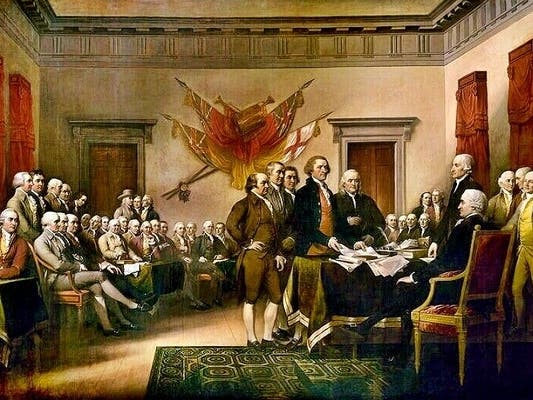
After reading the recent New York Times analysis, Were the Constitution’s Authors a Little Too Optimistic? By Adam Liptak, of the modern presidency, I was struck by a common flaw in how we talk about modern governance. The headlines are always about the people in power, but the real story is about how the guardrails of power are failing. The United States turns 250 this year, and the milestone invites a clear question: What happens when a governing design built on eighteenth‑century expectations is asked to regulate twenty‑first‑century political behavior?
The framers understood that they were creating a powerful executive. Benjamin Franklin warned at the Constitutional Convention that the office would "always be increasing here, as elsewhere, till it ends in a monarchy." That was not a casual prediction. It was a design constraint. The presidency was engineered to be energetic but bounded. The boundaries were not only textual. They were behavioral. The system's stability depended on a specific set of human incentives and institutional safeguards.
A clear‑eyed audit of the Constitution at 250 requires examining the governing expectations of the founding generation and assessing how those expectations have weakened under modern conditions.
Find out what's happening in Pelhamfor free with the latest updates from Patch.
1. The Madisonian Design: Institutional Rivalry vs. Partisan Alignment
James Madison built the separation of powers on a theory of human motivation. "Ambition must be made to counteract ambition." He believed that members of Congress would often identify with the legislature's institutional power and would resist encroachments by the executive, regardless of personal or political alignment.
Impeachment illustrates the gap between design and reality. The framers expected that a simple majority in the House and a two‑thirds vote in the Senate would mobilize when a president breached the public trust. That expectation made sense in a political world without disciplined national parties. It does not describe the system we inhabit. Once partisan alignment replaced institutional rivalry, the internal mechanics of Congress shifted. Party loyalty now routinely supersedes branch loyalty. Impeachment has become a polarized numbers exercise rather than a functional safeguard.
Find out what's happening in Pelhamfor free with the latest updates from Patch.
2. The Hamiltonian Design: Executive Energy Without Adequate Friction
Alexander Hamilton argued for an energetic executive, believing that vigor in the presidency was essential to national security and effective administration. He also understood the risks. In Federalist No. 1, he warned that republics often fall when populist leaders "commence demagogues, and end tyrants."
The modern presidency fulfills Hamilton's demand for energy while testing whether the constitutional restraints around that energy remain sufficient. Over two centuries, the accumulation of administrative, military, and regulatory authority has produced an executive branch of unprecedented scale. The contemporary president commands a vast federal apparatus that would be unrecognizable to the delegates in Philadelphia. Hamilton designed a high‑powered engine and assumed the steering mechanisms would remain intact. Today, the volume of executive orders, emergency declarations, and administrative actions shows that the engine can operate with limited friction from the other branches.
3. The Adams Warning: Written Rules Dependent on Civic Restraint
John Adams observed that the Constitution was made "only for a moral and religious people" and was inadequate for governing any other. His view reflected a broader founding expectation, shared by George Washington, that the written text would be reinforced by unwritten norms, personal honor, and civic shame. They believed that presidents would be constrained by a sense of constitutional duty and a desire for historical reputation.
Modern politics has exposed the fragility of this expectation. The Constitution contains few explicit defenses against a chief executive who disregards unwritten traditions, resists judicial authority, or bypasses statutory limits. When political incentives reward norm violation and partisan loyalty shields leaders from consequences, the limits of "parchment barriers" become clear. The system relied on behavioral restraint that no longer operates as intended.
4. The Democratic Transformation: The Loss of Founding‑Era Circuit Breakers
The consensus design of 1787 was cautious about direct, unfiltered democracy. The framers built circuit breakers into the system to buffer the federal government from sudden populist surges. Senators were chosen by state legislatures. The Electoral College was intended to be a deliberative body capable of filtering out unfit candidates.
Over the past 250 years, the United States has undergone a comprehensive process of democratization. Senators are now elected directly. The Electoral College functions as a binding formality. These reforms reflect modern democratic values but removed the structural filters the framers considered essential. The presidency is now directly exposed to mass populism, permanent campaigning, and the incentives of modern media. A design originally constructed to moderate public passion is now tightly coupled to it.
The Institutional Diagnostic
None of this analysis requires a partisan posture. It is not an argument about any individual officeholder. It is a structural recognition that the Constitution's durability has always depended on the alignment between its internal incentive structure and the actual behavior of political actors. That alignment has weakened.
The 250th anniversary is an opportunity to evaluate the Constitution as an operational framework rather than a sacred text. The central question is whether the behavioral expectations embedded in the 1787 design still describe the political reality of 2026.
A constitutional system built on behavioral premises requires those premises to be true. When they stop being true, the machinery begins to fail. The stability of the republic is not self‑executing. It requires a clear assessment of whether the incentives, guardrails, and expectations that once held the system together can still withstand the demands of the modern world.
Now that this foundational long-form piece is perfectly tuned, how do you want to handle the rollout—should we pull out a brief, punchy excerpt to serve as a preview for your LinkedIn network?