Neighbor News
Foreign Doctors, American Patients: Which Numbers Actually Matter?
From residency slots to patient access

When the inspector general for the U.S. Department of Labor recently turned to social media to question physician hiring practices at Rochester General Hospital in western New York, he directly challenged the health system: "Show us the numbers."
The questions followed a viral claim that 80 of 82 medical residents shown on a hospital webpage were foreign workers on visas rather than American applicants. Rochester Regional Health subsequently said that the webpage cited in the original post was not a list of a single incoming class, but a roster of residents across multiple years of training. The health system also said it had received no official communication from the Department of Labor at that point.
Asking for transparency is reasonable. Graduate medical education represents a substantial public investment, and questions about who receives residency training and whether applicants receive fair consideration deserve serious answers.
Find out what's happening in Pelhamfor free with the latest updates from Patch.
But the Rochester controversy raises another question: What happens when different data categories are treated as though they mean the same thing?
"Show us the numbers" is a useful place to start. The harder question is which numbers actually tell us something useful.
Find out what's happening in Pelhamfor free with the latest updates from Patch.
Number 1: Medical School Location vs. Citizenship
The claim surrounding Rochester General began by treating a physician's medical school location as evidence of citizenship and immigration status.
Those are different things.
Graduating from an international medical school does not make a physician a foreign national. The National Resident Matching Program distinguishes between U.S.-citizen international medical graduates and non-U.S.-citizen international medical graduates for precisely this reason. In the 2026 Main Residency Match, more than 4,200 U.S.-citizen IMGs participated as active applicants, with 70 percent matching to first-year residency positions.
A roster showing that physicians attended medical schools in India, Pakistan, the Caribbean, or elsewhere tells us where they received their medical education. It does not, by itself, tell us whether they are U.S. citizens, permanent residents, or physicians requiring visa sponsorship.
Medical school location is geography. It is not immigration status.
Number 2: Visa Sponsorship
The second number is more straightforward: How many residents actually hold H-1B or J-1 visas?
That is one of the questions the inspector general publicly asked Rochester Regional Health, and it is a number worth knowing.
Non-U.S.-citizen international medical graduates are a significant part of the U.S. physician-training pipeline. In the 2026 Match, their first-year residency match rate was 56.4 percent.
But knowing the number of visa holders still does not answer the larger question raised by the controversy. A visa count tells us how many physicians require a particular immigration status to train in the United States. It does not establish why a hospital selected those physicians, how they compared with other applicants, or whether an American physician would otherwise have occupied each position.
That requires another set of numbers.
Number 3: Displacement vs. Physician Supply
The harder question is how many qualified American applicants would otherwise have filled those residency positions.
National Match data provide important context. In 2026, 93.5 percent of active U.S. M.D. seniors and 93.2 percent of active U.S. D.O. seniors matched into first-year residency positions. That does not prove that displacement can never occur at an individual program. It does show why a one-for-one assumption that every international physician represents an American physician denied a residency position requires considerably more evidence.
The type of residency program also matters. Research has documented differences in the composition of university-based and community-based residency programs, with international medical graduates representing a larger share of physicians in many community-based programs. That context does not explain Rochester General's individual selections, but it cautions against treating one program's composition as representative of graduate medical education as a whole.
Evidence from the Conrad 30 visa waiver program also complicates a simple displacement argument. Researchers examining changes in the number of waivers available to states found that expansion increased the supply of international medical graduates, particularly in states with fewer restrictions, without detecting a corresponding reduction in U.S.-trained physicians.
That research concerns the physician workforce after training, not residency selection at Rochester General. It cannot tell us what happened in Rochester. But it does show why we should measure the relationship between physician immigration and domestic physician employment rather than assume it.
Foreign Doctors, American Patients: Which Numbers Actually Matter?
Number 4: What Happens After Residency?
One more number receives considerably less attention in these debates: Where do physicians practice after residency?
The question is especially relevant in Rochester. Federal shortage-area data identify medically underserved populations within Monroe County, showing how a region can include major medical institutions while still having communities with inadequate access to care.
Residency and physician immigration programs operate at different stages of the workforce pipeline. Graduate medical education provides the clinical training physicians need to practice independently. In 2023, Medicare paid about $22 billion to support residency positions at more than 1,400 hospitals.
Programs such as Conrad 30 operate later. The program allows eligible J-1 physicians to obtain a waiver of the requirement that they return to their home country after completing U.S. medical training if they agree to practice full-time for at least three years in qualifying underserved areas.
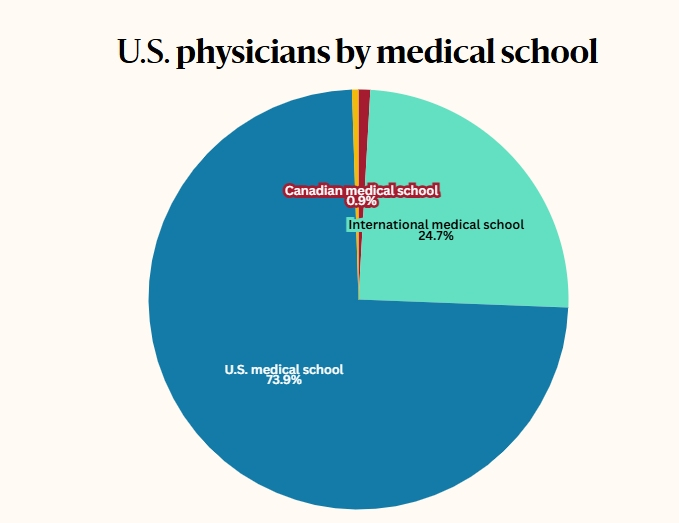
Between 2001 and 2020, the Conrad program recruited 18,504 physicians. International medical graduates more broadly account for roughly one-quarter of the U.S. physician workforce. According to the American Medical Association, nearly 21 million Americans live in areas where foreign-trained physicians constitute at least half of all physicians.
Those numbers do not settle the Rochester controversy either. They do something different. They remind us that residency selection is one stage in a much larger collection of policies that ultimately shape where physicians train, where they practice, and which patients have access to them.
Placement Is an Output. Access Is an Outcome.
The inspector general's basic instinct is reasonable: institutions receiving substantial public support should be transparent and accountable. Rochester Regional Health should be able to explain its residency practices and how those programs serve the public interest.
But oversight is only as useful as the measures behind it.
A foreign medical school diploma is not a visa. A visa holder is not evidence of a displaced American physician. And a residency directory tells us little about where physicians ultimately practice or which patients they eventually serve.
The distinction matters because the United States faces a projected physician shortage of between 13,500 and 86,000 physicians by 2036. At the same time, communities across the country continue to struggle with physician distribution and retention, particularly in areas that already struggle to attract them.
Those circumstances do not mean immigration programs should be exempt from scrutiny. They mean the scrutiny should extend beyond headcounts.
By all means, show us the numbers. But show us the numbers that help answer what ultimately matters to patients: whether our communities have continuous, durable access to the physicians they need.