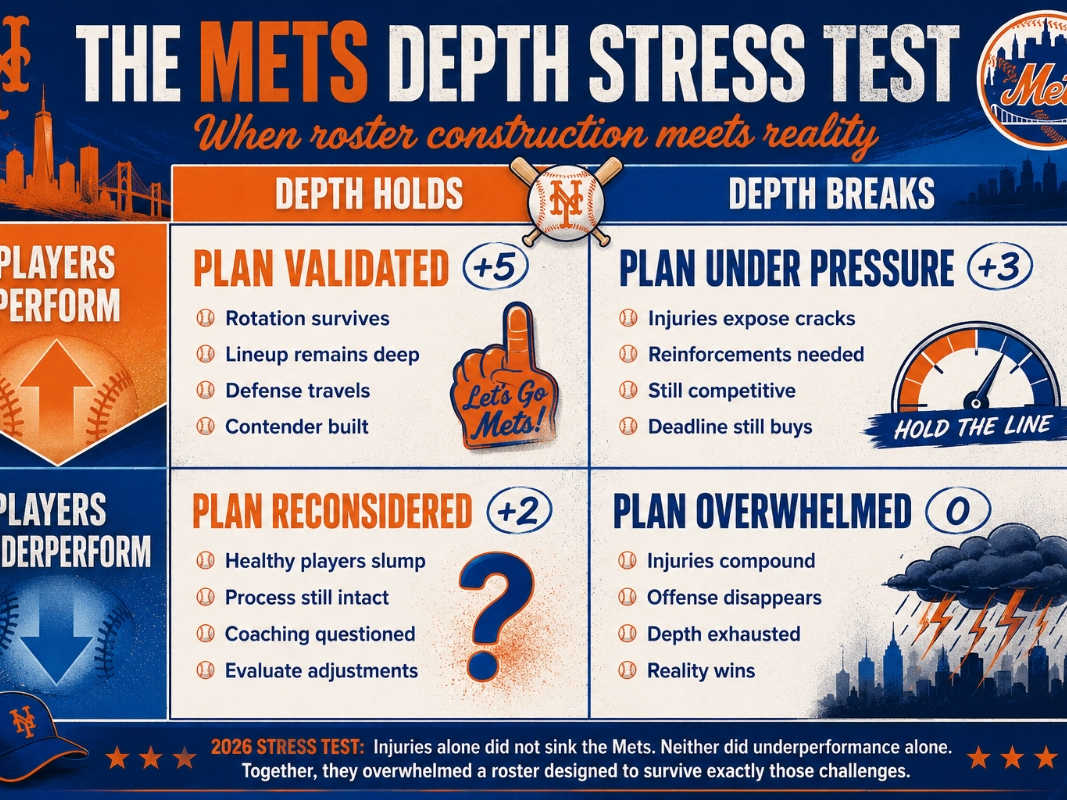
On the day before Opening Day, the New York Mets did not appear invulnerable. But they appeared deep enough, expensive enough, and talented enough to survive an ordinary baseball season.
FanGraphs’ ZiPS-based projections gave the Mets a 65.7 percent preseason probability of reaching the playoffs, the third-highest figure in the National League. Its standard playoff model was even more optimistic, placing their chances at 83.5 percent. The argument for optimism was straightforward: a veteran roster supported by Steve Cohen’s financial resources could withstand the standard attrition of a 162-game marathon.
What followed was anything but ordinary.
Find out what's happening in Pelhamfor free with the latest updates from Patch.
I. The Team the Mets Thought They Built
This season represented David Stearns’ first true stress test, and the priorities behind the roster appeared clear:
- Emphasize athleticism and defense rather than relying exclusively on power.
- Lengthen the lineup and reduce automatic outs near the bottom.
- Build layers of pitching depth capable of absorbing injuries.
- Avoid long contracts that could restrict future payroll flexibility.
Yet this was never a roster devoid of star power. Juan Soto and Francisco Lindor remained the everyday pillars of the lineup, while Kodai Senga was expected to anchor the rotation. Around them, Stearns assembled an experienced supporting cast that included Bo Bichette, Marcus Semien, Sean Manaea, Freddy Peralta, Devin Williams, and other veterans intended to raise the club’s floor over a 162-game season.
Find out what's happening in Pelhamfor free with the latest updates from Patch.
The objective was never to ask Soto or Lindor to carry the franchise alone. Soto continued to supply elite on-base ability and power, while Lindor remained the club’s central presence at shortstop and near the top of the order. The surrounding roster was supposed to prevent the entire offense from collapsing whenever one star slumped, another was injured, or the supporting cast thinned.
The front-office plan was to insulate Soto and Lindor, not maroon them on 2nd base.
Stearns assembled a roster intended to distribute responsibility rather than depend excessively on one or two stars. The expectation was that a deeper lineup, improved defense, and greater roster flexibility would allow the Mets to absorb the inevitable injuries and slumps of a grueling six-month season. The assumption was not that the Mets would steamroll the National League East. It was that their overall talent and depth appeared too substantial to permit a complete collapse.
Looking at the roster on paper, it is still difficult to identify where a 40–57 team is supposed to be hiding. The names suggest experience, athleticism, and upside. The standings tell a completely different story.
The question that now defines their season is clear: Did reality overwhelm the plan, or did the plan fail to account for reality?
II. Ninety-Seven Games Later
With the first half of the season officially concluded, the Mets sit at an abysmal 40–57. They reside at the bottom of the National League East, trailing the division-leading Atlanta Braves by 15.5 games. More critically, they are 12.5 games out of the third and final National League Wild Card position.
By late April, their playoff probability had already fallen to approximately 41 percent across the models. Entering the final game before the All-Star break, FanGraphs placed it at a microscopic 1.2 percent.
The physical attrition is undeniable, but the official medical report reveals that the Mets’ injured players occupy very different timelines.
Some help could arrive immediately. Center fielder Luis Robert Jr., sidelined since late April with a lumbar disc herniation, has been completing a Minor League rehabilitation assignment and could return directly after the break. Bo Bichette, dealing with leg and right ankle soreness, is considered day to day and may benefit from the additional rest provided by the All-Star break.
Marcus Semien could be a late-July reinforcement. The second baseman is recovering from a left hip-flexor strain and is approaching a rehabilitation assignment, although the break has complicated the availability of Minor League games.
Other losses will not be resolved during the decisive period leading up to the trade deadline. Mark Vientos became the latest casualty when a pitch fractured his right hand on July 9. Although he will not require surgery, he is expected to miss six to eight weeks, effectively removing another bat from the equation just as he was trying to find his footing. Clay Holmes is not expected back until August, while the Mets have also lost starter Tylor Megill and reliever Reed Garrett for the entire season as they recover from Tommy John surgery.
The injury to Holmes remains one of the most painful examples of this fragility. His transition from late-inning reliever to starting pitcher had been one of Stearns’ boldest early decisions as Mets president of baseball operations. Signed before the 2025 season after years as a high-leverage reliever with the Yankees, Holmes immediately moved into the rotation and started on Opening Day.
The experiment had already survived its first real test. Holmes made 31 starts in 2025, worked 165⅔ innings, and posted a 3.53 ERA. He entered 2026 not as an unproven conversion project, but as an established member of the rotation. Through his first nine starts this season, he was even better, producing a 2.39 ERA and emerging as one of the staff’s most dependable pitchers before a line drive fractured his right fibula in mid-May.
Holmes has recently resumed throwing live batting practice, but he still needs to rebuild his stamina and complete a rehabilitation assignment, making an August return far more realistic than an immediate post-break contribution.
His success across two seasons demonstrated that at least one of Stearns’ unconventional pitching decisions had genuine staying power. His injury, however, showed how quickly even a proven element of the plan could be removed from a rotation already struggling to withstand broader losses.
Holmes’ absence also compounded the instability surrounding Kodai Senga. The Mets entered the season expecting Senga to lead the rotation, with Holmes, Manaea, and Peralta forming an experienced group capable of absorbing innings behind him. Instead, back trouble sent Senga to the injured list in late April, and his return did not immediately restore the dominant pitcher the club had envisioned.
With Holmes unavailable and Senga unable to provide consistent ace-level stability, greater responsibility fell to Sean Manaea, Freddy Peralta, and the organization’s younger arms. Manaea supplied valuable innings after beginning the season in the bullpen, while Peralta alternated between stretches of reliability and inconsistency. But the most consequential pitching development may have been the accelerated emergence of a homegrown young rotation core.
Nolan McLean arrived in the organization with the unusual pedigree of a two-way player, earning the nickname “Cowboy Ohtani” at Oklahoma State before committing fully to pitching. By the 2026 All-Star break, his power arsenal and ability to miss bats had produced 125 strikeouts in 107⅓ innings and made him one of the rotation’s most compelling young arms.
Christian Scott’s emergence carried a different kind of weight. After flashing promise as a rookie in 2024, Scott underwent major elbow reconstruction and missed the entire 2025 season. His return in 2026 became one of the quiet triumphs of the Mets’ first half. Across 12 starts, he posted a 3.17 ERA and struck out 65 batters in 54 innings, demonstrating both the quality of his arsenal and the resilience required to reclaim a place in a major-league rotation.
Zach Thornton supplied still another kind of optimism. The left-hander entered the year as a prospect known more for command and strike-throwing than overpowering velocity. In the final game before the break, he delivered seven scoreless innings against Boston, allowing only two hits and striking out five.
Together, McLean, Scott, and Thornton changed the meaning of the Mets’ pitching crisis. The club did not merely lose the hierarchy that the rotation was designed around. It also discovered the beginnings of another one.
To blame the medical report alone, though, is to offer an incomplete alibi. The healthy portion of the roster has profoundly underperformed. The offense, engineered to be resilient, has instead ranked near the bottom of Major League Baseball in both OPS and on-base percentage. With runners in scoring position, the Mets have repeatedly failed in the precise situations where a deep lineup was supposed to distinguish itself.
The failure was systemic enough to cost Carlos Mendoza his job after a 34–47 start. His replacement, interim manager Andy Green, brought an unusually broad perspective to the dugout. Green previously managed the San Diego Padres and, crucially, served as the Mets’ senior vice president of player development. He understood not only the major-league roster but also the organizational pipeline that was supposed to reinforce it.
That background made Green more than a temporary change of voice. He had observed the franchise’s younger players as they developed, knew the limitations of the available replacements, and understood the organizational culture and developmental system Stearns was attempting to establish. Yet even that deep institutional perspective has not produced an immediate turnaround. The Mets have gone just 6–10 under Green, suggesting that Mendoza was the first visible casualty of a structurally flawed team rather than the primary cause of its struggles.
One position, however, tells a different story. Behind the plate, the organizational layering Stearns envisioned has largely functioned as designed. Francisco Álvarez remains one of the Mets’ most important young players, a catcher whose power and presence behind the plate continue to make him central to the club’s future. Alongside him, Luis Torrens has provided a steady veteran presence through his defense, throwing arm, game-calling, and ability to manage an ever-changing pitching staff.
Even beyond the major-league roster, the depth has held. Hayden Senger has moved between Triple-A Syracuse and the Mets whenever injuries created a need, giving the organization a capable defensive replacement rather than forcing an emergency solution. In a season when so many layers of the roster have broken down, the catching position stands out as one area where the original organizational design largely succeeded.
Álvarez, Torrens, and Senger cannot compensate for an offense that has struggled to score or a pitching staff overwhelmed by injuries. But together they illustrate an important distinction. The Mets’ blueprint did not fail everywhere. Some parts of it performed as intended.
Elsewhere, the season has accelerated a different organizational story. Earlier conversations about the Mets’ future centered on Brett Baty, Álvarez, and Mark Vientos. By the All-Star break, the next wave had expanded in two directions. Carson Benge and A.J. Ewing brought athleticism and energy to the lineup, while Nolan McLean, Christian Scott, and Zach Thornton began making a case for places in the future rotation.
Benge made the Opening Day roster and has shown flashes of the power and plate discipline that made him a first-round pick. Ewing arrived in May and quickly added speed, defensive range, and a willingness to pressure opposing teams.
McLean, in particular, has become the kind of young pitcher around whom anticipation can form. Scott’s return from major elbow surgery offers a different kind of encouragement, while Thornton’s breakthrough against Boston added another reason to look forward rather than simply backward.
Not every young player fits neatly into that optimistic progression. Ronny Mauricio remains caught between prospect promise and roster uncertainty. His development was interrupted by the knee injury that cost him the 2024 season, and injuries, performance, and a crowded infield have fragmented his opportunities since returning.
Optioned again to Triple-A Syracuse in early July, Mauricio may be approaching an organizational crossroads. His raw talent remains difficult to dismiss, but the Mets must determine whether he still fits their next competitive roster or has become the kind of change-of-scenery candidate who could help address another need.
None of these players can rescue 2026 on their own, and none should be burdened with that expectation. But together they represent evidence that the organizational pipeline Green once oversaw may still produce players capable of complementing Soto, Lindor, and the club’s remaining core.
The youth movement has not disappeared. It has begun taking a different shape.
For Mets fans, the disappointment is not simply that a favored team lost more games than expected. It is that the season seemed to disappear before summer fully arrived. The All-Star break is ordinarily a moment to imagine what might happen over the next eleven weeks. This year, it may mark the point at which the organization stops asking how the season can be saved and begins asking what can still be salvaged from it.
III. Better Is No Longer Enough
The Mets have only 65 games remaining, and the mathematics of a genuine playoff run have shifted from challenging to astronomical. If the National League Wild Card threshold sits at a modest 87 wins, the Mets must finish the season 47–18.
That requires playing at a .723 winning percentage over the final two and a half months, a pace equivalent to approximately 117 wins over a full season.
The central irony is unavoidable. The Mets believed they had built enough depth to survive the demands of a normal season. When the season became abnormal, that depth proved neither deep enough nor productive enough.
A serious playoff run now requires an immediate and nearly flawless transformation:
- The Mets must begin playing like one of baseball’s two or three best teams.
- Robert and Semien must return quickly, while Bichette must regain full health, and the remainder of the lineup must produce consistently.
- The rotation must stabilize without Holmes, while Senga, Manaea, and Peralta provide enough veteran structure for McLean, Scott, and Thornton to develop without being asked to carry the entire staff.
- The Mets must beat the teams directly ahead of them rather than merely accumulate victories against their fellow cellar dwellers.
- Several Wild Card contenders must falter simultaneously.
- The team must show sufficient improvement in both its standings and underlying performance to justify delaying a deadline sale.
The standings themselves add another layer of difficulty. Two of the three National League Wild Card positions are currently held by division rivals Philadelphia and Miami. Between the Mets and Miami sit seven additional clubs: St. Louis, Pittsburgh, Arizona, San Diego, Washington, Cincinnati, and San Francisco.
Head-to-head games give the Mets opportunities to gain ground quickly because every victory also hands a loss to a direct competitor. But no single series can solve a problem spread across nearly half the league. The Mets must gain 12.5 games on Miami while climbing past all seven teams positioned between them and the postseason.
That crowded field is why improvement and contention are no longer the same thing. The Mets may become healthier. They may play considerably better. But to mount a genuine run, they must become, almost overnight, one of the best teams in baseball.
The Mets are no longer chasing a playoff spot. They are chasing an entire field.
IV. The Three Weeks That Decide the Deadline
This brings us to the August 3 trade deadline. David Stearns cannot permit mathematical possibility to interfere indefinitely with organizational reality. He has roughly three weeks to make a final evaluation, and the schedule immediately out of the All-Star break offers no soft landings.
Over the next 18 days, the Mets will play 16 games against five National League contenders. Four are among the league’s strongest teams. The fifth, Miami, currently occupies the final National League Wild Card position. Off days on July 17 and July 23 provide the only opportunities to catch their breath before the trade deadline:
- July 16, 18–19: Three games at Philadelphia
- July 20–22: Three games at Milwaukee
- July 24–26: Three games against Los Angeles
- July 27–29: Three games against Atlanta
- July 30–August 2: Four games against Miami
If the Mets emerge from that stretch with an 11–5 or 12–4 record, regain key players, and make substantial progress in the Wild Card standings, Stearns can justify delaying a full surrender. But a winning stretch without corresponding movement in the race would amount to respectable baseball, not a revived season. Even an 8–8 or 9–7 record against this level of competition would likely leave the organizational calculation essentially unchanged.
At that point, the mandate becomes clear: preserve the long-term core, use Steve Cohen’s financial capacity to improve potential returns, and move short-term assets whose value is greater to a contender than to the 2027 Mets.
Cohen’s role in that process may be as important as any individual trade. His financial resources give the Mets an advantage few sellers possess. The organization can absorb salary, reduce the financial burden on an acquiring club, and improve the prospect return.
But Cohen’s greater test may be one of restraint. Despite the disappointment of a 40–57 first half, he has continued to support Stearns. He has shown little indication that he intends to override the front office with a desperate attempt to rescue a season carrying only the faintest mathematical hope.
That does not mean ownership views the collapse casually. Cohen has expressed concern about the roster, the developmental system, and the club’s future flexibility. The deadline will therefore test the partnership he envisioned when he hired Stearns: Cohen supplying the resources, Stearns supplying the discipline, and both resisting the temptation to confuse urgency with panic.
A deadline sale would not require dismantling the roster. It would, however, force the Mets to evaluate a bullpen that has quietly become one of the organization’s most valuable sources of trade leverage.
Brooks Raley and A.J. Minter remain among the most obvious candidates because both are pitching well on expiring contracts. They are precisely the kind of experienced left-handed relievers contenders pursue when attempting to shorten postseason games.
Luke Weaver presents a more complicated decision. After a difficult April, he emerged as one of the league’s most effective late-inning relievers, giving the Mets a dependable option near the back of the bullpen. Because he remains under contract beyond this season, Stearns must weigh the value of preserving that stability against the opportunity to trade Weaver while his performance and market value may be at their highest.
Huascar Brazobán raises a similar question. He has supplied durable, high-leverage innings and remains under team control for multiple seasons, making him useful to both the current Mets and any contender seeking more than a short-term rental. His workload and effectiveness have made him one of the bullpen’s most valuable contributors.
But relief pitching is among baseball’s most volatile resources. Holding a productive reliever because he appears to be part of next year’s solution can be sensible. It can also mean passing up the moment when his trade value is at its highest.
The question is therefore not simply which relievers the Mets can trade. It is whether Weaver, Brazobán, Raley, and Minter are more valuable protecting late leads in Queens or producing younger, more durable assets for the organization’s next competitive roster.
Other veterans present equally complicated decisions. Freddy Peralta’s value is elevated because quality starting pitching is scarce across baseball. Sean Manaea’s recent improvement likewise creates a difficult balancing act between present competitiveness and future value.
The objective would not be to trade everyone who has value. It would be to distinguish between players who can meaningfully contribute to 2027 and those whose greatest remaining value to the organization may come through the return they can produce.
At the opposite end of the spectrum sit the franchise cornerstones. Soto and Lindor remain the clearest everyday foundations of the next competitive Mets team. Álvarez anchors what may already be one of the organization’s most stable position groups behind the plate, while Benge, Ewing, McLean, Scott, and Thornton have expanded the conversation about the club’s emerging core.
The challenge for Stearns is not deciding whether to dismantle the franchise and rebuild from scratch. It is determining which veterans best support that next competitive roster and which can accelerate it through the return they bring at the deadline.
Clay Holmes represents a more complicated category. His successful conversion, uncertain August return, and ability to opt out of his $12 million player option for 2027 make him more than a conventional deadline rental. Stearns must determine whether Holmes’ greatest value lies in the trade market, in the 2027 rotation, or in a possible extension. Similar judgments will determine whether the deadline becomes a limited sale of expiring contracts or a broader reconsideration of the roster.
In many ways, the weeks following the All-Star break represent the final examination of the roster Stearns assembled. Every series will provide new evidence. If the Mets regain health, receive meaningful contributions from their veterans, and continue to see growth from their emerging young players, the organization may justify delaying some of its most difficult decisions.
If not, the trade deadline becomes less a reaction to disappointing results than an acknowledgment of what the first 97 games have already revealed.
Conclusion
There is a difference between preserving hope and refusing reality. The Mets still have a second half to play, and they owe their fans a professional, competitive product.
Even if the postseason recedes completely from view, the second half need not become meaningless. McLean, Scott, Thornton, Benge, Ewing, and the rest of the emerging core can give fans something different to watch: not the rescue of 2026, but the possible construction of whatever comes next.
The Mets Still Have a Second Half. Do They Still Have a Season?
Baseball people often say that a season is not defined by one bad week or even one bad month because 162 games eventually reveal what a team truly is. The first 97 games revealed what the Mets have been. The question facing David Stearns is whether the remaining 65 can reveal what this organization might still become.