Neighbor News
What Sociology Still Helps Us See
How the Discipline Can Recover Its Curiosity and Public Trust


When I studied sociology as an undergraduate with a concentration in criminology, the subject did not hand me a list of pre-approved opinions. It gave me a practical lens. It helped me see how personal struggles involving crime, poverty, joblessness, and distrust in institutions are connected to public policies, historical forces, and organizational incentives. It taught me C. Wright Mills' famous lesson that the obvious explanation for human behavior is rarely the whole story.
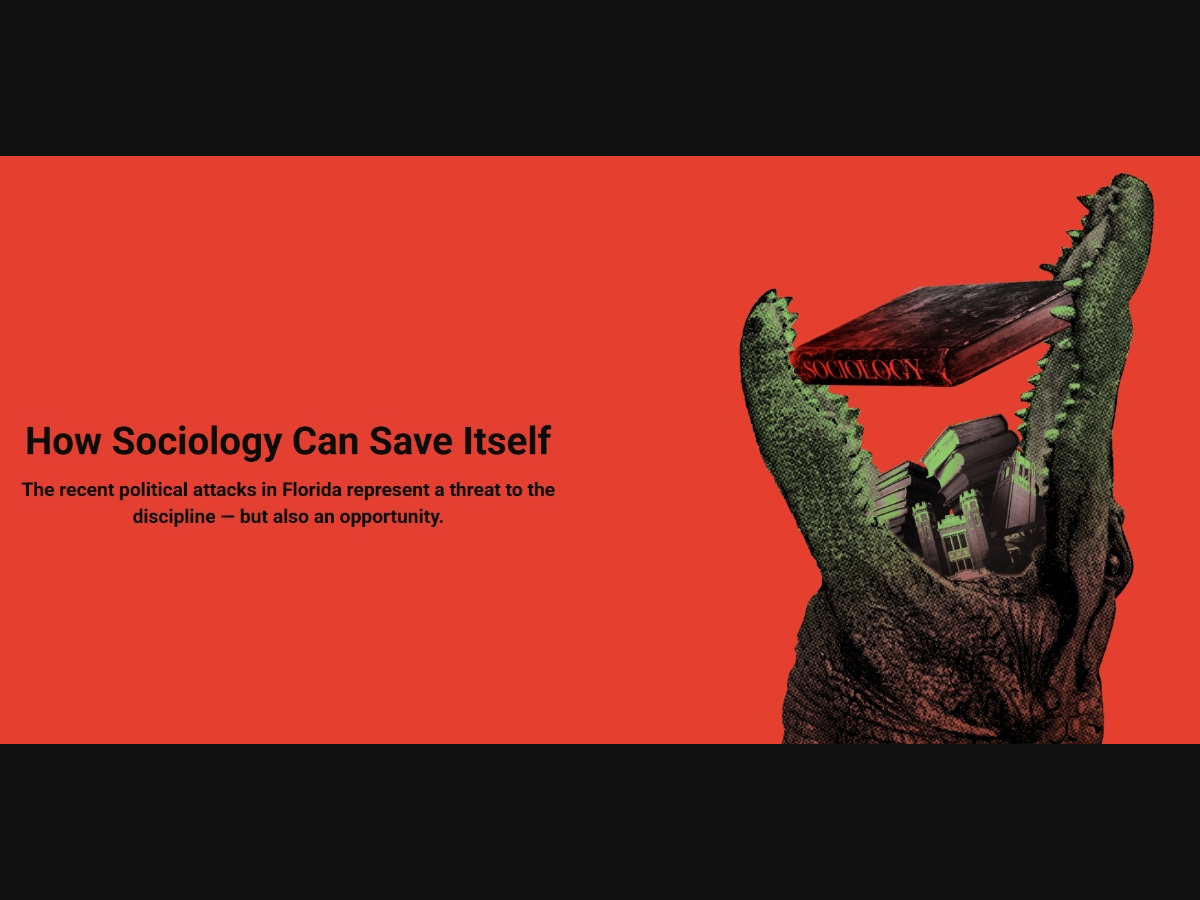
So when a recent Wall Street Journal essay asked whether it was time to "liquidate" sociology, the question felt less like a provocative opinion piece and more like a warning sign for higher education. Florida had removed introductory sociology from its general education core, framing the decision as a stand against political bias. The surrounding debate described a major in trouble, marked by falling enrollment, shrinking membership in professional organizations, and a growing belief that the discipline had traded careful research for political activism.
It is easy for supporters of sociology to dismiss these critiques as political noise. Doing that, though, misses a genuine vulnerability. Sociology does have a public credibility problem, but not because it examines inequality or power. The deeper issue may be a quiet shift in how parts of the field explain and justify their conclusions. A discipline built on studying social reality does not always explain clearly enough how it reaches the claims it makes about that reality.
Find out what's happening in Pelhamfor free with the latest updates from Patch.
Sociology cannot promise complete neutrality, and it should not become an instrument for predetermined political causes. What it can recover is a more honest curiosity, one in which concern inspires the questions but does not settle the answers.
The signs of decline are hard to ignore. Membership in the American Sociological Association is down significantly from its peak, and the number of students majoring in sociology dropped by nearly a third over the past decade. State leaders have responded by removing sociology from general education requirements and claiming that the field no longer teaches genuine critical thinking.
Find out what's happening in Pelhamfor free with the latest updates from Patch.
Political attacks on higher education can certainly be opportunistic, but some choices within the discipline have left it exposed. When professional organizations speak on contested political issues or describe the field primarily through the language of activism, the public may struggle to distinguish scholarly findings from organizational advocacy. These organizations should be clearer about when they are presenting research, defending disciplinary interests, or taking political positions on behalf of their members.
The deeper issue, at least as I have come to see it, is how the field tests and communicates what it claims to know. Critics argue that in some areas of sociology, moral conclusions can appear to arrive before the research has even begun. When unequal outcomes are treated as immediate proof of a single cause, or when disagreement with an interpretation is treated as a moral failing, public trust begins to erode.
Readers start to lose track of where the evidence ends, where interpretation begins, and where personal or institutional judgment enters. That does not mean sociologists should avoid difficult moral questions. It means the path from evidence to conclusion should remain visible.
One helpful way I have come to think about this problem is by separating four roles that are often mixed. Sociology involves conducting research, building theories, teaching students, and speaking publicly about social issues. All four roles are legitimate, but they do not operate under the same standards.
Research involves gathering and testing evidence. Theory involves building models that help us interpret the evidence. Teaching involves showing students how to examine different arguments and weigh them for themselves. Public advocacy involves applying sociological findings to change policy or improve social conditions.
Problems arise when these roles become tangled. What happens when a professor moves among them without making clear which role is speaking? When does an interpretation begin to sound like an established finding? When does a statement from a professional organization begin to sound like the settled conclusion of an entire discipline?
These are not reasons to abandon sociology. They are sociological questions worth asking about sociology itself.
The tension between studying society and trying to improve it is not new. It reaches back to the roots of American sociology, especially through the work of W. E. B. Du Bois.
Du Bois was a meticulous researcher and a passionate advocate for civil rights. In works such as The Philadelphia Negro, he used surveys, mapping, observation, and demographic evidence to document the realities of urban life for Black Americans. He did not regard scientific investigation and moral purpose as opposing forces. What I find compelling about his example is the suggestion that they can strengthen each other, provided the evidence is allowed to lead.
The sequence matters. Investigate carefully, test ideas against the available evidence, explain how the proposed causes operate, and acknowledge what remains uncertain. Advocacy may follow, but it should be grounded in an honest encounter with the evidence, including findings that complicate the argument we hoped to make.
Moral concern may influence what sociologists choose to investigate. It should not dictate what they are permitted to discover.
Removing sociology from college requirements in the name of fighting political bias deprives students of precisely this kind of disciplined inquiry. Sociology is not one political mindset. It is a collection of perspectives that can help us examine difficult questions from several angles.
Consider crime, which was my focus in college. A structural perspective might examine how job loss, housing instability, school quality, or neighborhood disinvestment affect crime over time. An interactionist perspective might study how labeling by police, schools, or communities influences a person's identity and future choices. An organizational perspective might look at how courts, probation departments, police agencies, and prisons respond to their own rules and incentives. A cultural perspective might ask why certain ideas about danger, disorder, and authority become dominant in the news and public discussion.
None of these perspectives has all the answers. Together, however, they offer a richer picture than any one explanation could provide on its own.
This is what first attracted me to sociology. It rarely leaves a familiar explanation alone. It asks what institutions operate in the background, which incentives people respond to, how identities are formed, and why one society defines a behavior as dangerous while another considers it ordinary. Sometimes the questions are more satisfying than the answers.
This kind of thinking extends far beyond policy debates. Writers and journalists such as Tom Wolfe built entire careers around a sociological way of observing the world. Wolfe used status competition, subcultures, rituals, language, and social performance to capture what daily life actually feels like. He showed that Mills' sociological imagination belongs both inside and outside the classroom, turning social observation into vivid human stories.
I am not trying to settle sociology's debates. I am trying to use the tools the field gave me to understand why those debates matter. This is where sociology becomes especially interesting to me: what happens when the discipline turns its own tools on itself?
When we ask sociological questions about sociology departments, we begin to see familiar human patterns. We see status competition within universities, publishing systems that may reward fashionable subjects or expected arguments, and professional pressures that can make it difficult to challenge prevailing views. Academic departments are made up of people, and they encounter the same office politics, group loyalties, status hierarchies, and insular habits that sociologists study in corporations, government agencies, and political organizations.
Applying this lens reveals an amusing contradiction in the debate. Critics often dismiss sociology as fake, useless, or hopelessly ideological. Yet in making that argument, they rely almost entirely on informal sociology. They talk about university incentive structures, class resentment, institutional capture, professional status, and cultural polarization.
People can hardly argue against sociology without using sociological concepts to do it. That alone should tell us something about how deeply the sociological way of thinking has entered public life.
If sociology wants to rebuild public trust and preserve its place in higher education, it does not need to claim perfect neutrality. It needs a dose of humility. It needs to show its work: how the evidence was gathered, which explanations were considered, where interpretation shaped the conclusion, and what remains uncertain.
It should present different theoretical perspectives in the classroom, remain open to competing explanations of social problems, and distinguish more clearly between scholarly findings and institutional political positions. None of this requires sociology to retreat from public life. It requires discipline to make the basis of its public claims more evident.
Sociology should not be liquidated. Abandoning the systematic study of human institutions would leave us far less prepared to understand crime, demographic change, workplace failure, social isolation, political division, and declining trust. Removing it from core requirements deprives students of valuable tools for understanding the world around them.
At the same time, those of us who value sociology cannot respond only by complaining about political attacks. The field must also be willing to examine its own habits and vulnerabilities.
Sociology is at its best not when it hands us the morally approved answer, but when it complicates the answer we arrived at. It connects private experience to public structure, makes the familiar seem newly strange, and reveals patterns operating just outside our view. That is the sociology I encountered as a student, the sociology I still enjoy exploring, and the sociology worth defending.