Schools
BMUFSD: Kindergartners Explore Laws Of Physics At Forces And Motion Assembly
How old do you have to be to begin learning about physics?


2023-02-01
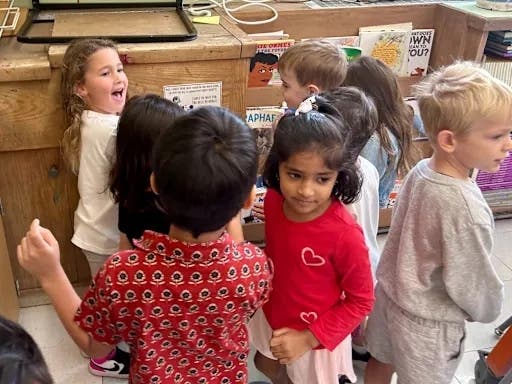
How old do you have to be to begin learning about physics? At Todd Elementary School, four and five-year-old kindergarteners learned about gravity, what causes objects to move and Newton’s three laws of motion, in a fun and interactive assembly called “Forces and Motion.”
Find out what's happening in Pleasantville-Briarcliff Manorfor free with the latest updates from Patch.
The assembly, funded by the PTA and PNW BOCES, was presented by Lluana Jones on the stage of the 3-5 cafeteria. She began by pulling a cloth off a table. The cloth had cups and plates on it and when she pulled it, the cups fell down but the plates did not.
“You will find out soon why the plates did not fall,” she told the students.
Find out what's happening in Pleasantville-Briarcliff Manorfor free with the latest updates from Patch.
Ms. Jones used various objects to demonstrate the different concepts of motion, and played upbeat songs about forces such as gravity, inertia and acceleration.
Both students and teachers had a chance to come up on stage and participate.
Ms. Jones spoke about various forces that push and pull, such as gravity.
She told the students that Sir Isaac Newton discovered gravity when he realized that there is a force that pulls everything towards the earth. She also introduced students to Newton’s three laws of motion.
“In the first rule, we learn about inertia, which says that an object in motion will stay in motion until an outside force stops it and that an object that does not move will stay that way until another object gets it moving,” she told the students.
Gravity and friction work together, she said, returning to what the students observed when she pulled the tablecloth in the beginning of the presentation.
“Gravity pulls something down, but if you move a ball on a table, the friction between the ball and the table will slow it down – more friction means it will slow down even more. The less friction something has, the easier it will be for it to keep moving – because something that moves has less friction. When I pulled the cloth in the beginning of the presentation, the glasses fell but the plates stayed on the table. The glasses did not have enough friction, so they moved easily. That is inertia.”
Ms. Jones discussed Newton’s second law of motion – that acceleration depends on an object’s mass and the amount of force.
“In physics, acceleration is going from one state to another,” she said. “For example, from moving slowly to moving fast.”
She also explained how mass is different from how much something weighs and discussed the third law of motion, which is that for every action, there is an equal and opposite reaction.
“All of these laws work together,” she told the students.
At the end of the presentation, students had the chance to ask questions and for the grand finale, everyone danced to an upbeat song.
This press release was produced by the Briarcliff Manor Union Free School District. The views expressed here are the author’s own.
Get more local news delivered straight to your inbox. Sign up for free Patch newsletters and alerts.