Schools
Briarcliff Shares Options for School Fields' Cleanup
Closed for almost two years over landfill concerns, the athletic fields face a range of remediation solutions.
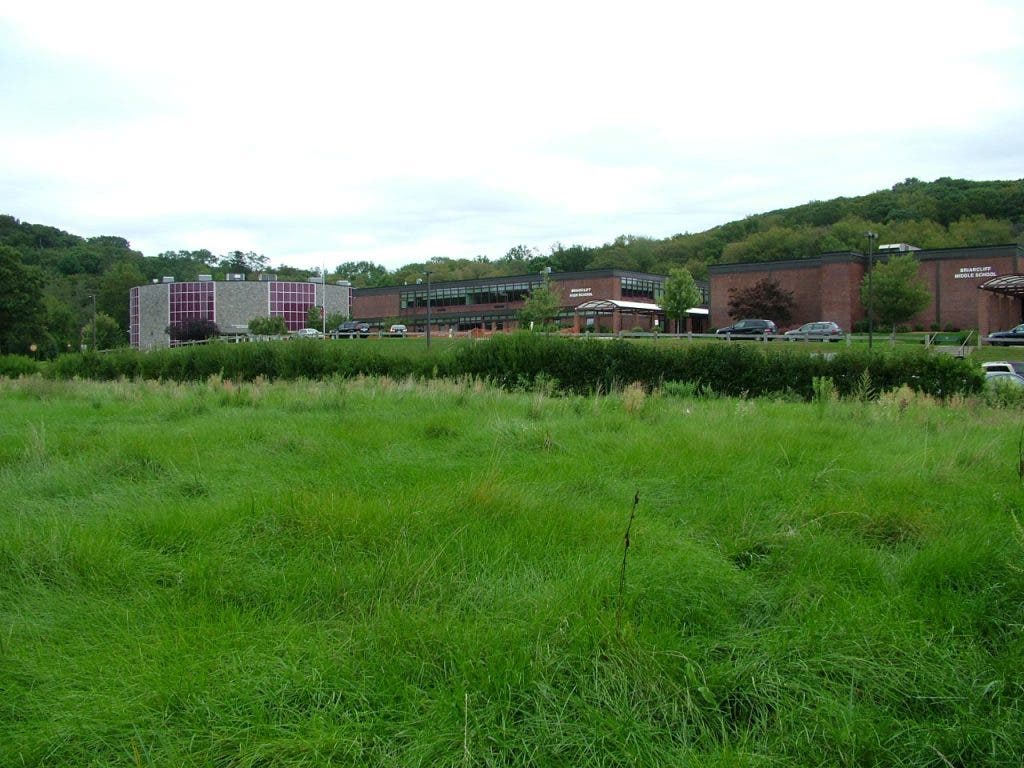

Briarcliff Manor residents were presented options Thursday for cleaning up a decade-old environmental mess that has closed two school district athletic fields.
Varying plans, with estimated price tags from $1.44 million to just over $18 million, address a potential hazard posed by illegal “fill” material. That fill—largely construction demolition material—was buried beneath the practice field and a softball field behind the middle school when they were built in the late 1990s.
Proposed solutions range from covering over the potential contaminants with grass, asphalt or artificial turf to digging up and carting away the mess, then restoring the fields to their pre-1998 condition.
Find out what's happening in Pleasantville-Briarcliff Manorfor free with the latest updates from Patch.
While specialists minimized the health risks for any one person using the fields, they said the sites constitute a public-health concern. Moreover—said the one lawyer on a panel of specialists convened by the school district—the state will mandate a cleanup, if only to bring the fields into regulatory compliance.
For two hours, more than 50 residents in the theater and a television audience beyond heard from five authorities on environmental matters. Buttressed by a welter of information and visual aids, including handouts, aerial photos, charts and graphs, a glossary of enviro acronyms and risk-factor formulas, the panelists took turns discussing the contamination‘s origins, its unlikely threat for now and its potential remediation.
Find out what's happening in Pleasantville-Briarcliff Manorfor free with the latest updates from Patch.
The lawyer, Michael S. Bogin of the environmental law firm Sive, Paget & Riese in Manhattan, provided the historical framework.
A Yonkers company, Whitney Trucking, he said, made a deal with the district in the late 1990s. In return for being allowed to dump 110,000 cubic yards of so-called “clean” landfill—organic and inorganic soil, with such things as small rocks, concrete and bricks—Whitney would build the fields on top of it. It did build the fields, in the fall of 1998, but the fill was not clean. Instead, Briarcliff’s two new fields rested atop illegal, possibly toxic, construction debris and demolition materials.
Inspectors with the state’s Department of Environmental Conservation (DEC) subsequently discovered the illegal fill. Testing uncovered polycyclic aromatic hydrocarbons, or PAHs, which have been linked to serious illnesses, in the subsurface fill as well as the topmost soil layer.
In 2003, DEC hammered out an agreement with the school district to clean up the practice field and to keep it off-limits until it had done so. For whatever reason, the softball field was not included. But only a year later, the school board apparently chose to ignore its consultants’ advice and breach the DEC agreement, It rebuilt the practice field by covering over the contaminated Whitney material with 7,000 cubic yards of new fill. The district also added a 3-foot topcoat and covered two monitoring wells.
In addition to Bogin, the panel members were Michael P. Musso, a senior project engineer with the consulting fIrm HDR; John M. Guzewich, an HDR project manager; Ronald C. Tetelman, president of Eberlin & Eberlin, a Somers-based landscape-architecture firm; and Dr. Robert Laumbach, a medical doctor and assistant professor in the department of environmental and occupational medicine at the Robert Wood Johnson Medical School.
Schools Superintendent Neal Miller introduced the panel and Stuart Mattey, the district’s assistant superintendent for business and technology, moderated the discussion.
Laumbach, the health consultant, drew a distinction between risk factors and the likelihood of contracting an illness, noting that cigarettes, fo example, are a known carcinogen and recognized health threat, but “nine times out of 10 [a lifetime smoker] won’t get cancer.” The landfill represents a “very, very low risk,” he said, but “it’s still a public health concern.”
Musso and Guzewich, the HDR consultants, described the cleanup options while Mattey, the assistant superintendent, discussed costs and financing. Restoring both the softball and practice fields to their pre-1998 state was, at $18,030,000, by far the most-expensive alternative.
Carpeting both fields with artificial turf, for example, would cost $3.65 million, Mattey said. Blacktopping both would run $2.91 million, he said, and old-fashioned grass, the least expensive, would come in at $1.44 million. Other alternatives, using combinations of coverings, were priced above $2 million but under $3 million.
Saying he advocated no specific option, Tetelman, the landscape consultant, said they “all will solve the problem and get the fields back in use.”
All of the options—including overall cost, average annual payment and available state aid—are expected to be posted on the district’s website.
In a question-and-answer session after the presentation, residents asked for more information and further opportunity for input before the school board settles on a remediation option.
___
Thanks for reading—you can also like us on Facebook and follow us on Twitter.