Health & Fitness
No news here
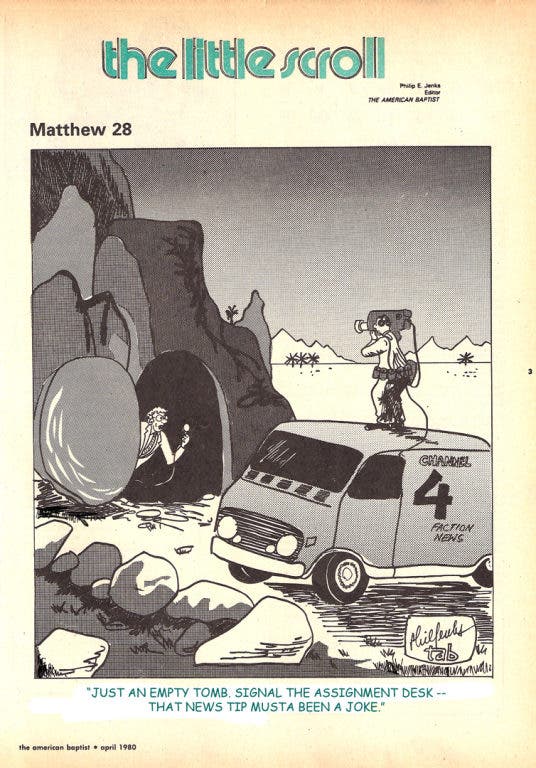
"Just an empty tomb," the reporter calls to the camera guy. "Signal the assignment desk. That news tip musta been a joke."

For the past three years I've been preaching to what must be called a faithful remnant at North Baptist Church in Port Chester, N.Y.
Just standing in that pulpit is an honor. The three Tiffany windows over my shoulder and other arrays of stained glass make it one of the most beautiful worship centers I've known. The church's storied past also includes a pastor to whom I am now married, the Divine M, ten inches shorter but always over me in the Lord.
But the church has seen better years and most Sundays the congregation approaches the minimal requirement for Jesus' presence, two or three gathered faithfully. But I work as hard on the sermons as if I was preaching in Riverside Church, and although the congregation looks like a small prayer group, I preach from the elevated pulpit so we all feel like we're really in church.
Un-ordained and un-adorned as I am, I had never preached on Easter until 2011.
That year I spent Holy Week pouring through scriptures and all the commentaries I could find.
By Saturday morning, I was leafing through dusty volumes of the The American Baptist magazine, which I edited until it expired. I wrote a monthly column for the magazine for nearly twenty years.
As any columnist knows, an approaching deadline may put the Muse to sleep.
That must have happened in the spring of 1980, because I didn't write an Easter message that year. I drew a cartoon instead.
The cartoon was hastily drawn and shaded with mis-matched press-on screens that had to be shaped by Exacto knives and pressed on to the paper. The drawing showed a TV news van pulling up to a tomb carved out of rocks in the middle of a barren desert. A reporter with a microphone emerges from the empty hole as a videographer waits tensely from his perch atop the van.
“Just an empty tomb,” the reporter calls to the camera guy. “Signal the assignment desk. That news tip musta been a joke.”
Ha, I thought at the time. Theological irony. Very funny.
But for me, the ecstasy of art would soon turn to self-conscious agony.
About a month after the cartoon was published, I was one of a thousand or more participants in Religion Communication Congress 1980, a once-a-decade event for religious communicators. That was the year the newly elected Pope John Paul II addressed the gathering by videotape, and Harvard theologian Harvey Cox was a keynote speaker.
I watched Harvey from a balcony at the rear of the auditorium. He was – and is – a major American Baptist celebrity. I had known about Harvey for years because he was idolized by a Roman Catholic chaplain I had worked for in the Air Force.
Chaplain Richard J. Kucharski – Father Kuch – was one of the young liberals swept into the church by the fresh air of Vatican II.
Father Kuch quoted Harvey Cox incessantly, especially paragraphs from Harvey's best-selling book, The Secular City. I had no idea who Harvey Cox was, but the fact Father Kuch kept quoting him made him a giant theologian in my book.
Years later when I joined the American Baptist staff in Valley Forge, Pa., I met Harvey Cox and even edited some essays he wrote for The American Baptist magazine.
I made plans to casually run into Kucharski one day so I could pinch my fingers together and tell him, "Yeah, me and Harvey are like this!" Sadly, the next time I heard about Kucharski, he had dropped out of the priesthood, gotten married, and died. (“That must have been some honeymoon,” my old sergeant said when he called with news of Kuch’s passing.)
As I was settling in the rafters of the auditorium on that warm spring day in 1980, I thought of Kuch as Harvey's resonant voice filled the hall.
My ears twitched when I heard Harvey say, "I saw a cartoon recently that summarizes the state of the church."
I was stunned and then breathless as Harvey went on to describe my drawing and quote the caption from The American Baptist. A smattering of applause broke out in the audience. Whoa, I thought. Is this my 15 minutes of fame?
I don't remember what Harvey said after that (although I think he ended his speech by quoting the cartoon again). After he finished I made my way through the crowd to shake his hand. He smiled toothily at me and I waited for him to remember where he had seen my drawing.
Still flashing his magnificent overbite, he began to wander away.
I stepped in front of him and said, "Thanks for the endorsement."
"What?" he said. He lowered his ear in a quizzical manner.
"The cartoon. Thanks for mentioning the cartoon."
His eyebrows knitted in puzzlement.
"Sher," he said after a brief hesitation.
I realized instantly he had no idea what I was talking about. He had forgotten where he had seen the cartoon and the magazine that printed it.
I thanked him again and stepped back so the rest of the admiring crowd could get to him. My fifteen minutes of fame fizzled in the footlights.
It was a harsher lesson then, when I was in my early 30s, than it would be now. Three decades later I've accumulated a sufficient number of humbling experiences to handle them with a modicum of aplomb.
But I'd like to think that the message of that cartoon still has meaning this Easter.
The fact that Jesus' tomb is empty is big news. But it no longer tops the news hour or appears on page one above the fold. Seasoned reporters don't get it. It's the most overlooked headline of our times.
But it's still big news, and it doesn’t really matter who gets credit for reporting the news. In fact, a Christian should probably be embarrassed for seeking recognition for evangelical efforts.
Next time I see Harvey Cox, I should thank him for protecting me from that embarrassment.