Arts & Entertainment
Fatoumata Diawara at Landmark: Banned Music Set Free to Soar
DarkViolin reviews a live music performance by Malian musician-activist Fatoumata Diawara at Landmark on Main Street



Impossible.
Imagine a country where music has been banned. Not impossible in certain areas of Mali controlled by leaders described by the New York Times as “Islamic militants” and who have since 2012 effectively banned all music in the areas of Mali they control.
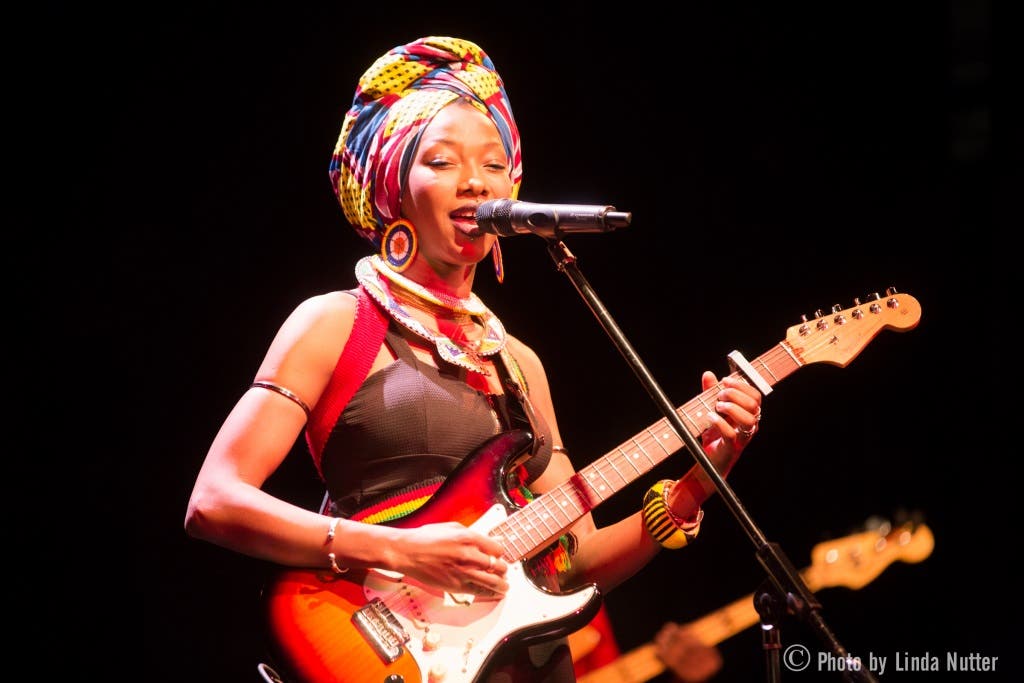
Recently the documentary They Will Have to Kill Us First won best feature documentary prize at the Chicago CIMMFest. As Andy Markowitz wrote in Music Film Web @MusicFilmWeb, “Mali has won global recognition as one of Africa’s sonic meccas. Which made the cultural fatwa proclaimed in 2012 in the country’s embattled north all the more shocking.” The documentary follows the lives of exiled Malian artists, and could well have profiled the striking musician Fatoumata Diawara who strode across the Landmark stage this past April 18.
Find out what's happening in Port Washingtonfor free with the latest updates from Patch.
Fatoumata Diawara made her dramatic entrance with a signature towering red and yellow headdress, colorful floor length dress, dual artisanal necklaces designed with concentric circular patterns, matching upper-arm bracelets, giant round earrings – and a decidedly Western electric guitar which she proceeded to fingerpick.
In songs that were at times layered pleas sewn together with a simple music fabric, Diawara asked for peace and for love’s conquering power to prevail. While her idioms and vocalizations set the cultural tone, the underlying harmonies were often straightforward (e.g., root – minor 4th, root – major sixth). The center of her musical circle was message: the plight of orphans, rights for African women, unity, of dignifying the memory of Nelson Mandela.
Find out what's happening in Port Washingtonfor free with the latest updates from Patch.
Supporting Diawara were Congolese bassist John Bashengezi, Nigerian percussionist Tosin Arbisala @TosinBeats from Nigeria and guitarist John Lee. Aribisala, who has also played with Mali’s Vieux Farka Touré -- son of a famed guitarist Ali Farka Touré -- struck rhythms drawn from both north African and progressive rock. It must be said that prog rock genre he brought with him was one of the evening’s not-too-secret delights.
John Lee, whose web persona is the “Chinese Irishman,” provided a second guitar to Diawara’s own. What Lee provided was sometimes gently complementary to what she first framed. Wielding a Gibson hollow body electric, he would at other times lay down rhythm guitar patterns, apply wah effects, or deliver a powerful lead line. Lee’s playing style blended Malian themes designed by Diawara with a more complex spice that combined George Benson with Jerry Garcia.
At some point during the show, Diawara insisted that her audience stand – “Everybody!” she commanded. And stand they did – for most of the remaining performance. But it wasn’t only the moment’s exuberance they were standing for. They had absorbed something of the “separations and segregations” of which the musician sang. They stood to honor her signaling of it.
Luggage of Lyrics
Equally Impossible: imagine that Fatoumata Diawara will not return to Long Island with a suitcase full of songs yearning to be free.
The evening’s proceedings were partly supported by the Baltimore-based Mid Atlantic Tours program of the Mid Atlantic Arts Foundation (@MidAtlanticArts) and the National Endowment for the Arts. Also in attendance were some of Weber Middle School’s Global Thinkers Mentoring Program, who will be the subject of a future story.
► Read a longer version of this review at DarkViolin.com.
► Next up: Landmark will host comedian Tom Arnold on May 2.
Image credits: Linda Nutter Photography