Business & Tech
Historic Sands Point Home for Sale
A lovingly restored farmhouse built by Quakers, and later owned by Guggenheim and then Harriman.




Just blocks from the recently torn down – the house said to have inspired F. Scott Fitzgerald to write “The Great Gatsby – sits Salt Meadow, considered one of the few remaining homes built by Quaker farmers in Sands Point.
Unlike Lands End, which was , Salt Meadow is now fully restored. Built in 1846 by Quaker craftsmen, this 6-bedroom, 5.5-bath Greek-revival-style farmhouse at 32 Sterling Lane is on the market for $2.495 million dollars. Taxes are listed as $36,075, and village taxes, $8,074.78.
On the market since January, the home sits on 2.7 acres, and includes a concord grape vineyard. The home has been lovingly restored by owner Robert Schapiro, a retired commercial airline pilot, and his wife, journalist Arlene Getz.
Find out what's happening in Port Washingtonfor free with the latest updates from Patch.
The couple bought the home in derelict condition in 2004 for $2.175 million.
“It was totally overgrown,” Schapiro said. “It had a toilet and one cold water tap.”
Find out what's happening in Port Washingtonfor free with the latest updates from Patch.
Yet the couple, with an appreciation for old homes, was sold on the house's potential.
They spent $450,000 restoring the home, plus Schapiro’s five years of labor. Schapiro says he does all of the home’s maintenance and tends to the vineyard from which he produces wine.
Through research, the couple learned that the home was built by Leonard Mott, a Quaker farmer, for his son Edward and his wife Deborah Burtis. Leonard lived nearby in his own farmhouse. Poised on the edge of a salt meadow, it is close to one of the Long Island Sound’s sandy beaches.
According to the 1850 census, the Motts, and their daughter Elizabeth, lived with four workers, two of them black. The Motts of Sands Point were abolitionists, helping escaped slaves hide before journeying further north through the Underground Railroad.
Elizabeth Mott later sold the farm in 1900 indirectly to William Guggenheim, who was buying up local properties. In 1929, the property was sold again to William Averill Harriman, who would become governor.
Harriman expanded the home, and when he remarried, his new mother-in-law moved in. A great entertainer, her guests included the artist Erte, and also Al Capone.
The home was later sold several times, ultimately neglected, until Schapiro and Getz purchased it. By then, the property was overgrown.
Through their restoration of the home and property, they uncovered an enormous glacial rock.
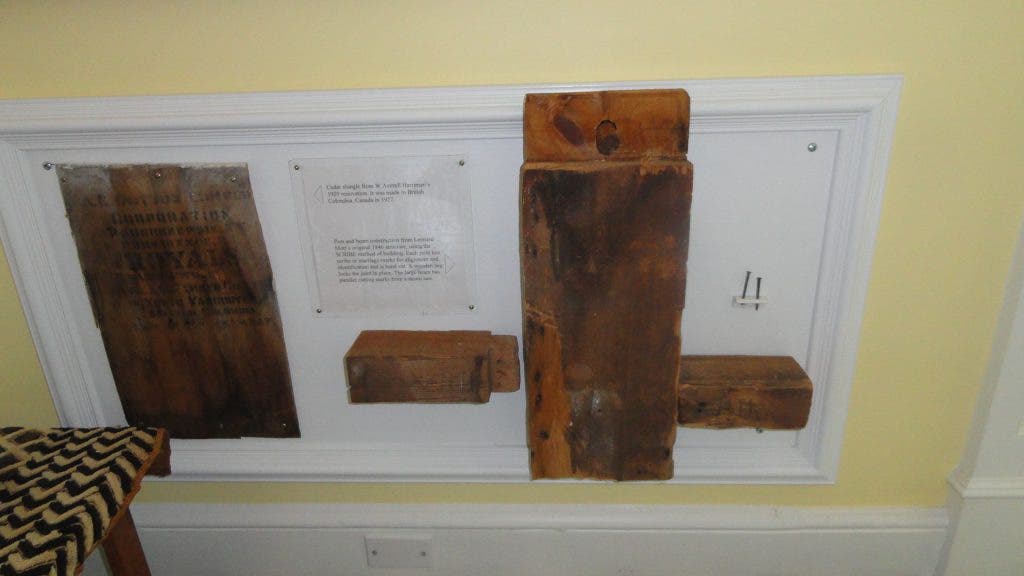
“It was used by the Quakers as a dump,” Schapiro said of the rock, from which he has uncovered canning jars, flatware, bottles and more. Many of these items are on display inside Salt Meadow as a testament to history of the home and its previous owners and inhabitants.
The couple also uncovered an original cooking hearth, beam structures, and an art nouveau fireplace thought to be designed by Erte.
Now, with their son off to college, the couple is ready to downsize.
Schapiro hopes that the buyer will appreciate the history of the home and not tear it down to build another McMansion.
“There are not many houses like this left,” he said. “These houses are disappearing.”
Get more local news delivered straight to your inbox. Sign up for free Patch newsletters and alerts.