Arts & Entertainment
I *Can* Go For That -- Up the Mississippi and Back
John Oates Bends into the Blues in Landmark Return

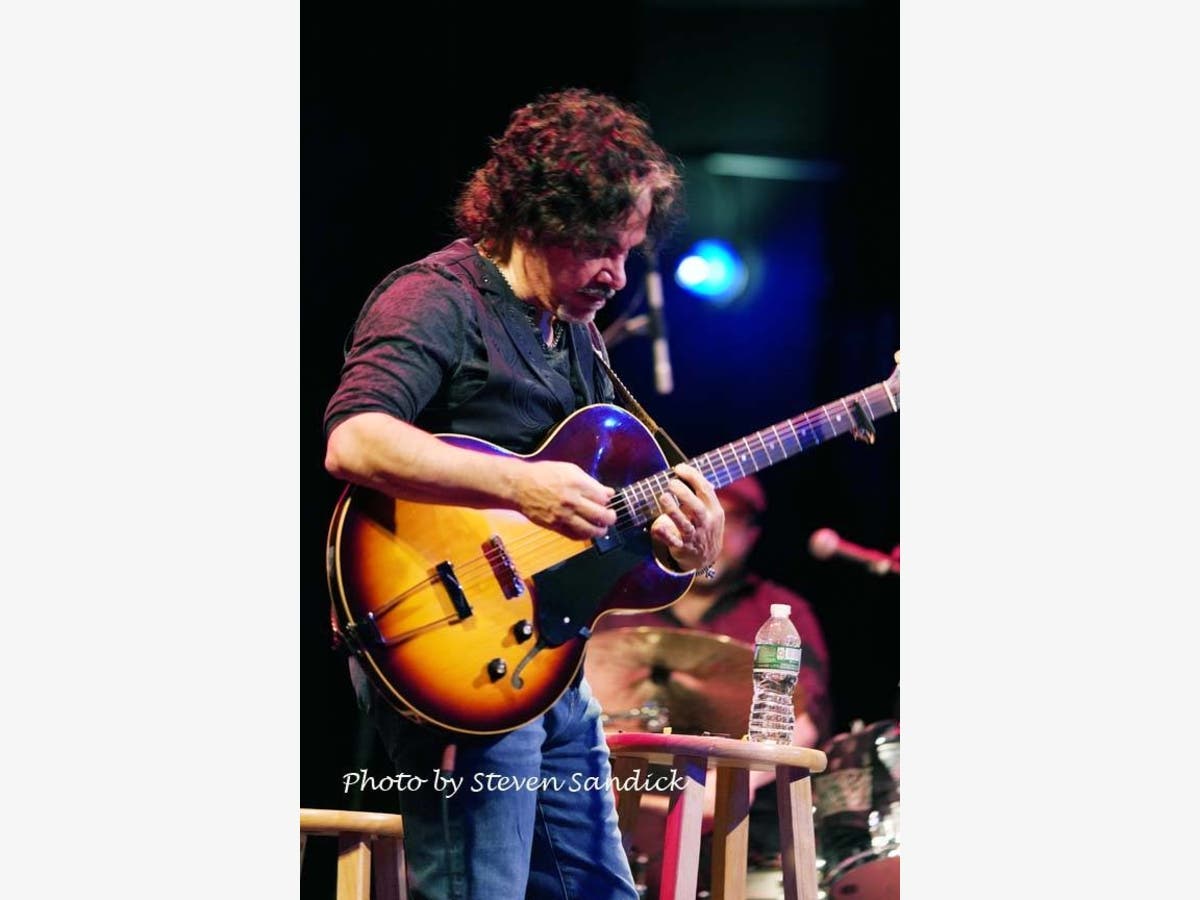


High profile artists are not unknown at the Landmark. The Indigo Girls are to be found on the docket for this season, for instance. But few may be better known than John Oates -- who returned to Landmark last week unlatched from his fame-preserving, Hollywood Star-studded connection to Daryl Hall (“I Can’t Go For That (No Can Do),” 37 million YouTube views).
As he told local reviewer and avid H&O fangirl Ann Latner of AnnReviews in 2010, Oates finds “inspiration in the great variety and history of American music.” At the time he had released a solo album, Mississippi Mile, and this year’s return to the venue struck many of the same chords, including the earlier album’s final song, “Dance Hall Girls.” Oates reminisced about hearing the Allan Fraser song in the late 60’s on “underground radio,” and resolving to give it the Oates treatment.
The night’s performance highlighted tunes from Oates 2018 album Arkansas, which features the very same Good Road Band he brought to Port Washington.
Find out what's happening in Port Washingtonfor free with the latest updates from Patch.
The evening featured several tunes from the project, including the title track and “Dig Back Deep” (catch it on Amazon Prime Music). As Oates told the Rolling Stone’s Robert Crawford last year,
“I was invited to go to Wilson, Arkansas and was inspired by the landscape where the cotton fields line the Mississippi River shore. My entire musical life has been influenced by the music that has flowed up that river from New Orleans through the Delta, and has had such an important sonic and cultural impact on America. It occurred to me that Arkansas was the last rural stop on the musical journey northward. I wanted both the song and video to reflect that.”
Find out what's happening in Port Washingtonfor free with the latest updates from Patch.
Before easing into the comfortable final set with its rousing, familiar Hall & Oates tunesmithing, Oates offered “Lose it in Louisiana,” co written with Craig Wiseman, “All I Am,” co written with Adam Ezra Olshansky, and “Let Him Come to You,” co-written with Jim Lauderdale.
And just what does John Oates voice sound like solo? Confident, at times raspy-warm, a voice with leavened with traces of those who influenced him, and whom he doesn’t hesitate to cite in concert: Mississippi John Hurt, Jimmy Rogers, “ragtime guitarist” Blind Blake -- and others.
Best among the lesser known songs from the evening was “Edge of the World,” easily the evening’s rocking-est of the songs from the solo Oates canon.
Down Mainstream’s Memory Lane
The show ended with rousing, sometime ear-bending versions of the Hall and Oates classics: a heartfelt “Sara Smile,” (this one had the audience humming in the foyer after the concert) a bluesy “You Make My Dreams,” and the finale, a jaunty rendition of Chuck Berry’s “Let it Rock.”
Best among these backward glances at the H&O heyday: a delightful reggae version of “I Can’t Go For That.” Put that one on repeat.
River Religion
Poet and visual artist Jen Bervin is known for her large scale (250 curvilinear foot) model of the Mississippi River, a model painstakingly hand-sewn in silver sequins. The project was undertaken as a clearer understanding was emerging of the impact on the U.S. engineering and farming practices on Ol’ Man River. She wrote “if there are indeed / ‘still songs to sing beyond mankind’ we’ll need those . . . ”
The John Oates on display at Landmark in 2019 was not quite ready to let the songs of his elders dissolve. Even if they must wind their way up the Mississippi bending hard into the oars with a blues third, and shimmy back down The River, frictionless as the well-worn fretboard beneath the singer’s guitar. Even if sliding on the slickened backs of the Algonquin, the sharecroppers, the forgotten poor -- they who sang to ennoble, if not escape, remembered privation.
Young John Oates got that religion, and a mature Oates is still listening to the river. He’s weaving sequins, song by song, into his body of work. It’s a tapestry whose curvilinear shape is not unlike the river itself.
I Can (definitely) Go For That.
Backing Musicians
The backing players, as is often the case, added hugely to the interest and diversity of sound - especially the playing of guitar whiz Guthrie Trapp @GuthrieTrapp. (Go down the country electric guitar lick / PedalBoard rabbit hole with YouTube’s Learn and Master to hear some of Trapp’s modest mastery of the instrument.). The Good Road Band was rounded out with Steve Mackey on bass and Josh Day on percussion.
Opening Act Joe D'Urso
Showing every bit of his Southside Johnny and Springsteen-inflected north Jersey roots, Joe D’Urso got the Landmark crowd into what he himself describes as “a pleasant weekend getaway.” With a Springsteen-like vocal and accompanied by keyboardist Seth Saltzman, D’Urso showed a polish reflecting more than a dozen album projects and a heavy touring schedule. Most movingly, he encouraged others to support Parkinson’s nonprofits, as he has himself done through the Light of Day foundation.
Images by Steven Sandick Photography