Arts & Entertainment
Voices in the Bow: Regina Carter's Southern Comfort Warms Northern Clime
Regina Carter's Southern Comfort and a gifted quintet warmed the Landmark stage.

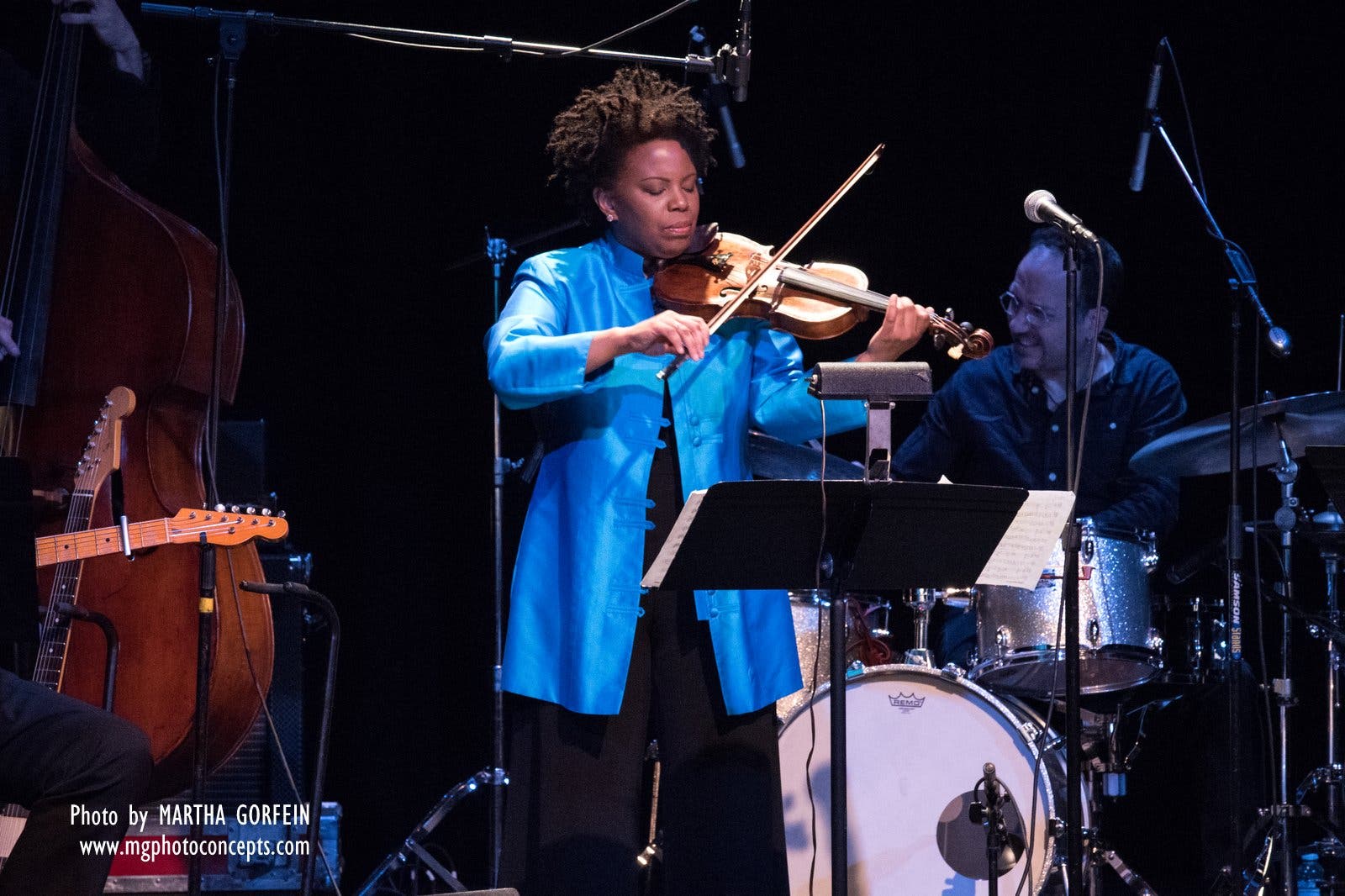
As every preacher knows, a whisper can garner more attention than a shout.
Violinist Regina Carter’s dynamic range begins at pianissimo and rises up in gently in a seductive wave to forte, and then settles into a memorable space where every voice can be heard.
What a concept.
Find out what's happening in Port Washingtonfor free with the latest updates from Patch.
Signposts on the “Comfort” Journey
The violin is no stranger to the Landmark stage (see a partial list below), but the treble instrument's voices Regina Carter brought with her on March 6 were as fresh and richly varied as the voices in a Manhattan subway car.
The evening began with jazz-inflected percussion – a style that instantly separated Southern Comfort from other Landmark folk and rock performances. What unfolded was “Honky Tonkin’,” followed by “Hickory Wind,” both arranged by bassist Chris Lightcap. The first phrase out of Ms. Carter’s instrument included “blue” notes – just the sort that intonation-conscious violin teachers often strive to correct.
Find out what's happening in Port Washingtonfor free with the latest updates from Patch.
Thus were the first stops of the Southern Comfort journey visited. Even Marvin Sewell’s electric guitar, the instrument most often invoked to lift Landmark rafters, had its treble controls attenuated.
Carter’s flexible tastes were immediately on display. In contrast to “Honky Tonkin,’” Gram Parsons’ “Hickory Wind” featured a slow country-like Hawaiian guitar intro from Sewell, and signature Grapelli-influenced violin parts from the violinist.
What came next was “Miner’s Child,” a clear storytelling stop on the Southern Comfort tour. Carter’s grandfather was a coal miner born in Georgia who died before she was born.
The evening’s best stop so far was “Shoo Rye.” As with several subsequent songs, Carter played original field recordings by Alan Lomax and John Wesley Work III so audience could hear the sketch from which the song had been drawn. “Shoo Rye,” sans guitar, featured some sweet violin-accordion unisons, a nicely crafted accordion solo by Wil Holshauser, and violin solos that reminded some listeners of Mark O’Connor’s Appalachian phrasing. The song ended with a drum flourish by Scott Amendola.
Vibrato to Cry For
From her Alabama childhood Sundays, Carter resurrected the hymn “I’m Going Home on the Morning Train.” Excuse the literary license, but Carter’s vibrato, which reflects the realistic variety of human vocal styles more than any other major violinist, is nothing if not prayerful.
A version of the girls’ playground song, “See See Rider,” (not the blues version) was a successful mix of tight arrangement and improvisation. The evening also included “Mandingo Street,” with an African / Caribbean feel, taken from her 1999 Rhythms of the Heart.
And, yes, there was plenty of “whispering,” but the quintet’s occasional forte could be just as memorable. Percussionist Scott Amendola, in particular, playing with an intense squint, delivered some wicked moments that rivalled – in the velocity dimension, even surpassed – past peak Landmark decibels delivered by the Smithereens and Southside Johnny.
Backing Musicians in Front
This Southern Comfort tour stop was backed by Marvin Sewell on guitar (and floor synth), Wil Holshauser on accordion, Chris Lightcap on standup bass, and Scott Amendola on percussion. As with many jazz ensembles, the term “backing musicians” hardly applies here. Check out any one of these musicians and you’ll discover composer-arranger credentials to accompany their instrumental skills. Little wonder that Carter herself, in the course of the evening’s performance, would move away from center stage, put down her instrument, and listen attentively.
Listening skills undoubtedly figured in Regina Carter’s master classes held the following day at Schreiber (an event sponsored by the ed Foundation).
Voices from Far, Wide – and Less
It’s the Soundcloud era, as Ben Ratliff suggests in his Every Song Ever book recently reviewed in the NY Times, but many music fans rarely venture outside a customary comfort zone. Ratcliff wants listeners to try “listening for more.” Reviewer August Kleinzahler adds a variant to this advice: “Listen to less, listen better and more carefully, and repeat . . .”
Follow this guidance through the Regina Carter repertoire and your North will hear the calling of its long-lost South.
https://www.youtube.com/watch?v=JGixpOmg-ww
Up-tempo version of “Anitra’s Dance” Edvard Grieg’s Peer Gynt Suite, arranged by John Kirby, captured live at Central Park in 2007.
The Violin at Landmark
The Landmark has been lucky enough to have hosted Natalie MacMaster, Black Violin, Eileen Ivers, Rhiannon Giddens and some truly fine backing musicians: Nicole Scorsone (Caravan of Thieves), Nate Grower (David Bromberg Band) and Javier Orman (Entropy Ensemble, which opened for Duncan Sheik).
Next at Landmark
Jorma Kaukenon is coming up, but that's sold out. Tickets are still available as of this writing for a March 11 performance of Wait, Wait Don't Tell Me panelist-comedian Paula Poundstone.
Image credit: Martha Gorfein | MG Photo Concepts