Schools
With Voter Turnout in Decline, District Issues Surveys
Port Washington School District hoping to gauge public interest in voting to determine proper number of polling places.

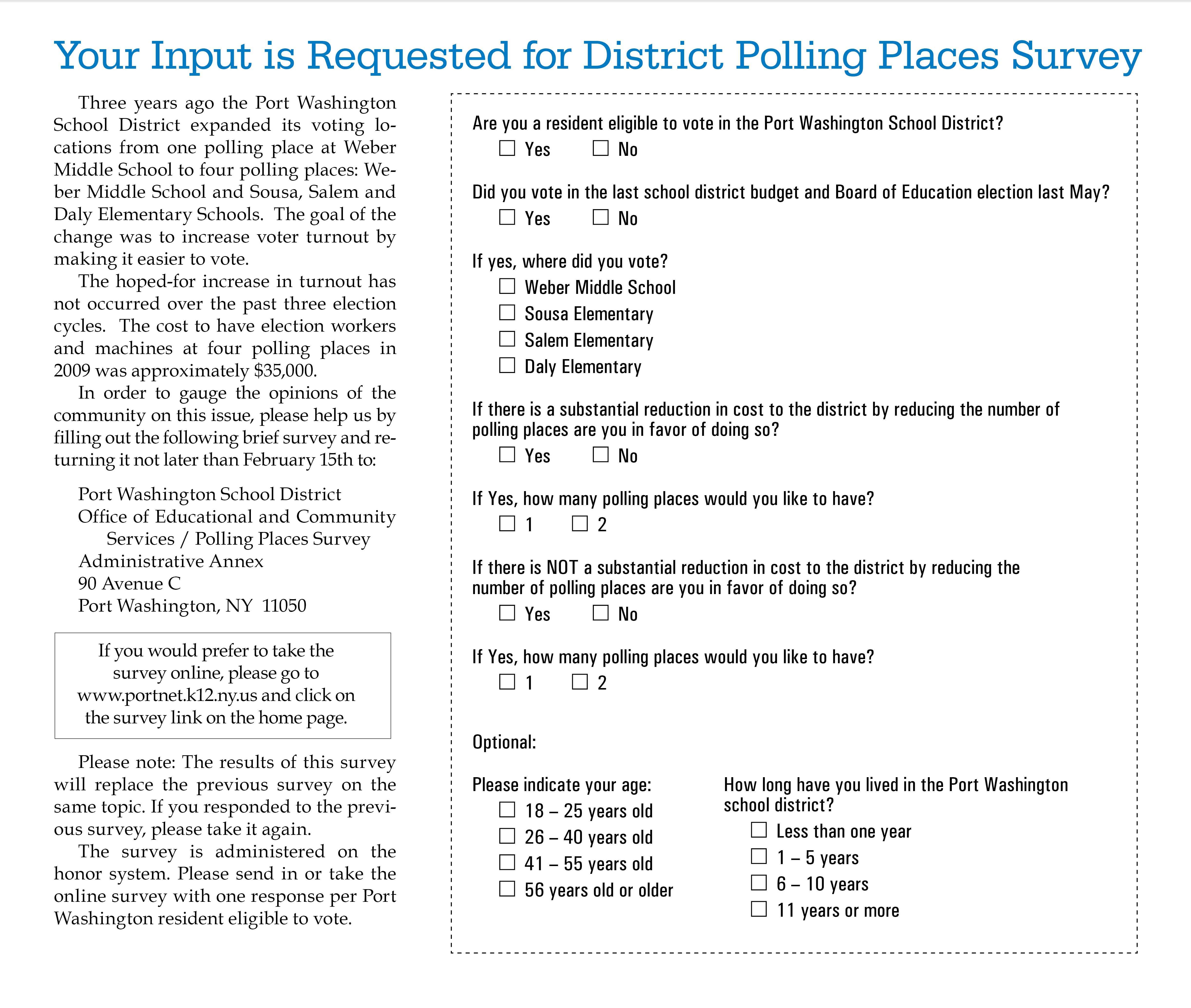
In an attempt to increase voter turnout, the Port Washington School District expanded from one polling place to four in 2007. The goal was to make it easier for residents to vote by giving them access to more polling places with shorter or no lines at each location.
But, according to district officials, voter turnout has remained stagnant over the past three election cycles and the cost of maintaining the sites has skyrocketed. The cost to have election workers and machines at four polling places in 2009 was approximately $35,000. Previously, the cost was just $9,000.
"Since we expanded the polling places the numbers have not grown, they've actually declined a little bit," said Board of Education trustee Larry Greenstein. "The goal is to get more people access to the polls, but the numbers didn't go up as we expected them to."
Find out what's happening in Port Washingtonfor free with the latest updates from Patch.
The school district recently released a survey to gauge residents' thoughts on the number of polling places for the coming election with their wallets in mind.
"We understand that the fundamental issue about the polling places is the voter turnout," school board member Sandy Ehrlich said. "We are now in a place where we're trying to evaluate whether it has indeed made it easier for people to vote or more difficult for people to vote."
Find out what's happening in Port Washingtonfor free with the latest updates from Patch.
As of Jan. 25, more than 200 residents had responded to the survey, which was mailed to every home within the school district. The deadline to complete a survey is Feb. 15. The school board will make a final decision on how many polling places the district will have before the next election on May 18, according to district officials.
Some residents don't understand how the survey is actually going to work.
"There's no way to determine who is filling out the survey," said Hank Ratner, who has lived in Port Washington for 40 years and saw the survey on the back of The Port Advance. "It could be a non-resident or a person that's not even of voting age or someone that's filling out a survey more than one time."
Frank Russo, president of the Port Washington Educational Assembly, feels the current polling places at Weber Middle School and Sousa, Salem and Daly elementary schools should be moved to the locations where elections are held in November each year to create familiarity for residents.
Russo considers tradition a core element to the voting process and that the general election locations, like local fire houses and churches, are a testament to that. "Voter turnout is always very low for school budget and for board member voting," he said. "People are familiar with general election locations. A good number of people are familiar with the current polling places, but the amount of people that are unfamiliar with them outweigh the former. Plus people tend to vote more when something big is at stake."
Russo added that he was in favor of increasing the number of polling places back in 2007. "The objective was to give the community a better chance of voicing its opinion," he explained.
Mary Callahan, the district's assistant superintendent for business and its clerk, said the school board has looked into moving the polling places away from the schools, but issues of handicapped accessibility and education law surfaced.
"Some of those locations are not handicapped accessible," Callahan said about the Election Day polling places. "Education law says when we have separate polling zones that we should use at least one school in each of those zones. We have schools in each of the four areas into which the town was broken up and that's why we're using the schools. It's what the law says to do."
The glaring number in terms of cost is the $35,000 it takes to run the four polling places at the schools. But Greenstein said certain costs won't change no matter what. "Some of the expenses we have will still be the same, regardless of how many polling places we have," he explained. "The election data is something that we have to pay for. The voting machines cost money, and we need those."
Whether the district has one, two, three or four polling places, exactly how much money could be saved won't be apparent until the school board crunches all of the numbers. "We don't exactly know how much the savings would be," said Greenstein, who made it clear that this was his opinion and not that of the entire board. "But there would be less workers, depending on the number of machines. There have to be two people per machine no matter what."
Callahan said that the biggest cost cutting won't be in the number of locations, but the number of people working throughout the district during elections. "The only cost that we can reduce is the cost of personnel," she said. "When we had one voting location, we had volunteers who manned the polls. But once it was in multiple locations, I could not depend on the volunteers and I could not be in four places at one time."
Although the survey is being circulated, and more and more residents respond everyday, the question of when this issue could potentially be resolved remains uncertain.
"We haven't discussed this [as a board] and we don't know whether, if we make a change, it happen in May 2010 or May 2011," Greenstein said. "We have to collect as much information as we can and have as much discussion as we need before we can make a decision."
Get more local news delivered straight to your inbox. Sign up for free Patch newsletters and alerts.