Community Corner
'Bee Whisperer' Rescues Massive Hive From Church Bell Tower
An auction will take place to raffle off the hive and proceeds will be used to help refurbish the church.


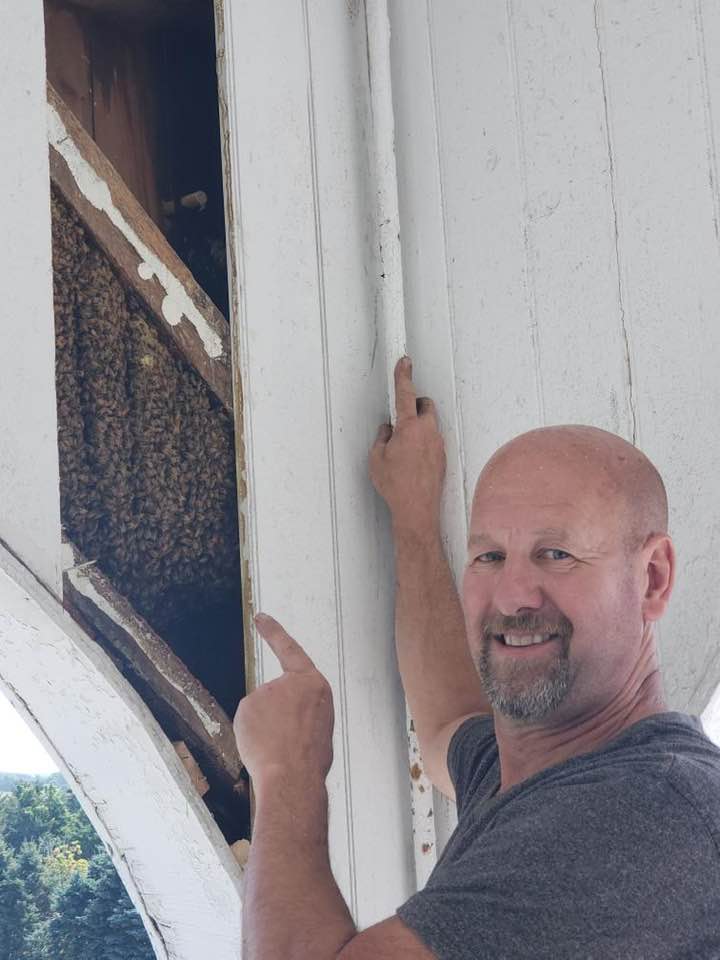
AQUEBOGUE, NY — A massive honey bee hive was removed from the steeple of a church in Aquebogue Tuesday.
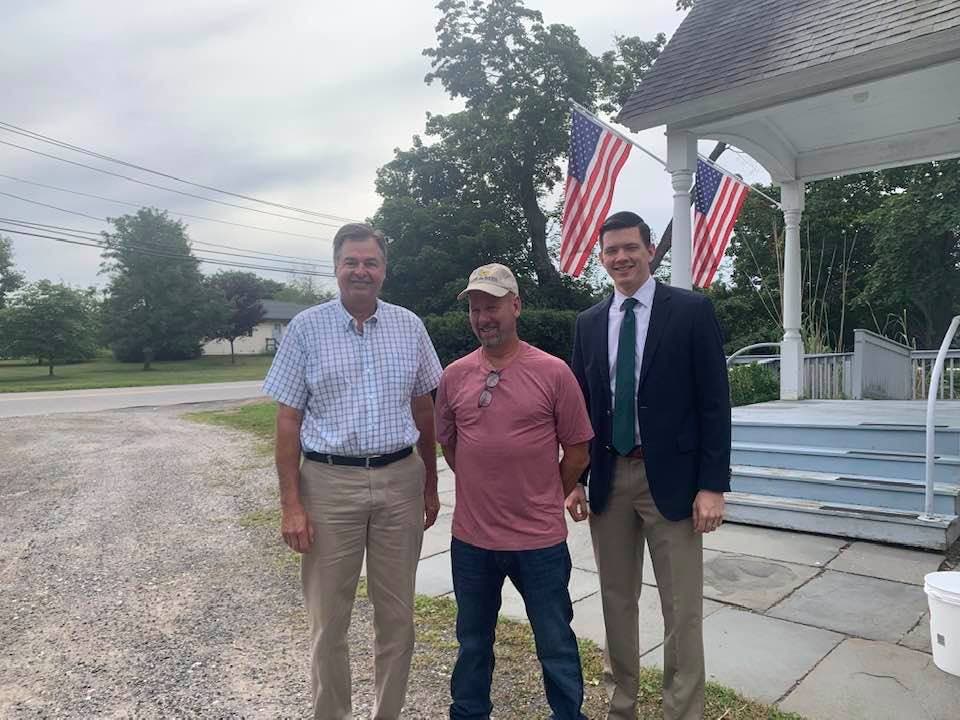
Ken Robins, a master beekeeper from Cutchogue with 60 hives, climbed three ladders into the church belfry to extricate the hive, with the help of Pamela Zahra-Kaminsky. Suffolk County Legislator Al Krupski, who recently sponsored legislation that passed protecting honey bee hives from exterminators and others who might find them and seek to kill the bees, also climbed up to help.
Robins, known as the "bee whisperer," according to Zahra-Kaminsky, scaled the ladders and spent over an hour carefully shepherding the swarm to safety.
Find out what's happening in Riverheadfor free with the latest updates from Patch.

Robins explained that the honeybee swarm moved into the steeple of the church, 65 feet off ground in the bell tower; Robins carefully sought the queen bee and put her in a "queen cage". Smoke and vacuums were used to help guide the bees into a colony box, which he readied with honey and made comfortable for the swarm.
Smoke is used to mask the pheromones, to help guide the swarm into the colony box.
Find out what's happening in Riverheadfor free with the latest updates from Patch.
Once the queen is located, pheromones help tell the swarm where she is, and the bees, 20,000 to 30,000 of which were in the bell tower, will "march in like an army of soldiers," Robins said.

Pastor Andrew Montoro of the Community Baptist Church, which moved into the storied structure at the corner of Church Lane and Sound Avenue in 2013, said he first noticed the bees because preparations are underway to paint the historic structure, originally built in the 1830s, and rebuilt twice after fires.
Parishioner Kelly Crudup, who has known Zahra-Kaminsky for years, connected Pastor Montoro with Robins.
The plan, Robins said, is to auction off the colony to the highest bidder with all funds raised donated to refurbishing the church; he said he would not take payment for his services.
Those wishing to participate in the auction should email riverheadbaptist@gmail.com.
Robins, who has 60 hives pollinating around the North Fork at locations including Wickham's Fruit Farm in Cutchogue — where his local honey is also sold — and also runs the Custer Bee Club in Southold, said the legislation is critically important.
Beekeepers and environmentalists are lauding new landmark legislation that will protect honeybees.
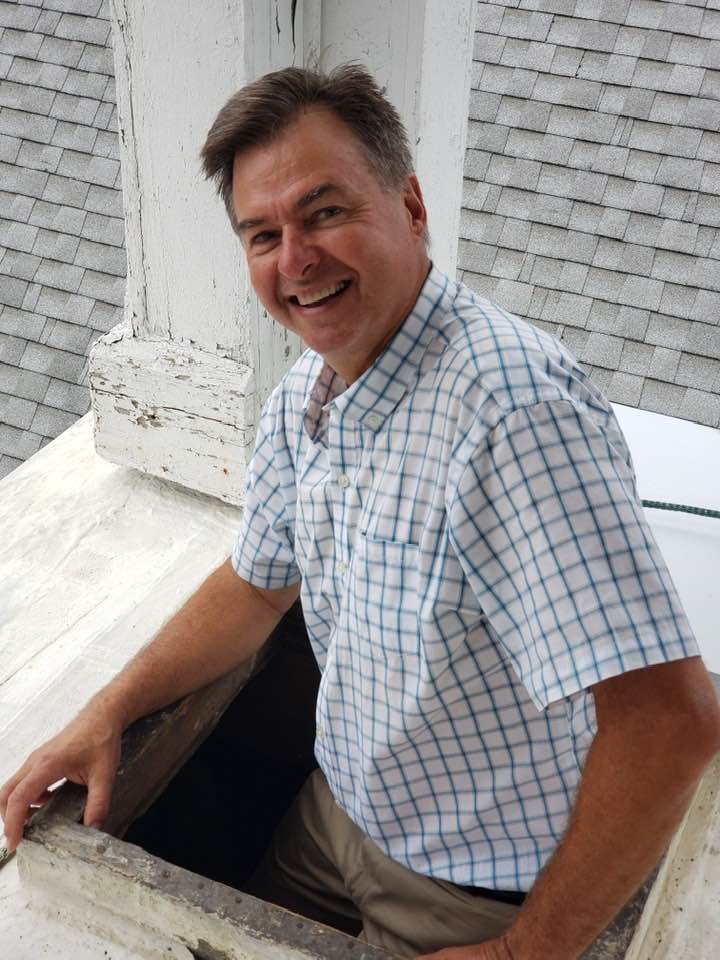
Krupski, who is also a farmer from Cutchogue, worked with Citizens Campaign for the Environment to craft and pass the bill, which prevents exterminators from killing honeybees found in without first calling a beekeeper to safely remove them, Krupski and Adrienne Esposito, executive director of CCE said.
On Tuesday, Krupski, who "pet" the bees after climbing into the tower, said the primary goal of the legislation was to raise awareness so that homeowners who see bees or other insects don't just rush to kill them.
Many people, he said, are "anti-insect," without realizing their true benefits. "They just see an insect and say, 'I don't want it.'"
"Insects are important and we need to protect them," he said. He has bees on his own farm and has never lost a hive, he said. Many who are new to the area do not initially realize how critical honey bees are to the food chain and awareness is key, Krupski said.
The bill passed the full Suffolk County Legislature on Tuesday, July 27 in a vote of 18 to 0. It requires homeowners, pesticide applicators, and exterminators addressing unwanted honeybee infestations first call a beekeeper to safely relocate the hive, Krupski said.
Honeybees are an integral component of the food web, but global populations have declined since 2005 — and massive bee die-off events pose a serious threat to this critical species, Krupski said.
"Healthy honeybee populations make for a healthy planet," Esposito said. "In Suffolk County, our agriculture industry and ecosystem rely on healthy honeybee populations. This bill protects and preserves our honeybees and prevents the unnecessary extermination of pollinators. CCE thanks Legislator Krupski for championing this important bill and we hope that other municipalities and New York State follow Suffolk's lead on honeybee protection."
Krupski said he was happy to sponsor the legislation, "which will help prevent the unnecessary extermination of important pollinators, honeybees. As beekeeping has become more common throughout Suffolk County, there are more beekeepers are willing to provide this valuable service."
In the past, if honeybees were found, exterminators might just come in, spray, and kill them, Robins said. Beekeepers, he said, are essential to the food chain. "Two-thirds of what we eat is pollinated by honeybees," he said.
Honeybees, he added, "have been having a rough time." The bees are facing environmental challenges including varroa mite infestations that sicken and cripple them, he said.
Mattituck master beekeeper Chris Kelly of Promised Land Apiaries also lauded the initiative. "Legislator Al Krupski has been a lifelong environmentalist and farmer on the North Fork. His work to help honeybees reflects his awareness that pollinators and food go hand-in-hand. This legislation creates an awareness for the public and exterminators alike to identify and save bees. It is a win-win. A win for the environment — and a win for us."

Joe McInnis, who, when he was in eighth grade in Greenport in 2016, launched a GoFundMe to help with a project that including cutting-edge research on bees. While still a senior at Greenport High School, McInnis published a scientific paper in a peer-reviewed journal after proving bees were susceptible to a virus found in honeybee hives; he is entering his sophomore year at Dartmouth this fall.
"As we continue to search for a definitive cause and cure for the sharp decline of bee colonies, there's one thing we already know. Honeybees — with their critical role as pollinators — are directly or indirectly responsible for a huge percent of our food supply and without them, we would starve. We're fortunate to have Al Krupski, with his advanced degree in plant science and a farm owner himself, fighting for the bees that are so critical for all of our survival," McInnis said.
Of the united effort it took to save the hive, Pastor Montoro said: "It was the Lord's work. We want to save the bees. We want to save the church. We want to help people."
Get more local news delivered straight to your inbox. Sign up for free Patch newsletters and alerts.