Community Corner
'This Is A Crisis': LIers Rally For New Legislation To Fight Fentanyl
"These individuals are not drug dealers, they are death dealers, and the punishment should match the severity of their crimes."


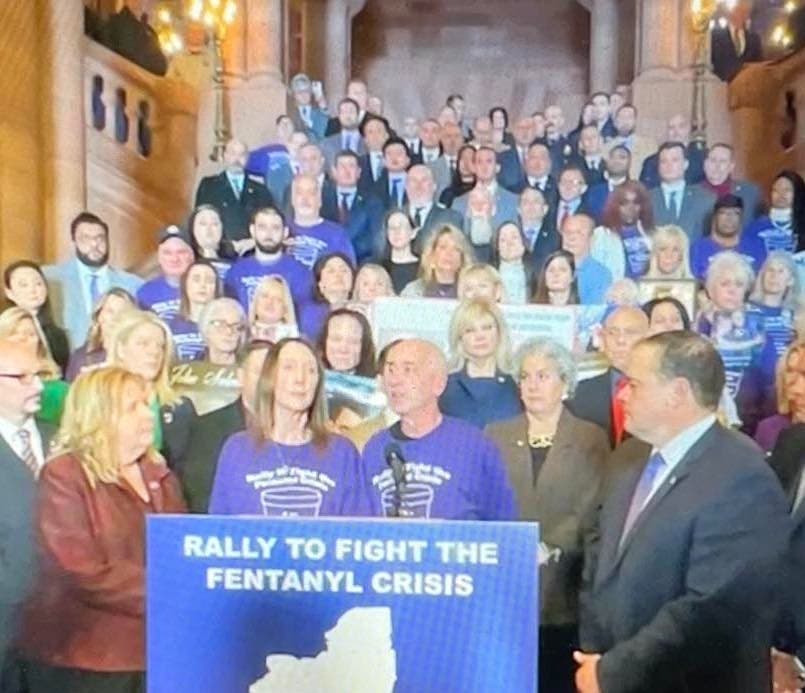
LONG ISLAND, NY — A contingent of Long Island lawmakers turned out in force Monday, heading to Albany to with a message about the deadly fentanyl scourge that's swept the nation: "Enough is enough!"
Suffolk County District Attorney Raymond Tierney today unveiled a bipartisan legislative package introduced by Assemblyman Steve Stern and Senators Dean Murray, Anthony Palumbo, and Steven D. Rhoads, that proposes to address the current drug overdose crisis.
The new legislation would charge suppliers of drugs that cause fatalities with manslaughter; adding Xylazine to the controlled substances list requiring a prescription; and allow families who have lost loved ones to fatal overdoses to access crime victim funding, Tierney said.
Find out what's happening in Riverheadfor free with the latest updates from Patch.
In addition, the package includes a bill that allows prosecutors the ability to ask for bail for those charged with the sale and possession with intent to sell dangerous amounts of fentanyl, nitazine, methamphetamine, LSD and other narcotics, Tierney said.
Suffolk lawmakers joined forces with others from Nassau County, as well as families devastated by loss, members of law enforcement, labor unions, community activists and constituents to "promote the need for common- sense changes to our drug laws in the face of an epidemic of deaths from opioid overdoses," Tierney said.
Find out what's happening in Riverheadfor free with the latest updates from Patch.
In 2022, Suffolk County reported more than 400 deaths caused by drug overdoses, with fentanyl being the "driving force and common denominator," Tierney said.
Nationwide, more than 110,000 lives were lost to fentanyl poisoning that year.
According to the U.S. Drug Enforcement Administration, nationwide, 7 out of every 10 pills sold on the streets are surreptitiously laced with fentanyl, Tierney said. The statistics illustrate a nationwide epidemic, he added.
Holding signs with photos of their children and family members, lost to addiction, Tierney said the familes present, their faces etched with loss, had sufffered incredible personal tragedy. "But what is it that they've done with that tragedy. They've decided, 'Look, we just want to make sure that no family has to go through what we just went through.'"
Parents present included Gene and Sue Murray who lost their daughter, Chelsey, 31, to a fatal fentanyl overdose in Suffolk County in 2022 and for whom "Chelsey’s Law" is named.
Jaquan Casserly, 34, of Holbrook, was indicted after being accused of selling fentanyl to Murray, of Lake Grove, which resulted in her fatal overdose, the DA said.
According to the investigation, on August 18, 2022, Suffolk County Police Department officers responded to a residence in Lake Grove for an apparent drug overdose. Murray was found unresponsive in the bathroom by her mother, Tierney said.
Murray was administered Narcan, and she regained a pulse; she was transported to Stony Brook University Hospital where she ultimately passed away several days later as a result of the drug overdose, Tierney said.
On August 24, 2022, a cell phone belonging to Murray was turned over to police by her parents, Tierney said. Using the phone, an undercover detective from the Suffolk County Police Department contacted Casserly and arranged for another sale of narcotics. Casserly, unaware that Murray had overdosed, reportedly instructed the undercover detective to go to the same location where he sold fentanyl a week earlier, Tierney said.
On August 25, 2022, in Holbrook, Casserly reportedly sold the undercover detective a combination of heroin and fentanyl contained in a red glassine envelope, Tierney said.
On August 27, 2022, police executed a search warrant at Casserly’s Holbrook residence and recovered a combination of heroin and fentanyl, a digital scale used to weigh narcotics, red and black glassine/wax envelopes used to package narcotics, a pair of metal knuckles, and Casserly’s cell phone, Tierney said. The red envelopes were similar in appearance to the ones sold to the undercover detective two days prior, Tierney said.
A search of Casserly’s phone reportedly showed that he made arrangements to meet Murray on August 17, 2022 at the Holbrook Commons offering to sell her a “fetty mix,” a street term used to describe a mix of fentanyl and heroin, Tierney said.
Casserly was arrested and charged with two counts of third-degree criminal sale of a controlled substance; a felony; three counts of third-degree criminal possession of a controlled substance; a felony; fourth-degree criminal possession of a controlled substance, a felony; third-degree criminal possession of a weapon, a felony;and two counts of criminal possession of drug paraphernalia, a misdemeanor, Tierney said.
On January 27, 2023, at his arraignment on the indictment, County Court Judge Steven A. Pilewski ordered Casserly held on $500,000 cash, $1 million bond or $5 million partially secured bond. Casserly is being represented by Christopher Gioe his next court date is March 3, Tierney said.
Gioe could not immediately be reached for comment.
"We would like to express oursupport for a new proposed law, 'Chelsey’s Law,' named in honor of our beloved daughter," the Murrays said. "Afterher tragic overdose from fentanyl and the arrest of the drug dealer, we were shocked to learn that in New York State, Chelsey’s fentanyl dealer who caused her death could not be charged with anything beyond the sale of the drugs that killed her. We need a stronger law to hold those, who sell the poison that kills so many like our daughter Chelsey, accountable."
Gene added: "It's not just about my daughter. It's about all the families that have lost their loved ones and are getting no accountability because they're back out on the streets after they have been arrested. They're back to selling and killing people."
The Murrays received a letter from victims services saying that their daughter was not a victim of a crime, he said. "And she was."
He added: "It has to stop."
The change starts with the legislation presented, Tierney said, adding that synthetic, designer drugs are proliferating. "Individuals on the street think they are getting one substance but what they are actually getting is fentanyl and it's kiling them — and it has to stop," the DA said.
Opioid overdose is the leading cause of death for young people aged 18 to 50, Tierney added. "This is a crisis. While legislation will never be the sole solution, these common sense changes will save lives," Tierney said. "It is our moral and ethical duty, at the very least, to ask each of our
elected officials to consider these bills. Work with us. More importantly, listen to and talk to these
families. What New York is doing now is not working — and young people are dying at alarming
rates."
Other elected officials also spoke.
"We have many different tools in our toolbox to combat fentanyl and other dangerous drugs, but one tool is missing: a specific statute that provides us with a clear path to charge dealers for deaths that occur when they sell, deliver, or administer their poison,” said Nassau County District Attorney Anne Donnelly. “Dealers must be held accountable, not only for selling dangerous illicit drugs, but for taking lives and ripping apart families."
"For far too long, the deadly scourge of fentanyl and opioid overdoses has ravaged our communities and cut countless lives short," said Assemblyman Steve Stern. "This epidemic is one of the defining issues of our time, and policy makers have a moral obligation to act swiftly and prevent these senseless tragedies."
"I promised my constituents I would be a fighter for public safety — this package of bills makes public safety a priority and delivers on that promise. This package of bills aims to directly combat the dangerous fentanyl epidemic our state and our nation is facing and is necessary to save lives,” said Rhoads. “It provides law enforcement officials and district attorneys with the legal tools they need to take drug dealers off the streets and prevent fentanyl from reaching our communities. As elected leaders of our communities, it is our duty and our responsibility to pass these bills and take action to save lives. The time to act is now."
"The fentanyl epidemic has devastated families, stolen the promise and future of so many young New Yorkers and left communities struggling with how to combat this scourge. Chelsey’s Law will increase penalties for individuals who knew or had reasonable grounds to know that the narcotics they sold were laced with fentanyl," said Palumbo, ranking member of the Senate codes and judiciary committees. "These individuals are not drug dealers, they are death dealers, and the punishment should match the severity of their crimes."
Linda Ventura, founder, and executive director of Thomas’ Hope Foundation, was present at the rally and press conference. Linda’s son died of a fatal overdose over a decade ago on Long Island.
"It is time that New York State appropriately penalize the people that are distributing this deadly poison, knowing it is lethal and is killing our loved ones, particularly our young adults," she said.
Tierney said the goal is just "common-sense changes."
Stern also discussed Xylazine. "This is literally about life and death," he said, of the package of ffour bills. "Understand this package of bills is going after the dealers, the people pushing this poison. They are preying on people with an addiction, people who are weak, vulnerable."
The dealers don't tell those who are addicted that the drugs they are buying are laced with fentanyl or cut with Xylazine, a sedative for large farm animals such as horses or cattle, he said. "If this doesn't scream common sense, that we make this illegal to be in the hands of dealers, I don't know what does."
Because Xylazine is not illegal in New York State, Tierney said, it won't appear on police reports and tests aren't done.
Tierney also addressed victims' compensation. "This is something we need to change," he said.
Murray said dealers tout their drugs as the best, wooing even the reluctant to try them. "We're talking about dealers who are taking advantage of people in the throes of addiction. They are lying to them. They are giving them poison, telling them it's one thing, giving them something else that they know could and. very well might kill them. If that's not the victim of a crime, I don't know what is."
Dealer say their drugs are the "greatest. . really good stuff." The new legislation is not only the right thing to do legally, but morally, he said — and it's about saving lives.
The cry for bail reform echoed.
Rhoads said people are dying every single day due to synthetic drugs and opioids. The families present were representative of the staggering number who die yearly due to fentanyl, Rhoads said. The amount of fentanyl necessary to kill a person is the amount to cover the nose of Abraham Lincoln on a penny, he said.
Conversely, in order to be eligible for bail, "one would have to have enough fentanyl to kill everyone in this Capitol building, everyone in the legislative office building , the Afred E. Smith building across the street and the Department of Education." To be bail eligible, the amount of fentanyl necessary could fill Citifield two-and-half-times, he said.
Enough fentanyl to kill 113,451 people is needed to seek bail — that, or the death of an individual, Tierney said.
As it stands now, criminals are released to peddle their wares, he added.
Only Class A felonies are currently bail eligible, he said, but that could change if the legislation passes.
Palumbo said Murray had struggled with addiction for years. The drug dealer called her phone even after she overdosed, he said. Once his phone was recovered, texts were found that said he was dealing a "fetty" mix — indicating "complete knowledge" of what he was doing, Palumbo said.
A small amount of ffentanyl, equaling the weight of a mosquito, he said, can kill you. And yet, that dealer would be bail eligible and he could not be charged with manslaughter, Palumbo said.
"If I put rat poison in your coffee and you drink it, you'd probably say I should be charged with murder. . . How is rat poison a crime in New York State but not fentanyl, that they're knowingly mixing at unknown levels and handing it to people?"
Sen. Rob Rolison, of the Hudson Valley, also discussed legislation that he is sponsoring that would protect first responders, corrections officers or police officers who are put in contact with fentanyl "in the midst of an onslaught of death." The bill would make reckless possession of fentanyl — if it causes an injury to a first responder, police officer, firefighter, an EMS provider or a correction officer — a Class C felony, making it bail eligible, he said.
Ventura added that families are "demanding change."
The four pieces of legislation that were drafted in consultation with the Suffolk County District
Attorney’s Office, are outlined as follows:
First proposed bill: Chelsey’s Law," Assembly Bill A08384 sponsored by Stern/ Senate Bill S07790 sponsored by Palumbo:
- A person commits the crime of manslaughter or aggravated manslaughter when he or she knows or has reasonable grounds to know that a controlled substance is likely to cause the death of another person and sells, administers, delivers, or causes the delivery of a controlled substance to another person and such substance causes, contributes to, or aids in the death of such other person.
- Formerly referred to as the "Death by Dealer" statute, the bill would be renamed "Chelsey’s Law," in honor of Murray.
- Currently, a person who provides an illicit drug that results in the death of a user can typically be charged only with drug sale, criminal sale of a controlled substance, a Class B non-violent felony.
Under the current law, bail, victims’ compensation, sentencing guidelines, restitution, Clean Slate provisions and parole eligibility are all determined by the section of the law under which the defendant is charged and convicted, Tierney said.
In New York State, drug sales are considered much more leniently than manslaughter, such that typically no bail may be set, no victim’s compensation or restitution is allowed, and they receive a lesser sentence, Tierney said.
Second proposed bill: Designates Xylazine or "tranq" as a controlled substance (Assembly Bill
A08395 sponsored by Stern/Senate Bill S07763 sponsored by Murray):
- Adds Xylazine, commonly known as "tranq," to a depressant designated as a controlled
substance, with the exception that it be administered and/or prescribed solely for cattle or
other nonhuman species, as approved by the federal Food and Drug Administration. Right
now, the sale and possession of Xylazine in New York is neither restricted, nor illegal in
any way, so there is no way to prevent drug dealers from adding this potentially deadly
substance to illicit street drugs.
- In recent years, there has been evidence of an alarming increase in illicit use of Xylazine,
a large-animal tranquilizer by drug dealers and drug users on the streets. In 2023 in Suffolk
County, the Medical Examiner has found xylazine to be present in the decedent’s toxicology reports in over 15 percent of fatal drug overdose cases completed thus far, Tierney said.
- The illicit use of the powder form of "tranq" is frequently being added by drug dealers as
a cutting agent to fentanyl, heroin, and other harmful street drugs. When mixed with these drugs, the effects are often deadly, because it has a severely high depressant effect on the human body’s central nervous system, the DA said.
- Tranq" can cause skin sores and users may develop necrosis, making resuscitation efforts more difficult, as well as producing a withdrawal syndrome that makes it more difficult for sufferers to recover or be abstinent.
- The bill was vetted by both agricultural and veterinary experts who advocated for the exception when the drug is being administered and/or prescribed by veterinarians for treating animals, the DA said.
Third proposed bill – Award crime victim assistance funds to include victims of overdoses
(Assembly Bill A08397 sponsored by Stern / Senate Bill S07805 sponsored by Murray):
- This bill amends the executive law to include families of loved ones lost to a fatal
overdose for financial compensation under the law, Tierney said.
- The New York State Office of Victims Services administers a fund whereby victims
of crimes that happen in New York State may be eligible to get reimbursed for certain
crime-related, out-of-pocket expenses. Types of compensation OVS can provide include
medical and counseling expenses; funeral and burial expenses; relocation, moving, and
storage costs; lost earnings or loss of support, the DA added.
- Eligibility for compensation from the fund depends on the type of crime that occurred.
The legislation would expand eligibility to any fatal drug overdose resulting from a sale
that is categorized as reckless or criminally negligent.
- Fourth proposed bill: Relates to bail for certain felony offenses involving the manufacture,
sale, distribution, or possession with intent to sell synthetic opioids (Assembly Bill A08383
sponsored by Stern/S07816 sponsored by Rhoads):
- This bill amends criminal procedure law to allow prosecutors to seek bail for second-degree criminal sale of a controlled substance and second-degree criminal possession of a controlled substance, both A-II felonies, Tierney said. This change would give local district attorneys the ability to ask for bail for sale and possession of dangerous amounts of fentanyl, nitazine, methamphetamine, LSD and other deadly narcotics, The DA said.
- Currently, New York State law only allows those charged with possessing and/or selling eight ounces of fentanyl to be held on bail, Tierney said. Those caught with less are arrested, arraigned,
and released without bail until their next court date. Eight ounces of fentanyl is enough to kill 113,410 people, Tierney said.
"Bail reform is necessary to stop dealers from continually selling fentanyl after they have been released," he said.
In addition, the DA said the ability to request bail can aid those suffering from addiction themselves when they are found in possession of fentanyl, as bail often acts as a catalyst to get defendants into drug court or treatment as an alternative to jail.
Get more local news delivered straight to your inbox. Sign up for free Patch newsletters and alerts.