Crime & Safety
Crowd Turns Out for Answers Regarding Suffolk County Hotel/Motel Tax in Riverhead
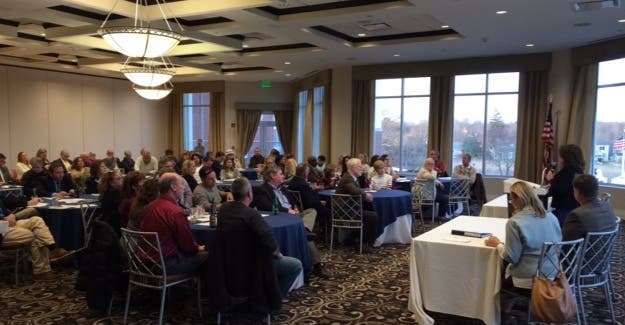
Many chamber of commerce members attended the event Wednesday evening.


RIVERHEAD, NY - Business owners and residents have long had questions about Suffolk County's hotel/motel tax program — and just who, exactly, has to pay.
And on Wednesday night, they set out to get answers.
A joint Chamber of Commerce and business meeting on the hotel/motel tax was held Wednesday night at the Hyatt Hotel in Riverhead.
Find out what's happening in Riverheadfor free with the latest updates from Patch.
Back in January at a Mattituck Chamber of Commerce meeting, Suffolk County Legislator Al Krupski discussed a proposal by Suffolk County Comptroller John Kennedy Jr. to collect a hotel motel tax from airbnb operators, and said many questions were swirling around the tax — some involving hotel, motel and B & B property owners who have not paid the tax in the past, as well as airbnb owners and private individuals who rent their homes for a number of weeks.
To start, Kennedy explained that anyone renting their properties for less than 30 days in Suffolk County has to pay the three percent tax, including those running a short-term rental of under 30 days, as well as owners of hotels, motels and B&Bs.
Find out what's happening in Riverheadfor free with the latest updates from Patch.
The tax is not new, Kennedy said, who has disagreed with efforts to raise the tax higher than three percent; his feeling is that compliance with the three percent tax should be sought first.
Should the owner of a short-term rental, hotel, motel or B&B not be in compliance, the first step would be a phone call, followed by an auditor's letter.
Currently, a failure to pay penalty of $100 per day exists; Kennedy has suggested lowering that amount to $50 per day. The change would need to be made on the state, not county level, however.
Kennedy has said the goal is not to put anyone out of business, just seek compliance; back taxes might be put in abeyance if a business owner has shown that they are now paying the tax as required, Kennedy's staff said.
The goal of Wednesday night's meeting was education, so that all business owners and chamber members could be on the same page as to the tax and who is required to pay.
Kennedy also offered a breakdown as to where the funds collected go; a majority of the money goes to tourism promotion.
Kristen Jarnagin, president and CEO of the Long Island Convention & Visitors Bureau, also spoke on how the funds benefit tourism promotion and shared her vision on how she sees the future of promotion on the East End and Long Island unfolding.
Suffolk County Legislator Al Krupski was happy to see the meeting well-attended, with approximately 80 turning out to hear Kennedy discuss the tax and how it will be enforced.
"My whole purpose is to keep that dialogue open," he said. "The law has been in place since 2008 and we want to make sure elected officials and the comptroller are accessible so people understand how it's being enforced."
Krupski said the tax generates funding for tourism, parks, cultural affairs and historic buildings, including the Vanderbilt Museum and the Walt Whitman House.
A two year extension of the tax was just authorized, Krupski said; the next time it will be voted upon will be in 2017 and anyone with suggestions on how the funds collected should be spent can contact elected officials. "We're looking for input," Krupski said.
Other elected officials present included Suffolk County Legislator Bridget Fleming, Southampton Town Supervisor Jay Schneiderman, Southold Town Councilman Jim Dinizio, Riverhead Town Councilman John Dunleavy, Riverhead Deputy Supervisor Jill Lewis, and Southold's government liaison officer Denis Noncarrow.
Dinizio said he learned a lot at the meeting. "My concern is that people that do short term rentals on a weekly basis will use the fact at they pay taxes to justify their business operations in residential zones. The county seems to be indicate that qualifying for a certificate of authority is enough to collect taxes. It needs to be clear that the entity paying the taxes is legally able to do so at that location."
"It was a good meeting," Krupski said. "It's outreach for people. They should have access to answers."
Get more local news delivered straight to your inbox. Sign up for free Patch newsletters and alerts.