Health & Fitness
'Flesh-Eating Bacteria' Found In LI Water Has 20 Percent Chance Of Killing People, Dogs In 48 Hours: Expert
"We have some incredibly pressing problems — but at the same time, some incredible opportunities to address those problems."


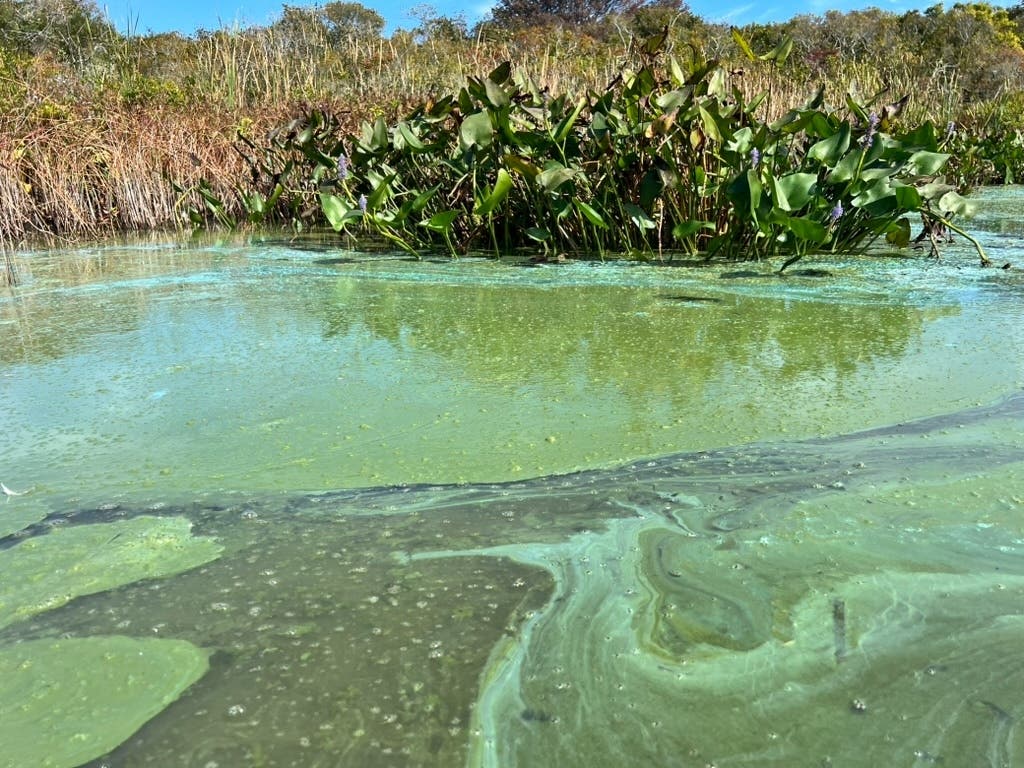
EAST END, NY — A deadly "flesh-eating" bacteria that can rapidly kill those who become infected by it has been found in Long Island waters, an expert warned this week.
Professor Christopher Gobler of the State University of New York at Stony Brook, speaking at a press conference on the Peconic Riverfront Park in Riverhead, said new data has been revealed on the condition of New York's coastal waters and current public health threats.
The briefing previewed Gobler’s annual State of the Bays Symposium presented by the Gobler Lab of Stony Brook University, which will be held and held at Stony Brook Southampton's Avram Theater Friday night.
Find out what's happening in Riverheadfor free with the latest updates from Patch.
"There is no time to waste," Gobler said. "We have some incredibly pressing problems — but at the same time, some incredible opportunities to address those problems."
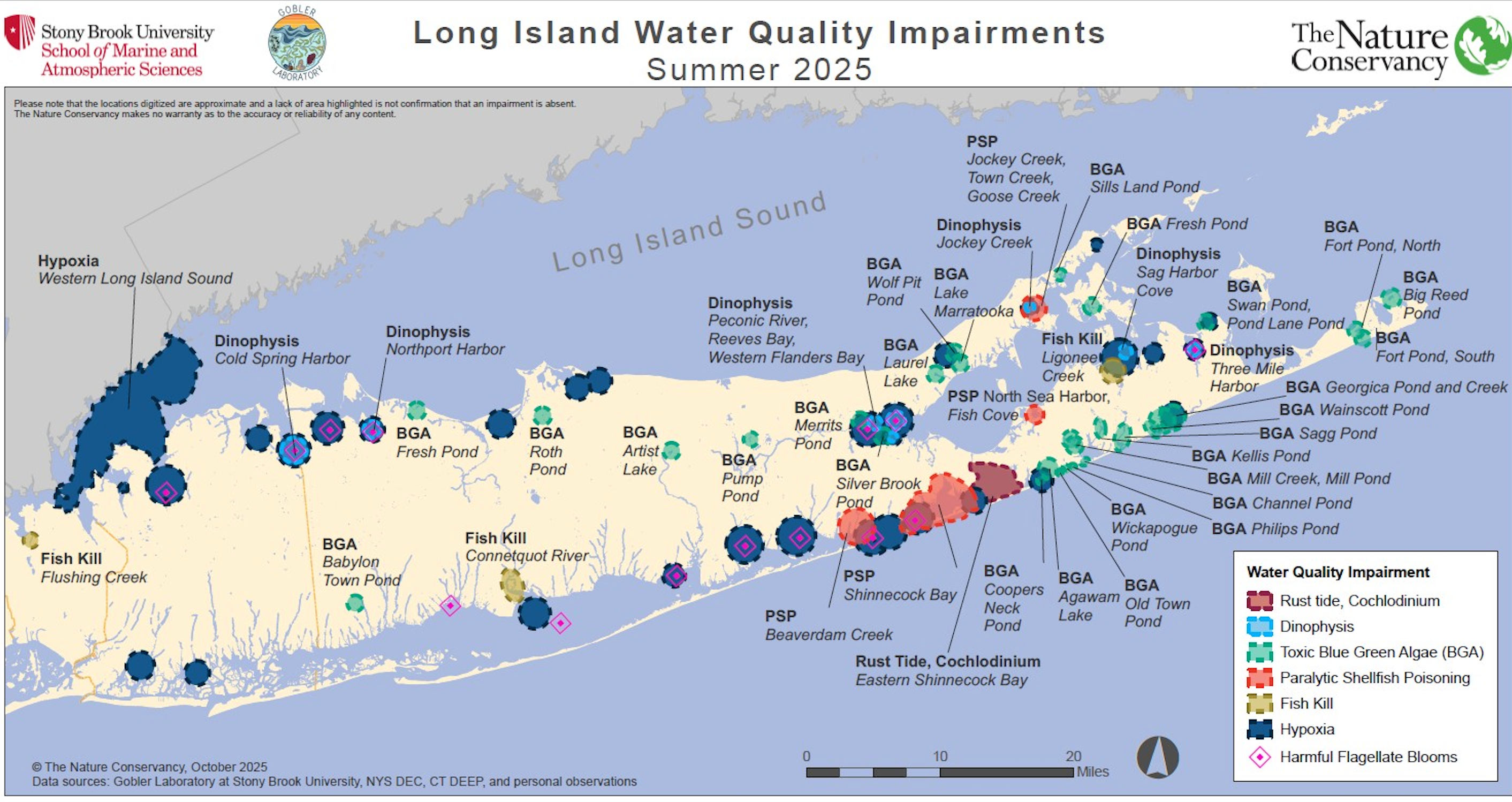
He presented a map of water quality impairment, which showed "dozens and dozens of locations" in estuaries, harbors bays and ponds across Long Island, where water quality is not meeting state and federal standards and where harmful algal blooms exist, Gobler said.
Find out what's happening in Riverheadfor free with the latest updates from Patch.
Toxins are being produced that "can sicken or even be lethal" for animals and even humans, he said. "On Long Island, dogs have gotten sick and died, just from drinking lake water," he said.
Last year, more than two dozen lakes and ponds had blue-green algal blooms on Long Island, he said.
Also last year, there were five different locations closed to shellfishing due to toxins, including one example in Southold Town where levels of alexandrium, which makes saxitoxin, were so high that they "could have resulted in extreme sickness and potentially even death," Gobler said.
Thankfully, he assured, the New York State Department of Environmental Conservation "was on the case and proactively closed that place to shellfishing, so no one got sick." But, he added, "That's a very dangerous situation. We've got a situation that is obviously very problematic."
Already, Gobler said, 2026 is "not off to a great start," with three different systems closed already to shellfishing in Southold and the entire half of Shinnecock Bay also closed to shellfishing.
In "happy news," Gobler said, "We know the root and cause of the problem — excessive loading of nitrogen from land to sea. The major source of nitrogen is what we call onsite septic systems," as well as climate change.
During the press conference, Gobler shared the latest research findings on water quality trends and their implications for public health, marine ecosystems, and the regional economy.
The data points to worsening environmental conditions, he said.
For example, Gobler said, the area is experiencing "the most intense paralytic shellfish poisoning harmful algal bloom in the history of New York."
He also discussed expanding low-oxygen “dead zones” impacting marine life.
Increasing public health risks include new evidence of environmental conditions promoting the "flesh-eating bacteria,"or Vibrio vulnificus," Gobler said.
What is Vibrio Vulnificus?
According to the Centers for Disease Control and Prevention, Vibrio are "bacteria that naturally live in certain coastal waters. They are found in higher numbers in May through October, when water temperatures are warmer."
Also, the CDC said, some Vibrio species, such as Vibrio vulnificus, can "cause severe and life-threatening infections. Some Vibrio infections lead to necrotizing fasciitis, a severe infection in which the flesh around an open wound dies. Some media reports call Vibrio vulnificus 'flesh-eating bacteria.' However, public health experts believe group A Streptococcus are the most common cause of necrotizing fasciitis in the United States."
Many people with Vibrio vulnificus infection can get seriously ill and need intensive care or limb amputation, the CDC said.
About one in five people with this infection die, sometimes within a day or two of becoming ill, the CDC added.
Gobler said the deadly bacteria had existed only in the Gulf of Mexico in the 20th century and this century, it has "slowly moved up the East Coast."
While the bacteria was not supposed to reach the Long Island area until 2080, in 2023, three people died from exposure to the bacteria in the Long Island SOund.
"We've been tracking this bacteria in our coastal waters — and there are certain hot spots on Long Island," Gobler said.
Those hot spots include Sagaponac Pond, Mecox Bay and Georgica Pond, he said, as well as locations on the North Shore.
The situation is more serious for people who are elderly or immunocompromised, Gobler said; those individuals are more at risk.
"It's a very, very serious infection," Gobler said. "I'm not going to sugar-coat it — people who are infected have a 20 percent chance of dying within 48 hours."
The bacteria gets into open wounds so those at greater risk should consider staying out of the water in summer, he said — and also wear foot protection to avoid cuts and open wounds.
There have been no deaths in the area since the three in 2023, he said.
Marine life impacts
At the press event, Gobler also said that there is new evidence that "nocturnal hypoxia" is having profound but previously unseen impacts on marine life.
He also outlined current mitigation strategies and available interventions including proven advanced wastewater treatment systems that dramatically reduce pollution; public grants currently available to pay for 100 percent of upgrade costs; and new "in the water" technologies designed to improve water quality and combat harmful algal blooms.
"Incredible solutions"
Gobler said he was excited to discuss the "incredible solutions we have right here on Long Island," including "cutting-edge research at Stony Brook University. When people take action to improve water quality, things improve," he said.
When the Long Island Sound study first proposed reducing nitrogen levels by 60 percent, "people were skeptical at first," Gobler said. "The Long Island Sound had one of largest dead zones in United States. Since that time, that's shrunk from hundreds of square miles to only 18 square miles. We know the idea of shrinking nitrogen can work."
To that end, Gobler said, Stony Brook's NYS Center for Clean Water Technology has been working on solutions that have to do with marine organisms, including seaweed and shellfish, which can be part of the solution by removing nitrogen via feeding and sequestering it in their tissues. When the shellfish and seaweed are harvested, that takes the nitrogen out of the water, experts said.
Cesspool upgrades will take decades; that's why bioextraction is seen as a more immediate solution, Gobler said.
He also commended Suffolk County for going from "worst to first." A decade ago, Suffolk County was deemed the "worst county in the nation for addressing onsite septic systems, sued by the Environmental Protection Agency for allowing nitrogen to drain into drinking water sources," Gobler said. "But in the last decade, Suffolk County has developed the most aggressive program for upgrading septic systems."
Suffolk County residents recently voted to approve a referendum that would allocate funding to water quality upgrades, officials reminded, adding that county and state programs exist to help cover costs for residents to install Innovative/Alternative (or IA) septic system upgrades.
Soon, a new online application system will be rolled out to seek that funding, officials said.
Studies have also been ongoing in places such as Northport Bay, utilizing aquaculture to reduce nitrogen by 20 percent, Gobler said.
"We have lots of problems but in very, very hopeful news, we also have the solutions at hand," Gobler said. "It makes it very exciting to be alive, especially during Earth Week."
Get more local news delivered straight to your inbox. Sign up for free Patch newsletters and alerts.