Community Corner
Tacos With Love: Friends Help Mom With Cancer Fund Research
"I'm praying that her trials and research helps me continue to live this blessed life in this amazing town." — Keri Lynn Stromski.


RIVERHEAD, NY — Taco love was in the air at Aquebogue Elementary School Saturday as the community came out in a big way to show support for a kindergarten teacher and mom living with Stage 4 metastatic breast cancer.
Keri Lynn Stromski is an inspiration and warrior in her quest to get the urgent message heard: "Stage 4 needs more."
This October, as the nation goes pink for Breast Cancer Awareness Month — "Pinktober," a time Stromski has dubbed "the worst month of the year," Stromski has raised her voice to bring awareness to the desperate need for research.
Find out what's happening in Riverheadfor free with the latest updates from Patch.
October is a month when the "pink-washing" and rah-rah and hoopla for "Save the Ta-Tas," the pink ribbons, balloons and goodie bags of pink plastic beads, the proliferation of pink cocktails, parties and empty pink promises have Stromski literally seeing red. "Pink is not a cure," she said.
Because, make no mistake about it: Despite the pink haze and hysteria of October, it's research that will make the difference, Stromski has said often in her blog, "Faith Over Fear."
Find out what's happening in Riverheadfor free with the latest updates from Patch.
Now, Stromski is urging others to help her oncologist, Dr. Alison Stopeck from the Stony Brook Carol Baldwin Cancer Center, with life-saving research.
And on Saturday, at the annual Aquebogue Elementary School Craft Fair, Marc LaMaina, owner of Lucharitos, brought his Taco Truck and vowed to donate all proceeds to Dr. Stopeck.
When all was said and done, LaMaina and Lucharitos raised $1,175 for Dr. Stopeck, Stromski said.
"That’s a lot of love, research and tacos. Thank you!" Stromski said.
Speaking to Patch after the event, Stromski said she was overwhelmed by the support of the community and especially grateful for the LaMaina family.
"I’ve been a fan and cheering on the amazing growth of this family and their business for a few years. Having them donate the profits of today’s sale is humbling and inspiring," she said. "My oncologist emailed me yesterday and the word she used to describe the groundswell of support the North Fork is sending her was 'tremendous'. She is not only an oncologist, but also a well-respected and brilliant researcher."
Dr. Stopeck, Stromski added, "works tirelessly to help prolong lives of Stage 4 breast cancer patients. Being able to give back to her means the world. I’m praying that her trials and research helps me continue to live this blessed life in this amazing town. I love Riverhead — and all of the people in it."
LaMaina was all smiles Saturday as he served up his tacos with hallmark generosity. "Keri draws people to her," he said. "I've know her for a few years and follow her battle daily. She inspires me daily. We saw she was raising funds directly for her doctor so we wanted to help. Lots of people ate tacos today, some just donated. Like I said, she draws people to her. You need motivation or affirmation that there are good people in this world? Follow her on social media or, better yet, meet her in person. I'm just glad we could help spread a bit of good to a great person."
Stromski is fierce in her fight for awareness.
"Mammograms do not save lives. They are not a treatment, but a diagnostic tool," Stromski said. "Get your mammograms, and if you have dense breasts, ask for a sonogram. Thermography is also an option."
While there is no cure for cancer, she said, research can make the disease chronic, so that those with the disease can live long lives making memories with their families.

Rather than succumb to doubt and crippling fear since her diagnosis, she's faced her foe with positivity and a thirst for life-saving knowledge.
Stromski, 46, first found a lump in her breast while in the shower and then made an appointment to see her gynecologist, who felt two more lumps and sent her for testing. She had her breast and lymph nodes biopsied on November 15, 2016.
"My birthday was the 16th and I got the call telling me it was cancer on the 17th. We went and had a PET scan at the end of November and they saw a spot in my sacrum. On my daughter's birthday on the 15th I had a spinal biopsy. On the 21st of December I was told it was cancer that had metastasized and was terminal — and I started treatment immediately," she said.
The news was devastating, Stromski said.
"We were in shock. I kept saying, 'This isn't my story'. All I could think of was my children and husband and family."
From the first, she embraced not only traditional treatment but other avenues of hope.
"I received an email from my friend, Maggie. I had her son in class the year before. She owns the Golden Earthworm. She was the first person to give me hope. She told me to go totally organic, change my household products, juice, fast, and to see two specialists she recommended," Stromski said previously.
Next, she met Debbie Falborn and Bridget LeRoy of Chaga Island, who gave her Chaga mushrooms to make tea. She connected with Paula DiDonato at The Giving Room in Southold — who has since become a beloved friend — and learned all about juicing. Danielle DeLongis at Peaceful Scorpion Wellness began a regime of reflexology and reiki, she said. Friends then introduced her to a Chinese herbalist, whom she affectionately calls "Snuffy,"; she now takes the herbs daily, Stromski said.
Almost three years later, she recently began a new treatment regime to attack the cancer in her liver, spine, breast and hips — a treatment so strong and toxic nurses have to wear gloves to administer it — it's called "the big guns."
Stromski believes Stage 4 cancer needs greater funding. "So much of the research goes to the lesser stages, because the average survival rate of metastatic breast cancer is so low. That needs to change," she said.
In her blog, Stromski wrote about her fervent mission: "There is so much education that needs to be done about this month and how pink is not a cure . . . We are all well aware that 116 women and men die every day from Stage 4 breast cancer. How about we spend money to cure or make it a chronic disease? Even the football teams get in on the act, with pink jerseys and goat yoga. How about every football player and team saves the money on the pink crap and goats and donates 2% to Stage 4 research? Is it that people want to look like they care and are helping — or do they really want to make difference?"
She added: "Cure Stage 4, or make it chronic, and everyone benefits. Keep your pink tutus and boxing gloves and goats and specialty drinks and pink shirts saying 'Save the Tatas.' And save our lives . . . I seriously need to take deep breaths despite the liver pain every time I see people in pink and tiaras and throwing parties. How did breast cancer become a party? All month long, Stage 4 breast cancer patients are assaulted by pink everywhere. You cannot get a mental break and pink pops up all over and vomits all over you. People say, 'You're my hero,' 'God gives battles to the strongest,' "You've got this!' While oncologists are like, 'We still have some options left before you die.'"
Stromski implores those that try to make cancer seem fun — to just stop. All too often, the attitude is, "Hey! At least you get new boobs!" she wrote. "Actually, mine were never able to be amputated because it was 'too late' for me. I would gladly amputate my breasts to be able to live and see my children grow up."
It's critical, Stromski said, to speak the truth. "Words matter," she said. Breasts are "amputated."
Cancer kills.
"'Died from complications from breast cancer' means 'murdered by metastatic breast cancer'. But you go and keep on making it light and breezy while men and women drop like flies around us," she said.
Stromski recently headed to New York City to protest with MetUp at the Susan G. Komen Race for the Cure Event, demanding that the organization allocate more funding to research.
Of Susan G. Komen, Stromski said, "19 percent goes to Stage 4 research. 50 percent goes to education and awareness — such as runs, and telling people to get mammograms. The rest goes to salaries."
The Susan G. Komen for the Cure organization responded to Patch via email: "Susan G. Komen is proud to have invested more than $1 billion in breast cancer research since our founding, far more than any other nonprofit outside of the U.S. government,"Sean Tuffnell, Director of Communications for Susan G. Komen said. "We are committed to discovering more effective treatments for the future. Komen is also one of the largest non-profit funders of metastatic breast cancer research, investing more than $210 million in metastatic breast cancer research, including more than 500 research grants and more than 50 clinical trials. This now represents more than 70% of all research grants made by Susan G. Komen. Just last month we unveiled $26 million in new research grants — 70% of which were focused on MBC."
Tuffnell added: "We are also committed to alleviating the suffering of those facing the disease now. That's why we are the only breast cancer organization that is working across every front of the disease, including driving research breakthroughs, removing barriers and improving access to quality care, providing treatment assistance and patient support, as well as advocating for patients with doctors and policy makers."
Stromski responded to Susan G. Komen organization's comments: "If they put more funding into research, more lives could be saved, and they wouldn't need as many services. Go for the end goal. Stop being a cheerleader — and get in the game."
"It's like a tornado"
When first diagnosed with Stage 4, Stromski said, "It's like a tornado. You hear things like 'Chemo will kill you,' 'Chemo will save you.'"
Eventually, she said, a path of treatment is determined. Her own father has had five primary cancers and today, is a strong survivor.
Stromski discussed the future of cancer research and said she believes genetic issues eventually will be spotlighted; anyone diagnosed, she said, should have a genetic profile done immediately.
After treatment at the Memorial Sloan Kettering Cancer Center, Stromski said she found inspiration and hope close to home with Dr. Stopek at Stony Brook University Hospital.
"Her bio said she likes to work with Stage 4 patients, get to know their families," she said. "She told me, 'Even if you don't choose me, feel free to come back and talk to me. I've got patients that have lived 10 years. There are new drugs coming down the pike all the time.' That's how I ended up with Dr. Stopek. Stony Brook is top notch, in my opinion."
Along with traditional treatment, Stromski seeks help and hope through "Snuffy," with Donnie Yance's regime, with the inspiration of Annie Appleseed and the others who've paved the way for her current path.
Last summer, after she was no longer NED and that she needed a port and Taxol, she turned to Yance and his Mederi Center, which presents a whole new approach to "wholistic health and healing," as well.
"Every single cancer is different," Stromski said. "There's never going to be a cure for cancer. But research is really important. Research is saving my life right now."
Chemo may deplete, but the key is making the body strong enough to survive. "As long as you're stronger than the cancer, you will keep living," Stromski said.
Hope, inspiration, and a steadfast certainty in a positive outcome mean everything, Stromski said.
"People don't understand that words can be magic — or words can be death. That first doctor said I had only a year. When she said that, God pulled me out of my body. I saw Rob's shocked face and my parents crying. I just heard, 'That's not my story. This is not my story.'"
Even recently, when Stromski was rushed to the hospital with pain so severe she thought the worst, she was told it could be a pulmonary embolism, a gall bladder, or cancer on her liver worsening, she persevered — and was back teaching in her classroom in a heartbeat.
Also buoying her spirits, Stromski said, is the love of the many that are cheering in her corner.
Recently, a film crew taped her and her family for a piece about Yance, so that his work and legacy will live on. She was chosen because of her extraordinary story — still teaching kindergartners while undergoing rigorous chemo for Stage 4.
A yard sale fundraiser hosted by Kait's Angels, a nonprofit organized in memory of Kaitlyn Doorhy, who died while away at college, raised $7,800. Although the proceeds were originally meant to benefit both Stromski and Nick Coutts, a young man badly injured in a crash, Coutts donated half of his share of the proceeds to help Stromski, who received a check for a total of $6,100 — with additional donations included — from Darla Doorhy of Kait's Angels.
It's that outpouring of love that affords hope, Stromski said.
As does a GoFundMe created by Justin Cobis, "Riverhead Run IV More," to benefit Stromski. Run IV More takes place October 22 at Indian Island. Everyone is welcome to cheer on the Riverhead High School girls cross county team run their race as they support their teammate, Madison, Stromski's daughter.
The funds raised are needed, she said, with herbs and alternative treatments costly; so expensive that her children's college funds have been dedicated to saving their mother's life.
And now Stromski is dedicated to helping to fund her oncologist's research, too — she's a woman on a mission to inspire change.
"With Stage 4, by the time women learn enough to get angry, they die," she said. "They pick up the torch and start to run, then they drop it and the next woman picks it up."
As those diagnosed with Stage 4 live longer, "We get angry. Stage 4 is the Pink Elephant in the corner. The lesser stages don't want to look at us. We scare people. They think, 'We don't want to be like her."
But statistics indicated that 30 percent of those diagnosed in early stages will ultimately end up at Stage 4, and that's why research is critical, she said. "Many think they're cured but they still have the cancer inside of them," Stromski said.
With 116 dying every day of breast cancer, including men, and 40,000 dying every year, more needs to be done, she said.
Men, she said, are often ashamed to talk about breast cancer because it's been sexualized.
To those newly diagnosed, Stromski would offer these words: "There's always hope. It doesn't matter what you're told. You just need hope and faith the size of a mustard seed."
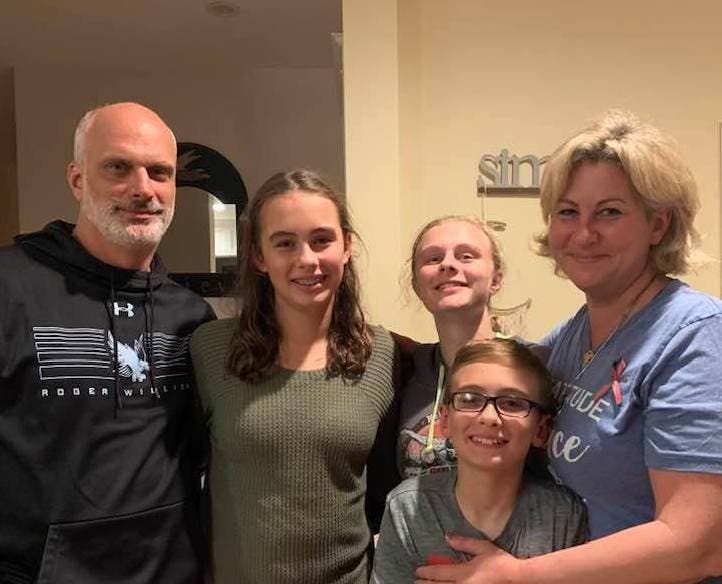
And she said, "Advocate for yourself. Stop with the pink. Buying pink merchandise and wearing pink isn't going to cure cancer. Funding research is going to cure cancer or make it a chronic condition."
"I've got a life. Fund the research so I can keep living my life," Stromski said. "I don't care about pink parties or pink feather boas. I care about research. Don't be afraid to say metastatic. Pink is not a cure. Don't ignore Stage 4."
Stromski said she wants to be a symbol of hope to others. "The average lifespan after being diagnosed with Stage 4 is two to three years. It was really hard, when I was first diagnosed, to find women who were beating those odds. Now I'm becoming one of them. That's why I want my story out there. Because someone today is being told they're Stage 4 — and they can see that for me, it's going on three years and I'm still teaching kindergarten."
Get more local news delivered straight to your inbox. Sign up for free Patch newsletters and alerts.